
Debra Aho Williamson will be a keynote speaker at AdExchanger’s Programmatic AI conference, taking place May 18-20 at the Park MGM in Las Vegas. Register today if you haven’t already signed up!
OpenAI’s ChatGPT, Microsoft’s Copilot, Google’s AI Overviews and Amazon’s Rufus are quickly becoming a new form of media.
And OpenAI’s hiring of Meta advertising veteran David Dugan shows just how serious these platforms are about competing for marketing budgets.
I call this new category “AI media” – ad-supported experiences inside AI assistants, AI-enhanced search and AI-native interfaces where people ask questions, research and make decisions.
So should businesses start advertising on AI media platforms?
The short answer is yes. But the more useful answer is that it depends on how consumers in your category are already using AI and how quickly your organization can respond.

AI is changing how consumers express intent
AI usage is no longer emerging. It’s expanding across age groups, use cases and industries. While younger consumers still lead, older consumers are quickly closing the gap.
What stands out is how people use AI search and chatbot interfaces. Consumers are turning to AI during the consideration and evaluation stages of the funnel to compare products, validate choices and narrow options. Those steps often happen in a single interaction rather than across multiple searches or site visits.
That shift has direct implications for advertising. AI platforms don’t just capture intent; they help shape and accelerate it. As research and decision-making compress into one interface, high-intent moments manifest earlier than in search.
For marketers, this means AI platforms are already functioning as media environments, whether they are fully monetized or not.
AI media requires a shift in marketing strategy
It’s tempting to think of AI media as an extension of search, especially since many early ad formats resemble search ads. But that framing misses what is fundamentally different about these environments.
AI interfaces are conversational rather than query-based. And they are narrative-driven, not link-driven. They blend discovery, evaluation and decision-making.
As a result, the role of advertising begins to change. Ads are not only capturing demand at the bottom of the funnel but also influencing how recommendations are interpreted within the same interaction.
Considering how quickly programmatic systems are evolving to incorporate AI-driven intent signals, the way media is bought and optimized is about to undergo significant change.
AI media adoption rate will vary
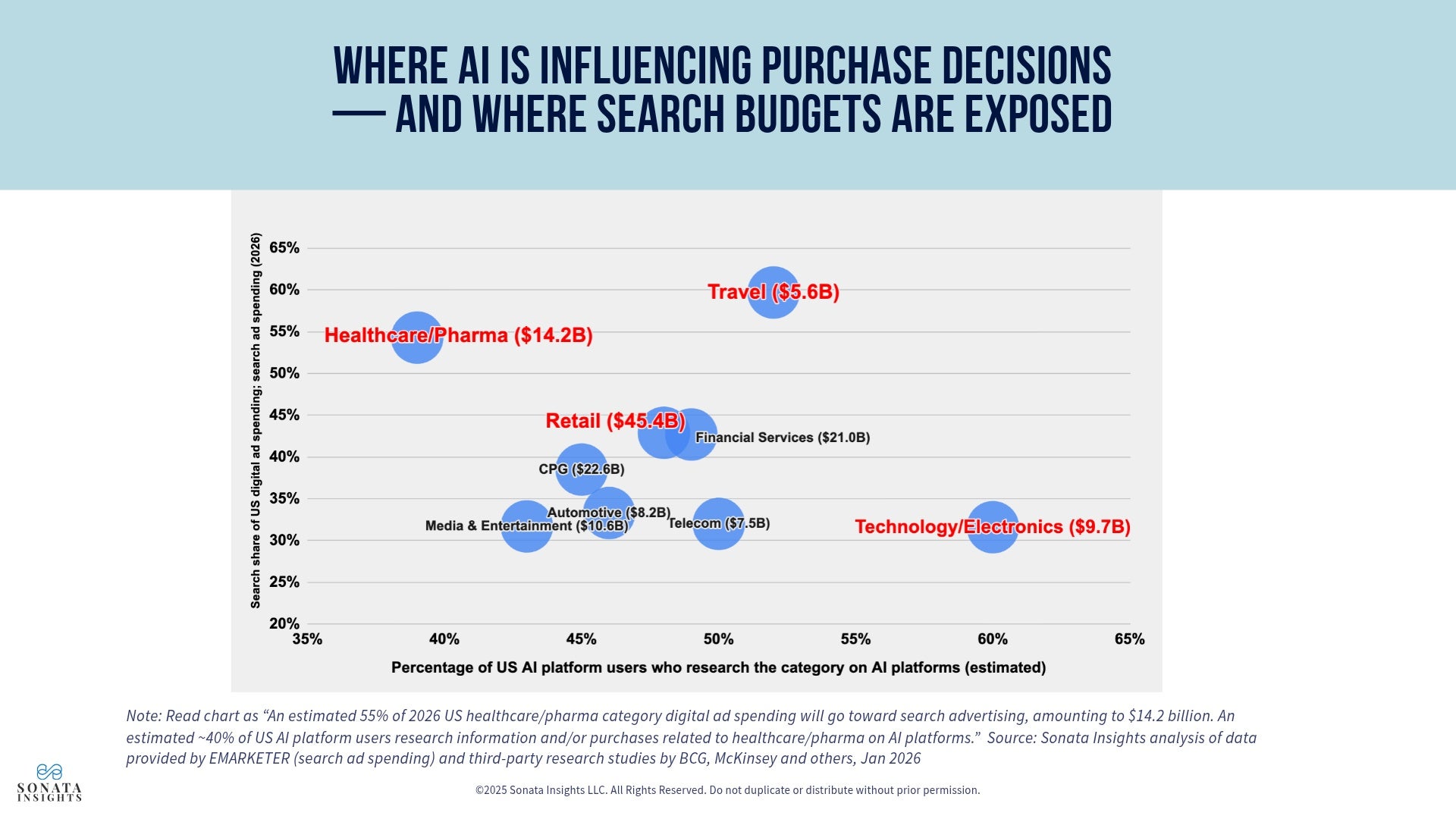
AI media adoption will not be uniform across industries. Some categories are better positioned to move quickly, while others face constraints that require a more measured approach.
Three factors determine how quickly an industry should act:
- the level of consumer AI usage in the category
- the degree to which the category relies on search advertising
- how well existing ad objectives align with AI environments
Four categories stand out as immediate priorities: retail, travel, health care/pharma and technology/electronics. These industries combine strong consumer AI behavior with heavy search investment and lower-funnel objectives that translate well into current AI ad formats.
Other categories, including consumer packaged goods, financial services and automotive, are emerging as fast followers. They have meaningful AI usage and clear long-term opportunity but face structural or regulatory challenges that make immediate large-scale investment less practical.
Organizational readiness will determine success
Many questions about AI media focus on external factors: ad formats, measurement standards and consumer acceptance. Those are important considerations, but they are not the primary constraint.
Readiness is largely an organizational issue. Companies that are moving forward tend to have clear ownership of AI initiatives, a willingness to experiment and alignment across teams that traditionally operate in silos. They can make decisions quickly and tolerate imperfect data in exchange for learning.
Those that struggle are often slowed by fragmented ownership, competing priorities or a lack of clarity about how AI fits into their broader strategy.
AI discovery functions as a flywheel
Success in AI media requires thinking of discovery as a system in which multiple elements interact and reinforce each other.
At the center of this system is a flywheel made up of four components: authority, visibility, paid media and measurement.
- Authority signals – such as content, PR and brand mentions – help determine how a brand appears in AI answers.
- Visibility influences how often and how favorably a brand is included, while paid media can reinforce or shape that presence.
- Measurement provides the feedback needed to refine all three.
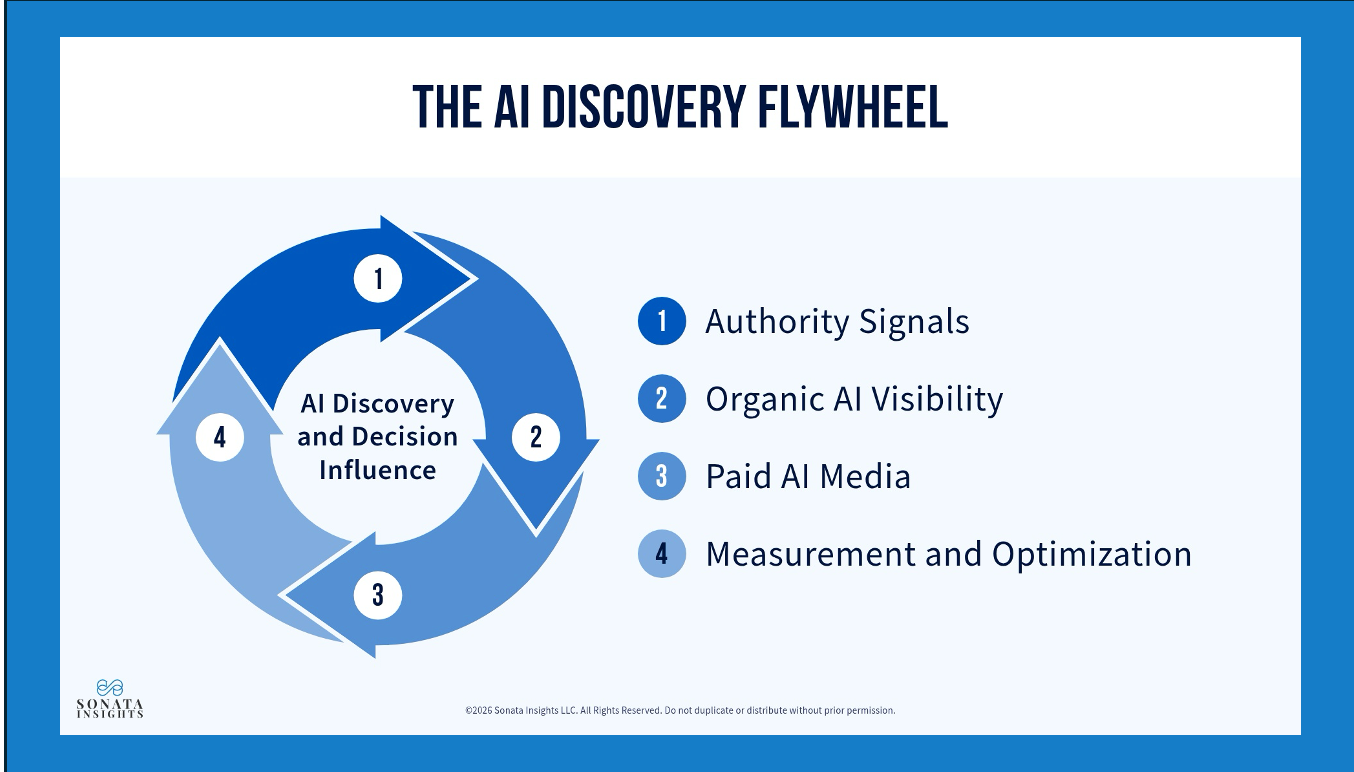
These elements do not operate independently. They influence each other continuously, creating a reinforcing loop that strengthens a brand’s position within AI platforms.
Organic and paid AI strategies must converge
Organic presence and paid advertising in AI media are developing in parallel and are already tightly connected. How a brand appears in an AI-generated answer influences how users interpret adjacent ads, often within the same interaction.
This creates a new dynamic. Organic visibility establishes credibility and shapes the narrative around a brand, while paid media amplifies and reinforces that narrative. When the two are aligned, they can improve performance. When they are not, the inconsistency is immediately visible, and the platform’s answer will carry more weight than the ad.
The window is open
AI media is not a future channel that marketers can afford to watch from a distance. It is an emerging system that is already influencing how consumers discover, evaluate and choose brands.
In any emerging media environment, there is a tendency to wait for better formats, stronger measurement or broader adoption. That instinct is understandable, but it can delay the learning that becomes most valuable over time.
As programmatic systems evolve to incorporate AI-driven intent signals, early movers will have more than a head start. They’ll have a foundation.
“Data-Driven Thinking” is written by members of the media community and contains fresh ideas on the digital revolution in media.
Follow Debra Aho Williamson and AdExchanger on LinkedIn.
For more articles featuring Debra Aho Williamson, click here.