
OPINION: The Sell Sider
Curation Isn’t Harming Publishers, But Their Lack Of Collective Action Is
Curation is amazing – for SSPs. The question publishers continually ask is, “Is curation good for us?” That’s the wrong question.

Curation is amazing – for SSPs. The question publishers continually ask is, “Is curation good for us?” That’s the wrong question.

Enjoy this weekly comic strip from AdExchanger.com that highlights the digital advertising ecosystem …

US judge rules generative AI has no fair use claim; Snap sets its sights on SMBs; MMM comes to CTV; and Disney introduces ads in live TV, even for paid users.

Reddit’s ambitions to build its own AI-powered on-platform search business suggest even Google’s allies need to find ways to protect themselves from its influence – sometimes by copying its playbook.

The New York Times and News Corp are case studies in how news publishers are evolving to be less reliant on ad revenue. Both publishers have also increasingly looked to new revenue streams for sustained growth.
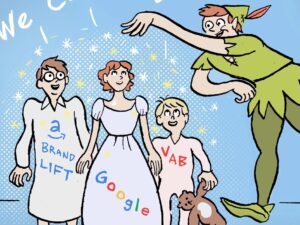
Things aren’t going well for Hollywood. Plus, Nielsen is finally ripping off the Band-Aid.
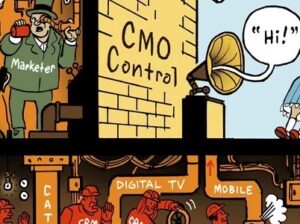
Kimberly-Clark didn’t hire a new CMO, and it doesn’t intend to. Plus, now airport bookstores are also ad networks.

Google plans to create an “AI Mode” for its web search engine users. Plus, the social media vultures now circling the air above TikTok.
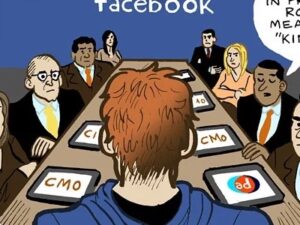
Publisher C-suite drama has been making headlines recently. Plus, there are now 27 different active lawsuits against various AI content generation companies.

OpenAI may be opening up to the idea of serving ads. Plus, Television for toddlers is quietly powering streaming media ratings.

Black Friday ecommerce continues to surge, mainly on mobile; social platforms pull optimization features for health and beauty brands; and Google’s antitrust lawyers subpoena info about rival AI search startups.

Driverless vehicles could become the next hot media channel; FDA reveals new ad guidelines for drug manufacturers; and artists come up with new ways to sabotage generative AI.
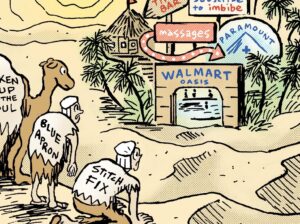
Walmart’s latest data play: an app for unlocking barricades on store shelves; training generative AI may rely more on scraping big-name sites than previously thought; and tracking the issues that mattered most to Trump and Harris, based on ad spending.

OpenAI’s ChatGPT will launch a web search engine. Plus, this year’s $12-billion-plus deluge in political advertising has priced brands out of certain markets.

Fertility companies are having their ads blocked on Google, TikTok and Meta. Plus, will the digital dark ages soon be upon us?

In today’s newsletter: Digital twins are marketers’ cool new AI tool; Netflix pulls a Prime Video and defaults lapsed subscribers to the ad-supported tier; and California compromises with Big Tech on two journalism bills.

Publishers are in the business of selling their readers’ attention to advertisers. But in response to consumer preferences and regulatory pressure, publishers should reposition themselves as champions of data dignity.

With a landmark ruling potentially forcing Google to change its business practices, who is actually likely to steal some of its search market share? And what should marketers do about it?

Ad revenue was helped along by 9% growth in unique visitors to the top sites in DDM’s portfolio. Programmatic ad rates were up roughly 36% in Q2, spurred by adoption of DDM’s D/Chipher contextual targeting solution.

Advertising is still Reddit’s meal ticket – but until its ad revenue tops the $2 billion per year mark, it can’t really be considered competitive with other social platforms.
In today’s newsletter: Google Performance Max enables third-party brand safety measurement for YouTube; gen AI firms roll out new data-scraping bots to replace those blocked by publishers; and RAG deals give publishers more leverage in licensing their content to gen AI.

With attribution-based platforms taking over, there aren’t many ways for an advertiser to bet (and win) big. Plus, what about the Google advertising ID?

Paramount Global finally agreed to merge with Skydance Media, but it’s not out of the woods yet. Plus, is YouTube really worth $455 billion?

AdExchanger caught up with Joy Robins, NYT’s global chief advertising officer, in Cannes for real talk on the top issues facing publishers, from overzealous keyword blocking to balancing subscriptions with ad monetization.

RAG is a recently developed process to ingest, chunk, embed, store, retrieve and feed first-party data into AI models. Here’s how to use these tools to inject first-party data into your next AI-enabled campaign.

In today’s newsletter: Companies looking to sell data target the US market; which media companies to bet on at TV upfronts; and generative AI data licensing is the new publisher revenue stream.

Dotdash Meredith previewed plans for how its OpenAI partnership could provide incremental traffic and scale its contextual targeting capabilities across a wider network of sites and media types.

Business Insider released a new targeting tool called SAGA reACT that analyzes the emotional reactions its content produces to create actionable, emotion-driven audience segments.

AdGPT, a startup that uses AI to automatically create hundreds of ads across Facebook, Instagram, Taboola, Outbrain, Google, LinkedIn and X, came out of stealth mode on Wednesday.

In today’s newsletter: Roku and The Trade Desk expand their partnership; Instagram changes its content recommendation system; and the European Commission investigates Meta for potential Digital Services Act violations.