You’ve probably heard the term “surveillance advertising” – used with increasing frequency – in reference to companies with an Orwellian agenda to keep tabs on you at all times.
See the recently introduced Banning Surveillance Advertising Act.
Minus the hyperbole, surveillance advertising is the practice of serving ads to individuals based on their personal information. But when does that become illegal? There’s still no consensus.
“We’ve seen a ‘rebranding’ going on in the last few years – people [used to refer to] targeted advertising, and now they say ‘surveillance,’” said FTC Commissioner Noah Phillips in conversation with Julie Brill, Microsoft’s chief privacy officer and a past FTC commissioner herself, during a virtual event hosted by LinkedIn earlier this week.
“As far as I can tell,” Phillips said, “we’re describing the same business conduct, but [now] we’re applying a pejorative.”
This negative sentiment is most likely related to the escalation of data collection over the past few years – and of consumer awareness that it’s happening.

“There’s a trend toward the utilization of more data about consumers by more and different kinds of businesses, and that has a multiplier effect over time,” Phillips said. “We’re adding issues, not subtracting them.”
In addition to concerns about data brokers, identity theft and children’s privacy (or the lack thereof), Brill said, regulators and consumers alike are apprehensive about advances in addressable advertising, algorithmic decision-making and the potential for bias.
“These issues are going to stay with us forever,” Phillips said. “I don’t think we’re going back.”
And yet data collection and online advertising are responsible for generating “literally trillions of dollars in economic activity,” he said.
Something has to give.
All the while, tensions are brewing internally at the Federal Trade Commission. The agency is under pressure to take action on issues that sit at the intersection of privacy and competition, including the advantages a company can gain over another if it has the opportunity to collect more data than its rival.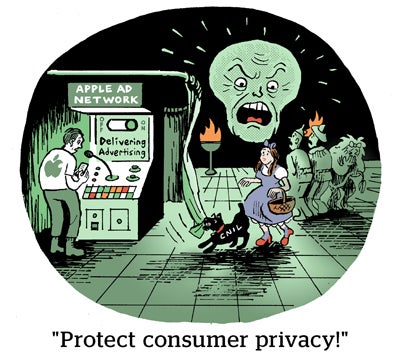
“There’s a trend of rhetoric that [the FTC] needs to require [advertisers] to get rid of the algorithms they use with their ill-gotten data,” Phillips said.
But there is a gray area here that the agency must grapple with, which is whether the collection of data is unfair and translates into consumer harm – historically the bar set for FTC enforcement – as well as how far the FTC can go when it comes to antitrust enforcement.
So, who’s responsible?
In October, Democratic Senators called on the FTC to write new privacy rules that address rampant consumer data collection by tech companies, which would give the commission more responsibility over consumer protection.
Getting federal privacy legislation across the finish line is going to be difficult, Brill said, which is one reason lawmakers are looking to the FTC to launch rulemaking in the meantime.
Phillips isn’t a fan of moving in this direction.
“Congress ought to make those big-value judgments,” Phillips said. “There are real trade-offs when you’re talking about privacy, so the best place to do that is the legislative process – not administrative rulemaking.”
Even so, the FTC has been flexing its rulemaking muscle recently.
In July – before the departure of Democratic then-Commissioner Rohit Chopra – the FTC voted along party lines to no longer limit enforcement actions to the consumer welfare standard under Section 5 of the FTC Act (which is what gives the commission its power to challenge unfair or deceptive acts or practices).
The consumer welfare standard, in a nutshell, is what’s used to determine whether business practices harm consumers based on whether they cause prices to rise or fall in the long term.
Lina Khan, the divisive chair of the FTC, is looking to replace that standard with something more expansive.
“There are people who have these grand visions that we’ll restructure society and ban [unscrupulous] practices that the law [doesn’t necessarily] bar,” Phillips said, referring to relatively newer concerns like algorithmic decision-making.
“Whatever we purport to regulate or ban actually has to be illegal,” Phillips added (original emphasis), “which means it needs to be either unfair or deceptive – and that’s a much harder test to meet in the context of some of these bigger [and more nascent privacy] issues.”
“It’s a real check on our authority,” he said.
But the FTC still has an important role to play, especially as the number of potential privacy issues facing consumers will only continue to grow.
“What we owe the public is focus; we’re gonna have to say, ‘This is a privacy concern we’re interested in [tackling], and this is not,’” Phillips said. “Congress already told us what ‘unfair’ means. Creativity is good for art; I’m not sold on creativity in law enforcement.”
Phillips acknowledged that other FTC Commissioners don’t fully agree with him.