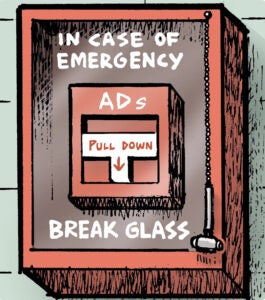
Comic: Revenue "Sharing"
Enjoy this weekly comic strip from AdExchanger.com that highlights the digital advertising ecosystem …
TikTok announced this week that it would allow search advertising to be targeted by keyword. Plus, streaming ad supply now outpaces demand.
Google isn’t perfect. But it offers convenient, cost-effective advertising tools that millions of small businesses use to find customers, grow and succeed. If the DOJ breaks up the company, it will also break those tools.
Outbrain is trying to shed its chumbox rep by bringing social media-style vertical video to mobile publishers on the open web.
A web crime ring that sold Facebook account service tickets collapses in dramatic fashion; how US antitrust precedent could inform the DOJ/Google ad tech trial; and more publishers turn to paywalls as the open web shuts its gates.
Oracle’s advertising and third-party data businesses are officially kaput; political pollsters are abandoning misleading online data; and AI-generated slop is already overtaking the internet.
Winners and losers are emerging from the streaming melee. (Or at least the winenrs are.) Plus, CNN will begin testing metered content.
At the risk of sounding like “the year of mobile,” we’re at the beginning of a new phase in ad tech with the rise of AI. Advertisers and ad tech partners alike are overwhelmed with AI opportunities, eager to implement it in meaningful ways. But when seemingly everything is powered by AI, how can you make sure you’re using it successfully?
Welcome to Week Three of the US vs. Google ad tech antitrust trial. Plus, ews publishers are turning to WhatsApp for traffic.
A lot has already been said and cited during the Google ad tech antitrust trial, with more to come. Here are a few of the most notable quotables from the first two weeks.
For two days, retail media luminaries gathered to discuss how best to expand the category’s effectiveness (and budgets) for brands and advertisers – without, of course, overlooking how the end goal consumer will react.
Chrome Privacy Sandbox adds support for deal IDs and extends Protected Audiences’ lifespan to 90 days; Google’s ad tech antitrust trial could open YouTube to DSPs other than DV360; and former Kubient CEO charged in accounting fraud scheme.
Two of the EU’s biggest Big Tech antagonists are set to resign; a GAM breakup could usher in post-ad-server programmatic; and how Google kept Prebid separate from the IAB Tech Lab.
Someone will eventually need to make a Netflix-style documentary about the Google ad tech antitrust trial happening in Virginia. (And can we call it “You’ve Been Ad Served?”)
Confidential matching – which uses a TEE built on Google Cloud infrastructure – will now be the default setting for all uses of advertiser first-party data in Customer Match.
Google and the DOJ are currently questioning witnesses regarding how particular ad channels are established as defined markets. Plus, a wave of freelance advertising consultants has arrived.
In today’s newsletter: How loosened ad restrictions helped snacks take over America; Brazil’s X ban dings stan culture; and Roblox partners with Shopify as it expands real-world ecommerce to all creators.
In today’s newsletter: Google Demand Gen is the industry’s latest over-attribution controversy; data from third-party brokers might not be worth it; and The Trade Desk launches a CTV operating system.
It’s a misconception that Redditors categorically dislike advertising, says newly hired VP of Ad Product Management Jyoti Vaidee. In fact, 60% of Reddit users want brands to participate in communities, she says, so long as their interactions are relevant and respectful.
In today’s newsletter: Amazon stands out among Upfronts CTV rookies; Google reveals how much revenue its ad tech divisions make; and women hold more marketing leadership positions than men, but churn is worse for women.
Starting last week and into this week, hundreds of court-filed documents have been unsealed in the lead-up to the Google ad tech antitrust trial – and it’s a bonanza.
In today’s newsletter: Google paid $445 million in rebates in 2018; publishers across the ideological spectrum blame brand safety for hurting the media biz; and Mark Zuckerberg apologizes to Congressional Republicans for Meta’s content moderation.
M&A is still hot in ad tech this summer. Plus, Netflix’s upfront results may sound promising, but the streamer still needs to grasp the finer points of the advertising game.
The publication still makes most of its on-site digital revenue from programmatic. But it’s doubling down on direct-sold custom content, especially when it comes to video and social media.
Special guest and prolific ad tech investor Eric Franchi of Aperiam Ventures discusses his firm’s recent bet on attention metrics startup Adelaide. Plus: What’s up with Meta’s new third-party attribution partnerships?
Yahoo DSP has new partnerships with the Planet Fitness media network and Rippl, a co-op of regional grocery and convenience store chains, including Wegmans.
The growth of Walmart’s ads business and third-party marketplace are separate, it says. Plus, Google and Meta’ve been targeting teens for a while.
In today’s newsletter: Digital twins are marketers’ cool new AI tool; Netflix pulls a Prime Video and defaults lapsed subscribers to the ad-supported tier; and California compromises with Big Tech on two journalism bills.
Adelaide used this latest cash injection to boost its valuation to $60 million ahead of an all-stock acquisition of Rita, an Amsterdam-based data marketplace with a focus on the EU.
Publishers are in the business of selling their readers’ attention to advertisers. But in response to consumer preferences and regulatory pressure, publishers should reposition themselves as champions of data dignity.