

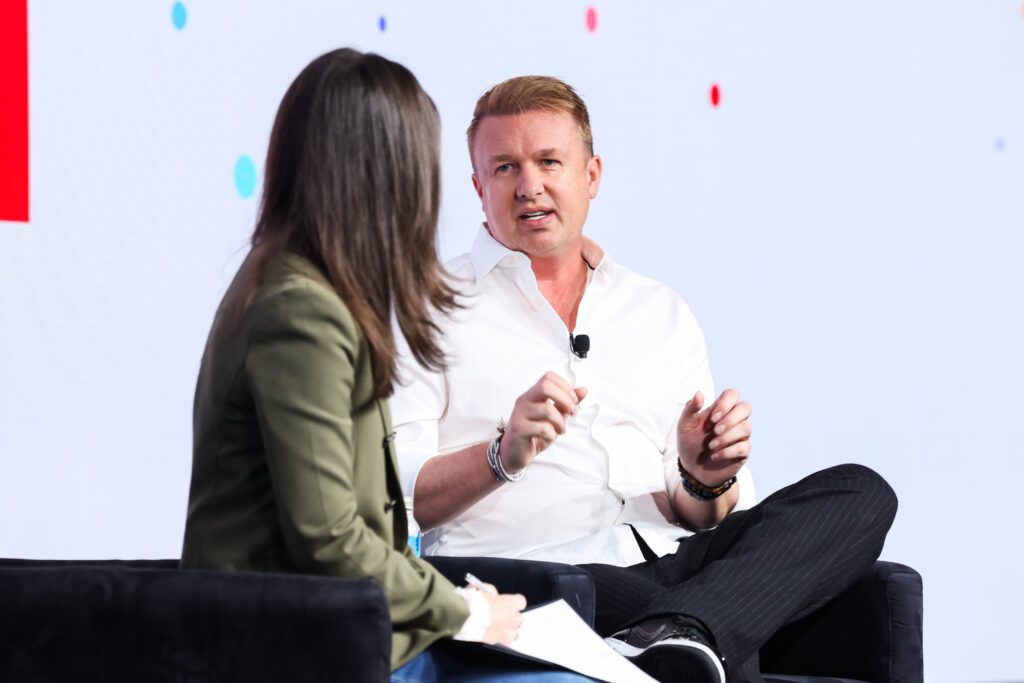
Jeff Green, CEO of The Trade Desk, calls it like he sees it.
And he doesn’t see a future for Google monetizing the open internet via its SSP and ad server business. (“The artist formerly known as DFP,” he said with an eyebrow raised.)
The outcome of the Google ad tech antitrust trial has yet to be determined. But Green told Axios’ Sara Fischer that he expects Google, which occupies “every box of the supply chain,” will “have to quit at least one of those jobs.”
“I do think that it makes sense for Google to exit the open internet and to focus on YouTube,” Green said on stage Monday at the IAB’s Annual Leadership Meeting in Palm Springs.
But until the judge makes a decision, nothing will happen. Which is also a problem for Google.
Any changes Google now makes to its current ad stack “look like tacit acknowledgement of wrongdoing in the past,” Green said, citing conversations he’s had with current Google employees who feel strategically stuck as we await a verdict in the ad tech trial.

Green said he gets the sense that people at Google recognize they could have done better in the past and should do better now. But since they’re “in the hot seat,” he said, they “have to wait until there’s an opportunity to negotiate.”
The Ventura venture
Speaking of where there’s an opportunity, connected TV is half of The Trade Desk’s business. CTV is more open in part because Google doesn’t control the sell side of the market the way it does in display, Green said.
Still, the news last year that The Trade Desk was building its own operating system, dubbed Ventura, prompted head-scratching in the industry, and even led to speculation from one Guggenheim analyst that The Trade Desk should acquire Roku.
Green made one thing clear about its venture: “We don’t own content. We never have and never will.”
Instead, he positioned Ventura as a way to maintain neutrality in the CTV ecosystem.
For example, Green observed that many streaming services are forced to a pay high tax in order to get their apps distributed. And he also critiqued companies that own both operating systems and content, calling out Amazon for “creating content and then biasing and promoting their own content.”
The Trade Desk, he said, wants to be a neutral party in the middle that “makes certain that the supply chain itself is effective” and doesn’t just promote its own content.
In short, Green wants to prevent Amazon and other walled gardens from building the same integrated tech stack that led to Google’s dominance.
“It feels like we’ve seen this movie before,” he said.
Why Sincera isn’t one of many acquisitions
But The Trade Desk isn’t only building things; it also recently did a bit of buying.
Earlier this month, The Trade Desk made its second-ever public acquisition: ad tech metadata startup Sincera.
When The Trade Desk bought Sincera, we heard that Green had a soft spot for its founders and mission. Well, now he said it on the record.
“I don’t know that there is a company more capable of improving the supply chain or the open internet,” Green said. “[Co-founder Mike Sullivan] is driven by the legacy that he can create and the internet he can leave for his children.”
Green also revealed why The Trade Desk has not been very acquisitive, which is “on purpose.”
“It’s really easy to acquire something that is your No. 6 priority,” he said. “But when you do that, then it’s forced to become a No. 1 priority.”
The Trade Desk’s current DSP business – a multichannel mix that’s now 50% CTV – still has plenty of room left to grow, Green said.
“There is so much TAM [total addressable market] left in our core business,” he said, “that we don’t want acquisitions to ever be a distraction.”









