
The “K” in “K-beauty” stands for “Korean.” But it should also stand for “kaboom” because Korean beauty product sales are exploding internationally, especially in the US market.
America is already the No. 1 foreign importer of South Korean cosmetics. And the K-beauty boom is just beginning. While K-beauty is expected to generate over 7% revenue growth in the US, it still comprises just 3% of US prestige beauty sales, meaning there is plenty of room to grow.
Sulwhasoo is one of many K-beauty brands trying to capitalize on the trend by competing for more US customers and shelf space. To do so, it’s playing both sides of the marketing funnel as it continues to grow its American consumer base.
For Sulwhasoo, “branding and performance go hand in hand” to create long-term success, said Jazmine Gonzalez, the company’s senior manager of performance marketing.
That rationale is becoming more common as brands realize they can’t chase performance at the expense of building their customer base. Especially not in a space as saturated as K-beauty.
Sulwhasoo first expanded into the US in 2010. Today, its products are available for purchase from the brand’s website, Amazon, Sephora, Macy’s and a handful of department stores.
To sustain growth, Sulwhasoo has to get in front of brand-new customers who are most likely to consider buying something. And it’s combining connected TV (CTV) and digital out-of-home (DOOH) with online retargeting to increase the odds that upper-funnel awareness drives lower-funnel sales.
C(TV) for yourself
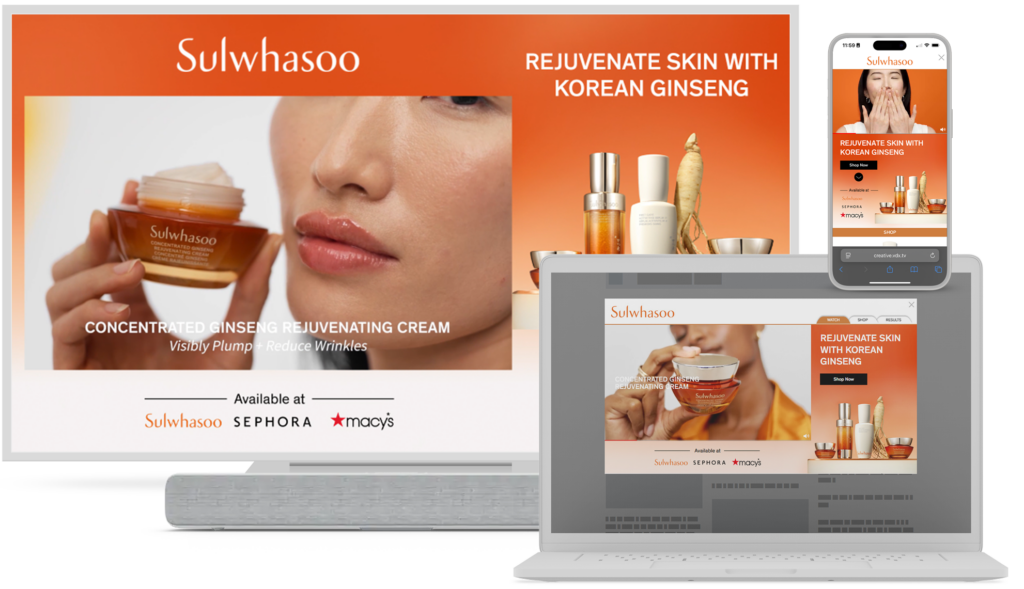
To make as many prospective customers as possible aware that it exists, Sulwhasoo tapped a video ad platform called VDX.tv for help running CTV and DOOH campaigns that also retargeted users on mobile and desktop devices.
It tested this strategy in two separate campaigns last year. One started on CTV and retargeted viewers across online video, mobile and desktop. The other campaign ran across both CTV and DOOH and also included digital retargeting.
The CTV-first campaign, which promoted a ginseng-based cosmetics collection, ran late last year. It targeted consumers who buy luxury skincare, shop at a retailer carrying Sulwhasoo products and/or are interested in anti-aging products.
To reach the right people, VDX.tv created audience segments based on shopper and social media data that it pulled from Foursquare, TransUnion’s Commerce Signals and Stirista’s 123Push. And to ensure the ads only reached an untapped pool of prospective customers, Sulwhasoo excluded past purchasers based on its own customer data.
The campaign ran across several streaming platforms, including Paramount, HBO Max, Hulu, Roku and Samsung. The creative had a QR code that, when scanned, took viewers to a microsite to browse the brand’s products. The microsite allows users to complete a purchase through their preferred vendor, including the DTC site.
The campaign also retargeted households exposed to the CTV ad between five and seven times in contextually relevant placements on personal devices, including on websites such as Vogue, Women’s Health, PopSugar and Glamour. These ads had more interactive features to encourage engagement and conversions, including a before-and-after tab that illustrates how different products create desired aesthetic effects.
For the most part, this campaign was an “upper-funnel play,” Gonzalez said. But because it also included shoppable elements, Sulwhasoo also expected to see lower-funnel metrics improve, such as cost per acquisition.
According to VDX.tv, this CTV-first campaign saw a 6.5% interaction rate, which it measured based on site interactions within the retargeted ads on mobile and desktop. Although it is hard to understand the significance of that number without benchmarks – interaction rates can vary widely depending on campaign features, according to VDX.tv – the brand considers the number promising.
Additionally, tracking incremental conversions can be a trade-off when a brand is integrated with several retailers, Gonzalez said. It can be tricky for a brand to compare conversions that take place on its own site versus on retail platforms where it doesn’t have ownership of the data.
For example, if an existing customer starts buying products from Sulwhasoo’s Amazon shop rather than its DTC site, Amazon might mark those customers as new when they’re already “recurring loyalists,” she said.
Still, some retailers offer custom integrations that make it easier to track performance, Gonzalez added. She cited a recent social media campaign in collaboration with Sephora, in which both companies shared access to conversion pixels for measurement purposes.
DOOH you wanna try this?
Since incremental performance boosts are difficult to pin down across platforms, Sulwhasoo is also experimenting with using broad upper-funnel awareness as a way to help drive foot traffic and in-person sales.
Sulwhasoo tested this approach in a DOOH campaign last year that also included CTV, online video, mobile and desktop ads. The objective for the DOOH component was to get in front of “anyone out and about who might be near a Sephora or a Macy’s,” said Vanessa Rottet, VDX.tv’s director of client partnerships.
The campaign ran on digital billboards near retailers carrying Sulwhasoo’s products, including in Manhattan, and retargeted people on CTV, online video and mobile based on device IDs that passed through the geofence. The brand found that serving an ad to the same person between two and three times garnered the best results.
As a result of this campaign, Sulwhasoo saw a 4.1% lift in awareness and a 3.4% boost in purchase intent, based on data from Cint.
The campaign also had a positive impact on foot traffic and in-store sales, Gonzalez said, although it is difficult to quantify exactly how much.
For example, Sulwhasoo increased the number of DOOH impressions it ran near certain Sephora locations when they were hosting in-store events. During those events, Sulwhasoo found that stores located near the brand’s digital billboards saw higher foot traffic and sales revenue compared to stores that weren’t near a DOOH ad.
However, Gonzalez said, “it’s a little hard to determine if DOOH drove the results because there are many other variables at play when there is an event at a store.” But, she added, the trend makes it fair to hypothesize that DOOH played a supporting role in that sales uptick.
Meanwhile, as Sulwhasoo continues to analyze how CTV, DOOH and retargeting campaigns contribute to both incremental sales and brand awareness, I’ll be in the mirror analyzing my under-eye bags to see how well this rejuvenating eye cream and face mask perform.
Hopefully, those results will be more obvious.