The public tussling between Facebook and Apple over the latter’s fast-approaching privacy push in iOS 14 is what grabs headlines.
But while the titans trade barbs, developers have been hustling behind the scenes as the deadline approaches. Apple is expected to release its AppTrackingTransparency (ATT) framework as part of iOS 14.5 at some point in the coming weeks.
“This is such a critical moment,” said Julie Shumaker, VP of revenue for the division within Unity Technologies that houses its suite of products and services for content creators, including user acquisition, monetization and player engagement tools.
Unity, which went public in September with much fanfare at a valuation of more than $40 billion, is one of the most popular and penetrated software engines for developing games and apps across platforms.
As of the end of last year, 94 of the top 100 development studios by global revenue are Unity customers.
And as of June, which is when Apple first made its ATT announcement, Unity has been fielding lots of questions from its developer community about how to get ready, Shumaker said.

Getting ready to roll
Mainly, developers have been looking for guidance on the exact steps they should take before Apple flips the switch, and what they can expect once the changes are in place, she said.
In response, Unity published an iOS 14 prep guide on Tuesday with detailed checklists and how-tos for app publishers and app advertisers that monetize, acquire users or do both with the Unity Ads SDK.
App publishers, for example, need to audit the data tracking preferences of all their current users, tweak their user opt-in flows to maximize revenue and optimize their ad waterfalls. Meanwhile app advertisers should make sure that their ad networks register for SKAdNetwork IDs, that their reporting APIs are up to date for the new reporting options in SKAdNetwork and that they’re ready to pay for impressions on a CPM rather than a cost-per-install basis.
App publishers and advertisers both need to update all of their third-party SDKs to the latest version and identify all of the data collected by their third-party partners so that they can disclose it on their App Store page as part of Apple’s new privacy “nutrition label” requirement.
Specifically related to mediated waterfall optimization, Unity is encouraging publishers to test placing the Unity Ads SDK higher up to make it easier to monitor increases in eCPMs for users that have opted out of tracking.
Unity recently made improvements to its contextual models that indicate increased eCPMs for users with Limit Ad Tracking turned on and for non-personalized ads served in certain regions, such as Europe, where GDPR is in effect.
Placing the Unity Ads SDK at multiple points through the waterfall will help developers see “which arrangement yields the most impactful results,” Shumaker said.
Unity is also advising its developers to come up with different monetization and engagement strategies based on whether users have opted into our out of ad tracking. To that end, Unity recently built a new feature within its monetization dashboard that lets developers check the tracking status of its app users and see an estimation of how eCPMs fluctuate between ATT-enabled users and those who allow for tracking.
Shumaker said that it’s still too early to share how eCPMs appear to differ between ATT and non-ATT traffic, but that Unity is planning to update the market on results throughout the year.
“There is no doubt that developers and publishers are facing uncertainty in their user acquisition and monetization efforts, especially as they may not understand how some of their monetization partners will adapt,” Shumaker said. “Developers are going to need to be nimble enough to act on new information as it arises.”
Bracing for impact
This uncertainty is also influencing the public markets.
Although only around 30% of Unity’s impressions come from iOS devices and Unity posted solid Q4 results in early February – revenue for the quarter was up 39% YoY to just over $220 million – its stock faltered based on a slower revenue growth forecast and the expectation of a one-time roughly $30 million impact on revenue this year as developers and advertisers adjust to Apple’s IDFA changes.
That impact could end up being less, though. In its modeling, Unity assumed a very low opt-in rate for ad tracking and didn’t take into account potential positive second-order effects of Apple’s changes, Shumaker said.
For example, although eCPMs are very likely to decline as user-level targeting takes a hit, she said, game developers might react by spending more on the top of the funnel, causing total dollars spent to actually increase.
Regardless, Unity doesn’t expect ATT to dent its revenue in the long term. “If you average out the estimated $30 million [impact due to ATT] over the year – even three quarters – it’s nominal compared to our broader guidance,” Shumaker said.
Unity is forecasting revenue for 2021 to be somewhere between $950 million and $970 million.
Public companies are generally starting to get more transparent about what ATT will mean for their business.
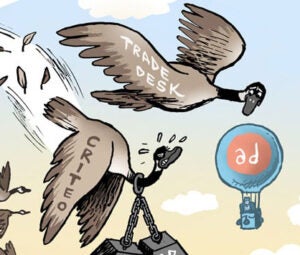
Criteo, for example, told investors last week to brace for a $60 million hit this year from privacy and identity-related changes, while LiveRamp expects an impact of up to $30 million.