

Apple didn’t explicitly kill off its ad ID during its Worldwide Developers Conference on Monday as some expected, but it sure looks like it’s laying the groundwork.
Sandwiched between flashy announcements about the Apple Watch, macOS Big Sur and surround-sound AirPods, Apple dropped a bombshell for third-party mobile ad tech.
Starting with iOS 14, which is set to ship sometime in the fall, Apple will require app developers to self-report their privacy practices, clearly summarize their privacy info in the App Store so users can see it before they download an app and make it easier for users to see and control what data an app is collecting about them.
Think of this as a form of Intelligent Tracking Prevention in Safari – but for apps.
Apple has been criticized in the past for some level of hypocrisy in going for broke with ITP on the web, but allowing a relative data-sharing free-for-all linked to the IDFA, which is a more persistent identifier than a cookie.

“We believe tracking should always be transparent and under your control,” said Katie Skinner, a manager for user privacy software at Apple, during the presentation. “So, moving forward, App Store policy will require apps to ask before tracking you across apps and websites owned by other companies.”
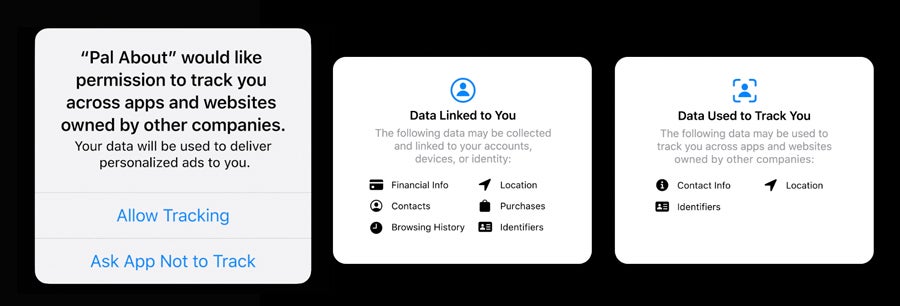
Users, for example, will see just-in-time notifications that alert them when an app wants permission to track them across sites and apps followed by two options: “Allow tracking” or “Ask app not to track.”
Put another way, Apple is lifting Limit Ad Tracking (LAT) functionality from where it’s currently buried within a phone’s Settings menu and calling attention to it at the moment of use, which will likely lead to more people enabling it.
While good for privacy-conscientious consumers, the new notifications are also detrimental for developers that rely on an ad-driven business model.
Eric Seufert, a media strategist and editor of Mobile Dev Memo, has theorized that Apple will eventually enable LAT by default. This could be a step in that direction.
Apple will also introduce notifications alerting people to the types of data that an app might collect and link to their account, device or identity, which could include contacts, browsing history, identifiers, purchases, financial info and location.
Erik Neuenschwander, a user privacy manager at Apple, likened the notifications to “nutrition labels,” but for privacy.
Given these changes, it’s now reasonable to expect Apple in the near future to start requiring that apps ask users to consent before using an identifier, such as the IDFA, for ad personalization.
In other privacy-related WWDC news, users will have the option to only share their approximate location with an app, rather than their precise location and, on the web in Safari, users will be able to exert more control over the extensions in their browser and access a privacy report that shows how many known trackers were blocked by ITP.







