
Here’s today’s AdExchanger.com news round-up… Want it by email? Sign up here.
Hard Of Hearing
Podcasters are rushing to add programmatic to their bag of monetization tricks. But they’re confronting familiar issues for publishers when software decides what ads to run and where, The Verge reports.
An ad for HBO’s “The Sex Lives of College Girls,” for example, was placed into a children’s show on American Public Media’s podcast network. Ads for ExxonMobil and BP have run on a science podcast that refuses sponsorships from oil and gas companies. All of these ads were served through the Spotify Ad Network (SPAN).
Part of the problem is that broad categories for labeling audio ads, like those promoted by the IAB, can be easily circumvented by savvy (or cynical) advertisers.
In the case of the science podcast filtering fossil fuel ads, the BP creative was categorized as “other,” and the ExxonMobil ad was filed under “elections.” This allowed the ads to slip through the podcaster’s classifications, which are meant to weed them out.
American Public Media dropped its deal with Spotify after “The Sex Lives of College Girls” incident, which shows how problematic placements can poison the programmatic well for a new crop of potential clients.

Wait. That’s An Ad?
Video game advertising may soon be a key channel, alongside the likes of CTV, social and linear TV, in the quest to reach US consumers across fragmented media. Advisory firm Technavio projects that in-game advertising will be a $3.5 billion business come 2025, Business Insider reports. That’s still small, but gaming is a potential goldmine of opportunity for advertisers.
Ad totals remain relatively low for now because gaming marketing often takes the form of prizes or in-game rewards, as opposed to media. For instance, Bud Light has game consoles shaped like six packs and Chipotle offers free food to in-game players.
McDonald’s debuted on Twitch shortly after a menu and merch branding deal with Korean boy band BTS. An esports collab with the brand offered streamers a chance to win McDonald’s gaming gear and DoorDash discounts.
That partnership may prove more fruitful than the new “McNFT” sandwich art.
Other social media platforms like Twitter are also expanding brand sponsorships into livestreams – and no prize is too big. A partnership on the platform between Honda and Riot’s League Championship Series last year left two lucky fans with new whips … and a lot more people tweeting about gaming, of course.
Finally, A Not-Three-Letter Acronym
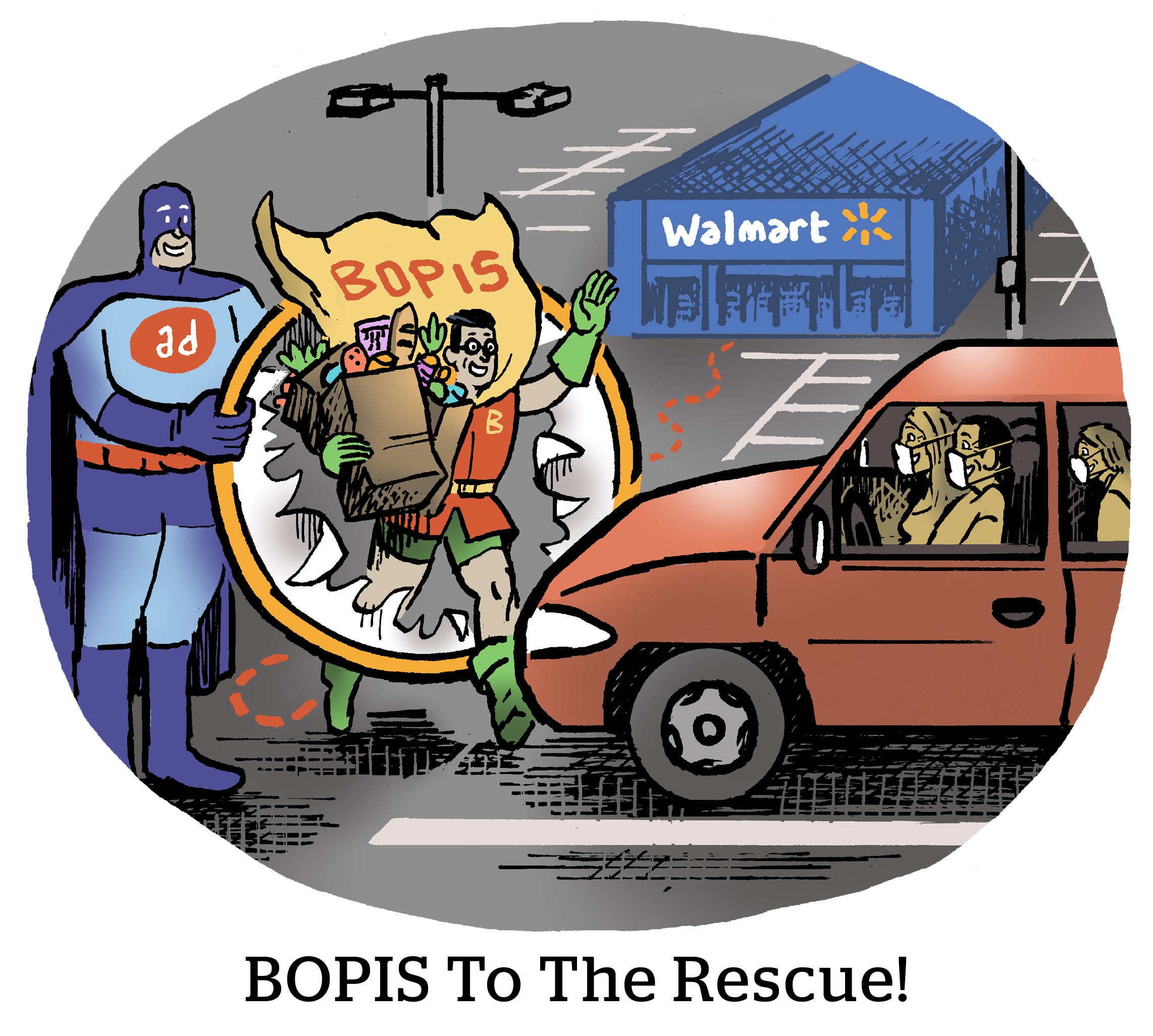
You down with BOPIS?
Some call it click-and-collect. Others prefer “buy online, pick up in-store” or simply curbside pickup.
The common thread in retail in recent months has been the value of a brick-and-mortar footprint for ecommerce.
BOPIS orders totaled $80 billion in the US in 2021 and are projected to reach $100 billion this year, CNBC reports. Walmart claimed a quarter of those sales, with Home Depot, Target, Best Buy and Macy’s (the only other chains with multibillion-dollar BOPIS businesses) rounding out the top five.
Retailers love BOPIS because they finally hold a strategic advantage over Amazon. Getting products from warehouses to people’s homes is the most difficult leg of ecommerce fulfillment. (Presumably, container ship queues aren’t the new normal.) If customers visit the store – consider the biggest grocery and department stores as akin to warehouses – retailers can save a big slice of profit margin.
And retailers can also save on the inevitable returns. From mid-November through January 22, UPS expects to process 60 million returns, up 10% from last year, according to the Louisville, Kentucky local Fox affiliate WDRB. Those costs usually land on retailers.
But customers returning BOPIS orders typically bring the item back to the store.
But Wait, There’s More!
Bloomberg Media CEO steps down to start new venture with NYT columnist Ben Smith as editor-in-chief. [Deadline]
Clean rooms, explained: How they became the buzziest tool in ad tech. [Marketing Brew]
NPR’s content plans are big on subscription podcasts. [Axios]
Best Buy launches its own media network – although still with the help of vendors, including Criteo and Google. [Digiday]
Democratic legislators disagree on Big Tech regulation, and that’s delaying DOJ antitrust staffing and enforcement. [The Information]
You’re Hired!
Jeanine Poggi promoted to editor of Ad Age. [Ad Age]








