


Behind the scenes, the TV industry continues to grapple with the splintering of content consumption across channels and questions about how to effectively measure it.
But hey, let’s party.
If the NewFronts is where buyers flirt with newer media channels and, increasingly, streaming services, the upfronts, which wrapped up this week, is where things start to get serious, as legacy broadcasters showcase their new content in the hopes that advertisers will put a ring on it.
But this year, pretty much all of the major programmers (other than Warner Bros. Discovery) had streaming on the brain. NBCUniversal, Disney and Paramount made streaming a central theme of their upfronts pitch – and they’ve got their work cut out.
The competition for upfront dollars is getting fiercer.
YouTube, for example, made its upfronts debut this year – on the same day as Disney’s presentation – which was a cheeky move. While YouTube TV does distribute linear programming, the company’s roots are in streaming video, not linear.

Honorable mentions
Although, as expected, the topic of alternative currency was an afterthought at the upfronts – partly because some publishers (including NBCU and Disney) already hosted their own tech-focused showcases earlier in the year – there were a couple of mentions here and there.
Jon Steinlauf, chief of US ad sales at Warner Bros. Discovery, tipped his hat to measurement, noting in passing that “a multicurrency marketplace will benefit all of us.”
And Linda Yaccarino, NBCU’s ad sales chief, threw a little shade Nielsen’s way when she declared, “We’re liberating you from what you all know is broken … and finally breaking away from legacy.” (Say “Nielsen” without saying “Nielsen.”)
And then it was back to soon-to-be scheduled programming.
But wait, rewind: Why was YouTube there?
To brag.
YouTube reaches 230 million people a month in the US, with more than half (135 million) watching on a connected TV device, said Allan Thygesen, Google’s president of advertising in the Americas.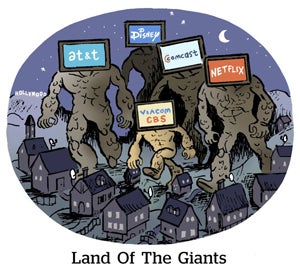
According to research from Nielsen, 30% of these viewers couldn’t be reached on any other AVOD service.
On the big screen overall, YouTube commands more than 50% of total CTV watch time, Thygesen said, and DV360, Google’s DSP, reaches 93% of CTV households.
Still, the rest of the legacy TV industry doesn’t think YouTube belongs at the upfronts because it’s not spending $17 billion on content. But YouTube wants some upper-funnel love, too.
That’s why its upfront event is called “Brandcast,” LiveRamp’s chief strategy officer, Jay Prasad, told AdExchanger.
Google wants to apply its “razzle-dazzle measurement and targeting on the big screen, too,” he said.
Movies make moves
But another surprise at this year’s upfronts, beyond YouTube shouldering its way onto the schedule, was the focus on film content.
For example, NBCUniversal CEO Jeff Shell celebrated Peacock’s coup in poaching Pixar movies from HBO Max. “This might be the first time films have been mentioned at an upfront,” Shell said, and possibly the first time a movie studio made a wholesale commitment to a streaming service.
Disney is also prioritizing flicks but, of course, it’s making its own. Its entertainment studio has 35 genre-spanning films actively in or recently out of production that are specifically slated for Disney+, including a new Hocus Pocus 2 and a Marvel movie dubbed “SHE-Hulk.”
Even Warner Bros. Discovery-owned CNN is making movies, albeit not for streaming. CNN Films is producing several original documentary titles for the CNN linear network in the upcoming year.
Sports
Speaking of linear, sports is meant to be its savior – but sports is also a must-have for streamers specifically because it’s still the biggest anchor for linear audiences.
“Live sports is a hook – it’s the last of event-based viewing other than depressing news,” Prasad said. “Whether you’re reinforcing your linear business or looking for more hooks into your AVOD service – you need sports.”
Programmers compete fiercely for exclusive licensing deals with sports leagues in the hopes of attracting ad dollars, he added.
Disney milked its hold over the now 42-year-old ESPN network, which set a new record for partnership signings last year, in addition to a more recent exclusive broadcast deal with the WNBA.
Multiple female athletes came on stage during Disney’s presentation to help it hawk inventory, including Olympics gold medal winner Suni Lee. (Sorry, NBCU.)
Diverse talent
Publishers also paid homage to underrepresented talent.
Disney, for instance, showcased content focused on the Black experience and highlighted the need for ad dollar commitments that help keep diverse talent on the stage.
Rita Ferro, president of Disney Ad Sales, said the team looks for an inclusive campaign commitment in every deal it strikes with brands. This year, “we’re asking for three times the investment of last year’s upfront for multicultural, diverse content,” she told advertisers.
Paramount is also well-positioned to move the needle on Black content because it owns Black Entertainment Television (BET), which launched an initiative called Content for Change in 2020 to help with media representation.
Six months ago, BET expanded the initiative into Content for Change Academy, a talent program that offers training and certification courses to diverse, aspiring media professionals. The initiative focuses not just on attracting diverse talent but also on making sure that diversity is reflected behind the scenes.
For example, it’s not enough to showcase Black women if publishers aren’t paying attention to how their characters are portrayed, said BET CEO Scott Mills.
YouTube, always the odd one out, is using its positioning in social video to invest in diverse content creators (including LGBTQ+ and BIPOC creators) via YouTube Shorts rather than focusing on original scripted content.







