E.W. Scripps Is The First CTV Publisher To Adopt The Trade Desk’s OpenPass
E.W. Scripps becomes the first CTV publisher to adopt OpenPass, The Trade Desk’s single sign-on product for user authentication.
How big of a deal is The Trade Desk’s top 100 list? AdExchanger spoke to industry experts for their reactions and bounced some of their hot takes off The Trade Desk.
Who gets to decide what is premium? Is it dangerous to outsource that decision to The Trade Desk (or any one DSP)? And how should publishers position themselves within the future of this so-called premium internet?
In today’s newsletter United Airlines gets into retail media; why AI fails to catch AI-generated content; and political advertisers flock to X for cheap impressions.
SPO is moving from efficiency to curation to ranking the top 500 publishers. We talk through industry reactions to The Trade Desk’s SP500+ product. Plus: Seedtag acquired Beachfront, a deal that’s emblematic of multiple trends in CTV, privacy and the rise of contextual.
Here’s today’s AdExchanger.com news round-up… Want it by email? Sign up here. The Path Less Traveled We all know what supply-path optimization (SPO) means and why it’s useful. Except, wait, what does SPO mean? “‘SPO’ – perhaps already a bigger buzzword than MFA. Every definition of SPO is different,” tweets Jud Spencer, engineering leader at The […]
Since launch, 82% of advertisers that buy inventory through the Yahoo DSP have tried Backstage at least once. And buyers are seeing lower CPMs from cutting out SSPs.
In today’s newsletter: How changes in streaming ad inventory could impact upfront CPMs; video cracks 50% of engagement on Meta’s platform for the first time; and Apple is in talks to launch Apple TV+ in China.
Future believes its new monetization offering can succeed where other publishers have struggled with selling ad tech and consulting to third-parties.
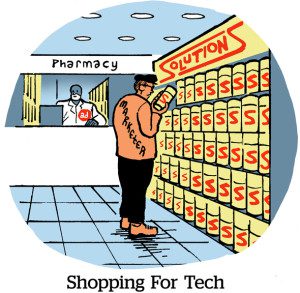
Enjoy this weekly comic strip from AdExchanger.com that highlights the digital advertising ecosystem …
Here’s today’s AdExchanger.com news round-up… Want it by email? Sign up here. Best Buy’s Best Bet Sales at Best Buy were down more than 6% from last year in Q2, as consumers cut back on discretionary purchases, especially electronics and home appliances. Best Buy’s shares jumped more than 10% on the news. Wait, what? Although sales […]
Inspire Brands, the fast-food franchise that owns popular chains such as Dunkin’, Sonic and Arby’s, is rewriting parts of its TV playbook to better manage reach and frequency in streaming media campaigns.
In today’s newsletter: Why Apple’s SKAdNetwork 4.0 is a bust; advertisers are irked by Google’s optimization-driven demand for different creative formats; The Trade Desk releases a baffling list of top 100 publishers.
Late last year, Morning Brew hired Sara Badler, a longtime programmatic advertising executive, as CCO. But the publisher, which built its business on direct, isn’t planning to change its approach to monetization.
Breaking down how incrementality complements multitouch attribution and media mix modeling, and how advances in AI and ML have evolved incrementality measurement beyond A/B testing.
In today’s newsletter: Publishers fear they’ll be excluded from The Trade Desk’s “premium internet”; buyers weigh in on Netflix’s plans to offer an ad server; and PayPal launches an ad network and data brokerage.
RAG is a recently developed process to ingest, chunk, embed, store, retrieve and feed first-party data into AI models. Here’s how to use these tools to inject first-party data into your next AI-enabled campaign.
In today’s newsletter: Ampla suspends loans to DTC brands, putting their ad budgets at risk; why Sony is investing in IP rather than a streaming platform; and Netflix will move on from Microsoft in favor of in-house ad tech by 2025.
Wishing you all a beautiful Memorial Day! This classic comic first ran in October 2011.
Audience targeting and online information campaigns have had some gnarly byproducts. Advertisers need to own our contributions to political polarization before it can get better.
Data and ad tech experts at Programmatic IO in Las Vegas discuss how brands can make better use of their first-party data by working more closely with walled gardens – whether brands like it or not.
Fixating on ROAS makes it harder to figure out how certain parts of a campaign perform, especially now that retail media buys often include other, less performance-focused channels like display and CTV as audience extension.
Pivoting to a “premium internet” is like avoiding the parts of town that have been blighted by illicit activity. The only real solution to MFA is for the dollars to dry up.
The phaseout of third-party cookies kicked off the sell-side curation trend. But it’s also being driven by advertiser concerns about open web media quality and the need to enhance publisher contextual signals with audience data.
SSP, meet PET. TrustX has been spun out of Digital Content Next and is now housed within a newly formed company called Symitri, which is developing privacy-enhancing technologies for programmatic advertising.
Curation’s shift to the sell side is giving DSPs less control over how advertisers curate audiences, which is creating new tensions in the programmatic ecosystem.
Even if the industry finds a way to replace the cookie, it won’t matter if publishers no longer have traffic to monetize.
In today’s newsletter: Google tries to buy its way out of a jury trial in the DOJ’s antitrust case against its ads business; Walmart sees some of its best margins on ad sales; and TikTok tests 60-minute videos.
Enjoy this weekly comic strip from AdExchanger.com that highlights the digital advertising ecosystem …
In today’s newsletter: How the Amazon-TripleLift deal illustrates retail media’s need for standardization; legacy publishing brands persist as investors extract value from their name recognition; and mortgage lenders get caught sharing data with Meta.