
Q2: PubMatic Licks Its Wounds As Growth Remains Flat
PubMatic reported meager YOY revenue growth in Q2, up just a smidge to $63.3 million from $63 million in Q2 of last year.

PubMatic reported meager YOY revenue growth in Q2, up just a smidge to $63.3 million from $63 million in Q2 of last year.

Here’s today’s AdExchanger.com news round-up… Want it by email? Sign up here. Pubs Crawl Publishers are more selective about ad tech vendors nowadays after suffering through incidents involving sequential liability, Digiday reports. Publishers are more discerning about ad tech but don’t expect much to change following the MediaMath bankruptcy, like the Sizmek bankruptcy before that […]

SSPs including PubMatic, Magnite and Wunderkind are moving ahead with plans to recoup revenue paid to publishers from deals conducted on MediaMath’s DSP

The current model for ads.txt isn’t helping the industry understand how publishers are working with sellers and resellers, writes Rotem Shaul, co-CEO of Primis.

On Tuesday, PubMatic entered the crowded retail media space with the launch of a self-service ad platform for commerce media called Convert.

When MediaMath filed for Chapter 11 bankruptcy protection in a Delaware district court on Friday, its debts were laid bare.

Here’s today’s AdExchanger.com news round-up… Want it by email? Sign up here. A Voyage Of Discovery Newspaper publisher Gannett is suing Google for alleged ad tech monopolization. Google, of course, disputes the charge. Dan Taylor, VP of Google Ads, tells The Wall Street Journal Google will “show the court how our advertising products benefit publishers […]

It’s possible to improve your efficiency as a publisher while also reducing your carbon footprint, with no cost to revenue.

In addition to buy-side integrations, content curation, proprietary ad formats and flexible pricing models are also helping set SSPs apart.

Cutting out hops in the supply chain means skipping over a DSP or an SSP – especially for video inventory. Plus, inside Cadent’s bid for bankrupt SSP EMX.

On the heels of the launch of its latest supply-path optimization product, PubMatic posted $55.4 million in Q1 revenue, growing 2% YOY.

PubMatic’s end-to-end platform, Activate, lets advertisers buy CTV and online video inventory via direct deals, bypassing DSPs.
When you combine ad tech integrations, in all their messy complexity, with data privacy laws like GDPR, the stakes for mistakes are high. Last week, our managing editor, Allison Schiff, broke one such story. PubMatic had set the default timer to get consent in its own identity management solution so low – between 1 millisecond […]

Ad tech companies manage billions of advertising bids across thousands of publishers in a matter of milliseconds. So, when a privacy error slips through cracks, it can metastasize into a potential GDPR concern in the blink of an eye.

Here’s today’s AdExchanger.com news round-up… Want it by email? Sign up here. A Verified Love Triangle When Netflix jumped into ad sales, it promised to include ad verification through both DoubleVerify and Integral Ad Science. And so it came to pass. On Monday, DV and IAS both released their verification solutions for Netflix inventory. Considering […]

In its Q4 earnings report Tuesday, PubMatic highlighted how SSP consolidation is an opportunity for the company to pursue its goal of capturing a fifth of the SSP market.

Yahoo pulling the plug on its SSP demonstrates how difficult it’s become for supply-side platforms to prove their value in a commoditized marketplace.

Whereas brands and DSPs are whittling down the number of supply paths they use to purchase ad inventory, publishers are financially incentivized to work with as many partners as possible. But there are changes afoot that could alter the economics for publishers.

Sustainability was a hot topic for the advertising industry in 2022. The momentum will only grow in 2023, though decarbonization remains a multiyear journey.
In 2022, SPO solutions largely revolved around creating direct connections to so-called premium publishers. But machine learning (ML) and artificial intelligence (AI) also took on a bigger role in SPO this year. And 2022 was the year the ad industry began touting SPO as the solution of choice for sustainability-focused marketers.

TV advertising is undergoing a tectonic shift from programmed to programmatic. Not unlike on the open web – but unlike on linear – advertisers can use programmatic to get scale across connected TV. There’s demand for biddable CTV because buyers realize they can get more flexibility and transparent signals from publishers.

The most commonly cited rationale for publisher staffing cuts has been marketers’ hesitance to spend on advertising amid persistent economic uncertainty. But publishers’ latest pivot to video and increased competition among digital channels is also likely to blame.
As part of a plan to consolidate its SSP partners, Horizon Media struck a deal with PubMatic Monday. Horizon’s clients who purchase open-auction inventory through its HX trade desk will be able to use PubMatic’s SPO products to automatically optimize their bidding depending on which KPIs they want to boost, whether the deal is open auction, programmatic guaranteed or a private marketplace.

PubMatic’s total Q3 revenue grew 11% to $64.5 million despite an industry-wide downturn, but the company doesn’t have high hopes for the rest of the year. It expects that ad spend will continue to trend down in Q4. But although spending is decelerating due to recession fears, PubMatic is planning to capitalize on the eventual rebound by focusing on video, retail media and particularly CTV, which continues to grow.

My Code, a publisher network that specializes in multicultural media, manages display and video inventory across nearly 800 sites under its umbrella. Because of the complexity of programmatic sales across such a diverse portfolio of sites, including a mix of owned and third-party clients, My Code has relied on PubMatic’s OpenWrap unified bidding solution for the past two years.
Transparency is the keystone that will bring together the best of linear advertising with the best of programmatic. Brands should be able to get more transparency on programmatic CTV, but, just as importantly, publishers should get something in return for sharing this information, writes Nicole Scaglione, global VP of OTT and CTV at PubMatic.

How will the high-stakes game of antitrust chicken between Google and the US Department of Justice play out? It could be a first important proactive step toward true structural change – not just at Google but across many of the biggest players in the industry, writes Arnaud Créput, CEO of Equativ.

Google’s decision to kick the can on cookie deprecation even further down the road to 2024 did not come as a shock to many in the digital advertising industry. The longer runway will give advertisers and publishers more time to test post-third-party-cookie solutions. But despite the temptation to procrastinate, publishers and tech vendors told AdExchanger they don’t anticipate straying too far from the road maps they’d already established to meet the previous 2023 deadline.
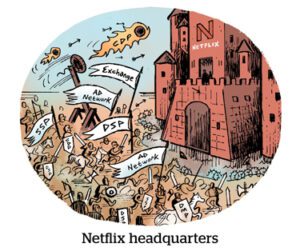
Just three months after Netflix surprised the world with the news that it plans to launch an ad-supported tier, the streaming leader has settled on its third-party vendor of choice: Microsoft. But why Microsoft? It wasn’t considered a serious programmatic contender until it acquired Xandr from AT&T (and that deal only closed last month). Still, something made Microsoft stand out from the crowd.

Google may have a solution to the antitrust regulatory pressure it’s facing from governments around the world: a proactive spinoff. Alphabet, Google’s parent company, is exploring splitting Google’s digital ad business into a separate entity under the Alphabet umbrella. The question is whether Google’s proposed solution will pass muster with regulators, and if it does, who stands to win – and who stands to lose?