

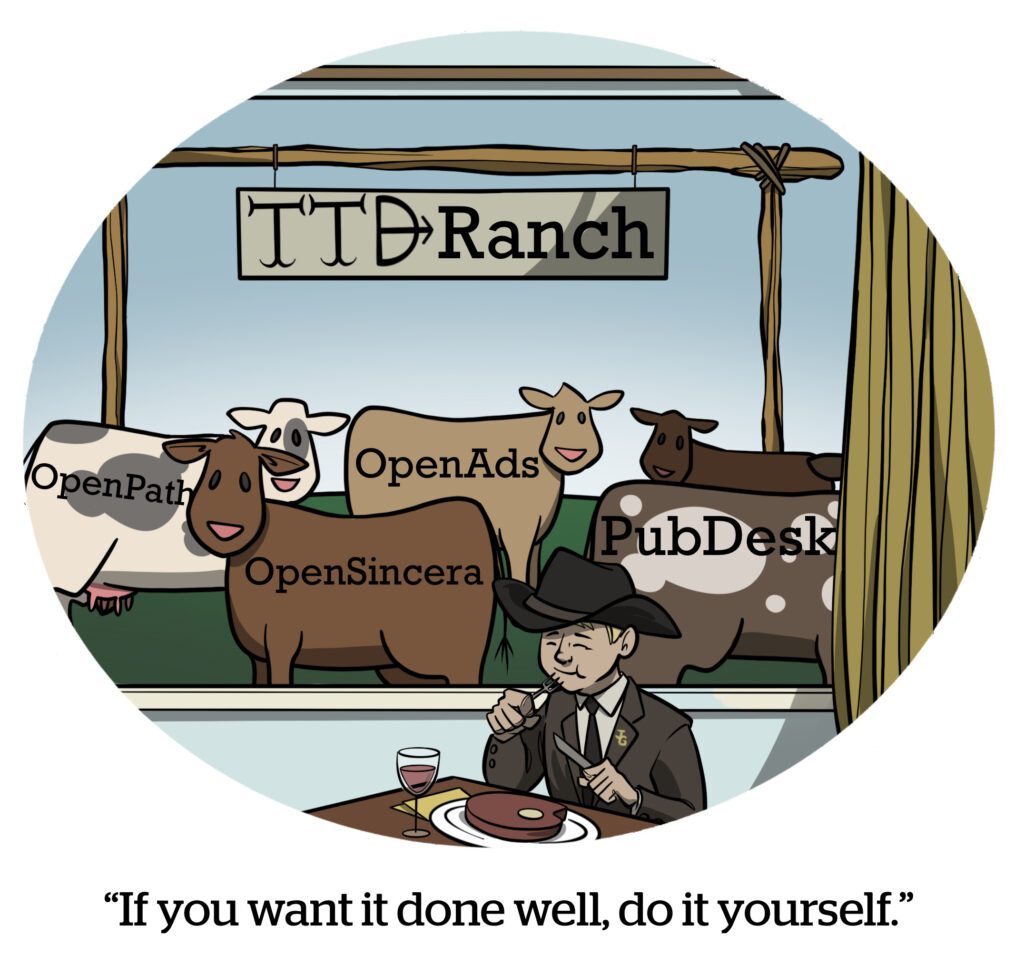
Add another “Open” to the list.
The Trade Desk has OpenPath, OpenAds, OpenSincera and, as of today, a new platform portal called OpenTTD.
The OpenTTD product, which will be announced by the DSP during LiveRamp’s RampUp conference in San Francisco later this morning, creates a single login and integrated analytics for companies that span different services as TTD partners. The product serves companies like DoorDash, which, as a brand advertiser, ad seller and data seller in different parts of the TTD platform, would previously have to use separate sign-ups and user interfaces.
There are “several hundred” such companies that occupy multiple partnership roles, TTD director of product marketing Jaime Nash told AdExchanger. Although, she added, the product will also include benefits for single-brand marketers or for agency buyers who operate many accounts.
OpenTTD will essentially be the analytics portal for all TTD partners and advertisers.

The Trade Desk created OpenTTD partly as a simple time-saver, Nash said. Why bother with numerous platform logins for what is, in fact, the same platform?
But there are also real data and analytics advantages, she said.
Last September, The Trade Desk introduced a new data marketplace product, Audience Unlimited, that requires data sellers that participate to greatly decrease their prices, and further incentivizes data price decreases by turning any such discount into advertiser ROI. In other words, the further a data seller discounts its prices compared to on TTD’s open marketplace, the better the ROI attributed to its data.
Using OpenTTD, Nash said, data sellers will be able to identify and study with much more granularity what particular audience segments or types of data are performing well for advertisers. Audience Unlimited, akin to another TTD data-selling product called Data Alliance, operates as a black box.
This should help data sellers improve their “curb appeal” to buyers, Nash said. Advertisers that user custom algorithms or publishers that integrate via OpenSincera can also use OpenTTD for finer segmenting and analytics capabilities, she added. A retailer or retail media network company might also study how co-promotional spend from one brand (like how Walmart spends ad dollars on behalf of brands it carries in stores) affects traffic or shopping trends across other product segments, or attracts different types of shoppers.
The idea, she said, is to help TTD advertisers and partners across the board convey the value they find on the platform.
Even for a company like DoorDash that sits across all of TTD’s partner functions, different individuals are still logging in as the media buyer, ad seller or data marketplace seller. So there still needs to be different workflows for ad buyers, developers, data scientists and all the different business personas that are logging and need their own particular tools.
“But what we’ve been seeing increasing over time is that they’re all laddering up to the same executive functions,” Nash said.
And people from every corner of the digital media and marketing world are “being held under fire to show more monetization opportunities, higher revenue, higher growth,” she said. Being able to tell that story, whether “to a CFO or a CMO,” will unlock new opportunities for The Trade Desk.






