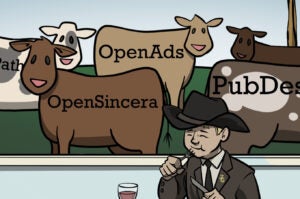
The ad industry is racing toward a not-too-distant future where AI agents negotiate programmatic deals on their own – and Prebid doesn’t want publishers to get left behind.
The group that turned header bidding software into an open-source standard announced on Thursday that it’s taking ownership of code developed using Ad Context Protocol (AdCP) that will power publisher-side AI agents.

Emerging frameworks like AdCP are laying the groundwork for AI-to-AI transactions. But expecting publishers to build and maintain their own autonomous AI agents for selling ad inventory is a stretch.
The new offering, dubbed the Prebid Sales Agent, is now available to all publishers. Publishers can download the software from GitHub and offer their feedback on its development regardless of whether they’re Prebid members.
Agentic automation
For automated agentic advertising to really work, AI agents need to handle all of the different tasks involved in executing a digital ad campaign, Garrett McGrath, SVP of product management at Magnite and chairman of the Prebid board, told AdExchanger.
This vision calls for specialized agents on both the buy side and sell side, plus others dedicated to data matching, measurement and other advertising use cases.
AdCP, which launched in October, has emerged as an early standard to help these AI agents communicate. It was created by a consortium of ad tech companies, including Scope3, Triton Digital, Yahoo, PubMatic, Optable and Swivel.
This consortium also created a new industry group, called AgenticAdvertising.org – or AAO, if you need yet another acronym to keep track of – to govern the AdCP standard.
AAO handing development of the sell-side AI agent to Prebid is about making it open-source and more broadly available, McGrath said. Prebid will provide ongoing support for the Sales Agent initiative in the same way it supports its other open-source codebases, Prebid.js and Prebid Server.
And because Prebid still views itself as a publisher-first organization, despite its work with other industry stakeholders, it’s well positioned to ensure that sell-side agents built on the AdCP protocol serve the best interests of publishers, McGrath said.
Prebid will also form a sell-side agent working group and host sessions at its future events to educate publishers and gather their feedback, said Prebid President Mike Racic.
And it’ll tap its publisher community to test and refine the new software, which is the same collective approach behind the development and optimization of its header bidding tools.
“Prebid.org is a natural home for people to collaborate to support agents as they enter the yield picture,” said Patrick McCann, SVP of research for publisher ad network Raptive and chair of Prebid.js.
But, although Prebid will lead software development for AdCP’s sell-side agents, McGrath stressed that the group isn’t taking over governance for any part of the AdCP protocol.
“We’re not a standards org; we’re a software org,” he said. AAO will continue to oversee AdCP governance and compliance and Prebid will maintain its independence and remain open to working with other emerging agentic advertising protocols and standards.
For example, Racic and McGrath said Prebid would be open to working with the IAB Tech Lab on the latter’s agentic advertising road map, which was announced earlier this month.
But any formal partnership would depend on interest within the Prebid community and on publisher adoption of the Tech Lab’s standard, Racic added.
The groundwork for interoperability
It’s too soon to crown a winner between the AdCP protocol and the IAB Tech Lab’s agentic road map – or to say whether one type of sell-side agent will work across the entire digital publishing ecosystem.
That uncertainty is why Prebid’s AdCP-based sales agent won’t be one-size-fits-all, McGrath said. Instead, it will be a “reference implementation” that publishers can adapt to meet their specific needs, much like Prebid’s header bidding software.
Building agents from a shared software reference should prevent the interoperability issues that would arise if each publisher was responsible for creating its own agent from scratch and then integrating it with proprietary agents developed by other platforms.
That type of interoperability headache isn’t new. In the early days of header bidding, publishers needed bespoke integrations with each individual demand partner, Racic said. Prebid was formed to address that problem, he added, and now it’s bringing the same approach to agentic advertising.
Laying the groundwork for interoperability should also pave the way for AI agents to eventually take over open-auction programmatic ad deals, McGrath said.
So far, AI agents have been limited to handling direct and programmatic guaranteed deals. But Prebid’s header bidding expertise will most likely encourage development that would bring AdCP’s agentic AI into the open auction, according to McGrath.
Collaboration like this is what will make AI work in programmatic, said Phil Bohn, SVP of demand at publisher ad network Freestar and also treasurer of Prebid.org.
“Publishers gain a clear path to agentic advertising capabilities without needing to build from scratch or adopt vendor-specific solutions,” Bohn said. “It democratizes choice for publishers and accelerates ecosystem-wide adoption.”