
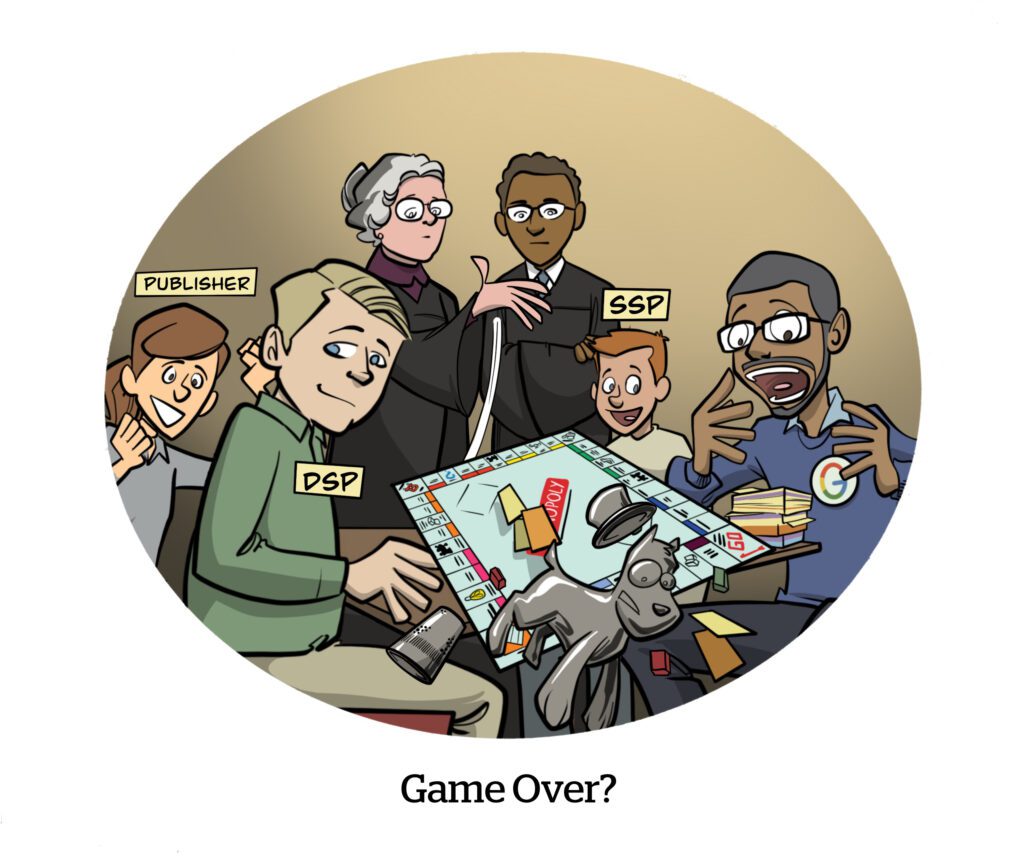
Half of Magnite’s C-suite may be heading out the door, but the company still posted strong Q1 numbers – and leadership is quick to predict that Magnite will prevail in its battles with both Google and The Trade Desk. (#manifesting?)
Magnite’s total first quarter revenue was up 6% year over year to $164.4 million thanks to the usual suspects. Just over half of Magnite’s revenue, excluding traffic acquisition costs, came from CTV, keeping up the momentum it saw last quarter. Live sports are also having their moment, with 80% year-over-year growth in March Madness revenue.

Although live sports has “strong traction,” Magnite CEO Michael Barrett told investors on Wednesday, there’s still plenty of room for growth. Live sports is one of the largest opportunities in programmatic advertising, he said, but also one of the “least penetrated.”
(Someone, clearly, hasn’t seen “Heated Rivalry.”)
But for every action, there is an equal and opposite reaction, which perhaps explains why, alongside the surge in streaming growth, DV+ (Magnite’s ad exchange for display, video, out-of-home and pretty much everything else that isn’t CTV) took a hit.
Magnite remains “confident” in DV+’s long-term success, said Barrett, noting 8% growth in mobile and app compared to the same period last year. But don’t mistake confidence for naivete.
DV+ saw a 5% year-over-year decline, which, he said, “was better than expected.”
Eyes on the prize
In other words, Magnite is navigating a world where CTV is the star, the programmatic ecosystem is becoming more agentic and the old SSP playbook is being rewritten.
This year, Magnite has already introduced multiple of its own AI tools, including mediation features within its self-serve CTV solution, ClearLine, and a seller agent built into SpringServe.
But the company isn’t concerned that buy-side and sell-side agents will render Magnite obsolete. In fact, it expects AI tools to increase Magnite’s value, rather than replace it, according to CFO David Day.
AI has been “a real tailwind,” said Barrett, especially now that publishers no longer need to navigate between “12 different dashboards” – one for SpringServe, one for DV+, etcetera.
We’re also seeing sell-side platforms developing buyer agents now.
It makes “a ton of sense” to have agents communicate directly with each other, Barrett said, and “who’s to say that that buyer agent isn’t ours?”
One investor asked whether AI tools will remain table stakes – bundled into the platform the way most companies offer them now – or if they’ll eventually be unbundled and sold as separate products.
Barrett was unequivocal in his response. “We’re collecting payment. We’re policing fraud. Our plumbing, our bandwidth, our servers are all being utilized to make it happen,” he said. “Yes, we will charge for that.” He didn’t share a timeline, however.
Trouble in paradise
And there’s another timeline we’re all waiting on: the final remedies from the Google ad tech trial.
Depending on the results, Magnite could see “instant gains” from the remedies, said Barrett. Magnite’s win rate is “very low” against Google, he noted, so any behavioral change would have a palpable effect. Barrett said he anticipates a “favorable” ruling for Magnite, although he’s “a little disappointed” it’s taken so long. (We can relate.)
And as for the OpenPath controversy?
Late last year, The Trade Desk classified all SSPs as resellers, favoring its own direct-to-publisher connections in the process.
Barrett sounds like he wishes people would stop asking about it. “I think we’ve talked about it ad nauseam,” he said.
Similar to its stance on Google, Magnite is unbothered and even rather optimistic. All of its biggest agency clients are still buying through Magnite, and the results are consistently strong, Barrett said.
“I think that the OpenPath extinction event is coming on,” he said, “and we’re still here and doing quite well.”