


Google Ad Manager is still the dominant supply-side platform – but the race for second place is tighter than ever.
Forty-six percent of publishers say they use Amazon Publisher Services, Amazon’s supply-side platform, according to Advertiser Perceptions’ SSP report for the second half of 2021, which was enough for Amazon to maintain its grip on the No. 2 spot. But, at 42%, PubMatic came in not too far behind.
The rest of the pack, however, was very tightly clustered, with OpenX at 35%, Magnite at 33%, Yahoo SSP (the former Verizon Media Ad Platform) and Magnite’s SpotX at 29% apiece and Xandr Monetize (which now belongs to Microsoft) and Index Exchange at 28%.
(It’s worth noting that the results for Yahoo SSP may have been skewed by its recent rebranding. And FWIW, Google is so dominant, it makes two appearances in the Advertiser Perception survey: 36% of publishers say they use Google AdMob for app monetization.)
Fierce competition down the chain is a promising sign for all non-Google SSPs, because it’s evidence publishers prefer to work with multiple SSP partners. Advertiser Perceptions found that publishers use 5.4 SSP partners on average, meaning an SSP doesn’t need to be a publisher’s first, second or even third choice to do a decent amount of business.
“There is still very much healthy competition for that third, fourth and fifth spot,” said Lauren Fisher, EVP of business intelligence at Advertiser Perceptions. “First and foremost, publishers are working with SSPs that are making them money, they’re working with SSPs that are good partners and helping to manage their business – and they’re also looking for SSPs that are specialists in the type of inventory that they can monetize.”

Not so fast
Even so, the number of SSP partners publishers will be using this year is expected to grow more slowly than previously anticipated.
Advertiser Perceptions is projecting that publishers will use an average of 5.8 SSPs in 2022, down from its previous projection of 7 SSPs on average.
Still, with hot-button issues like identity and data privacy remaining top of mind, publishers of all sizes expressed interest in working with and exploring a number of ID solutions.
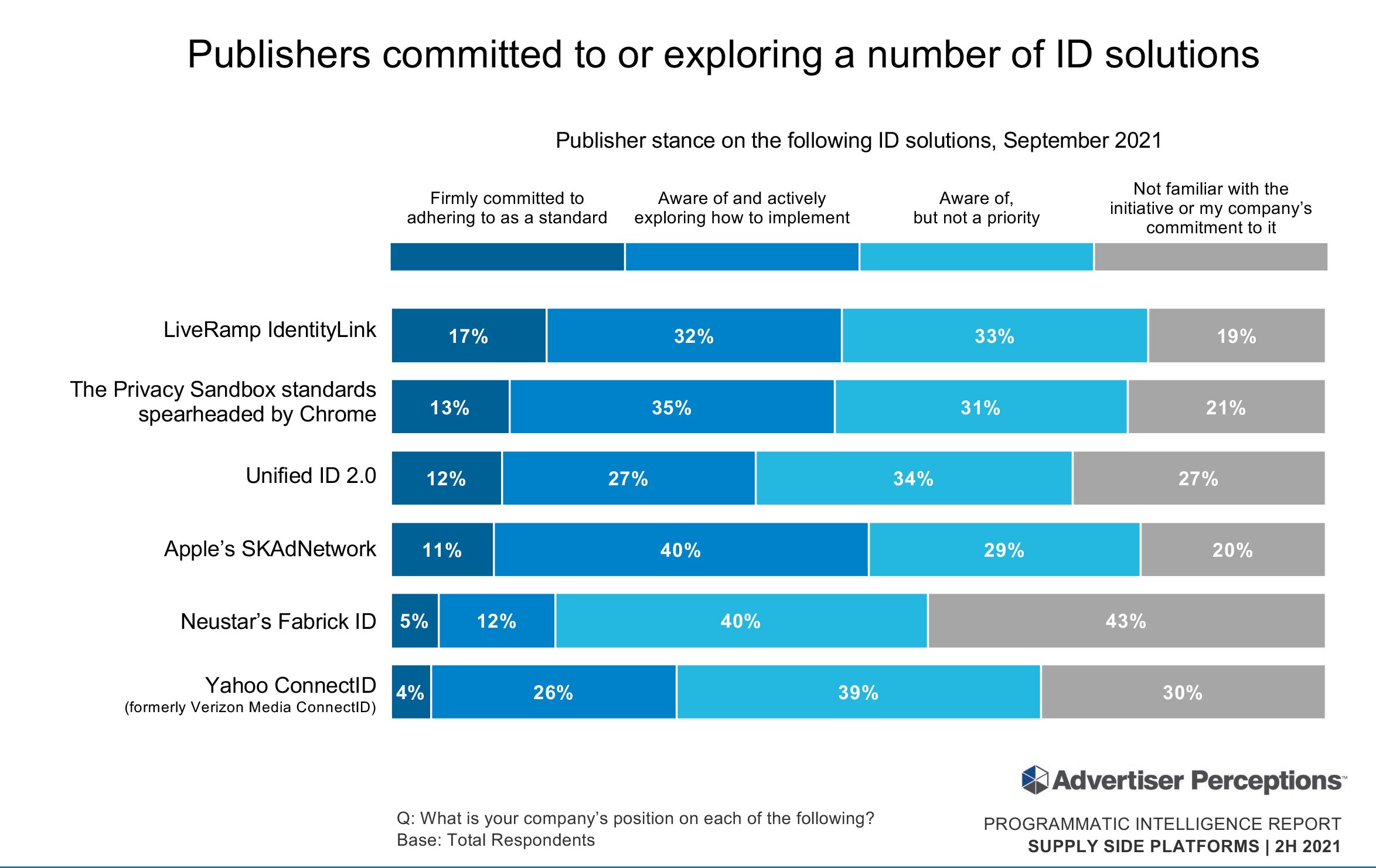
“Publishers continue to work with multiple partners, and they’re continuing to lean on their SSPs quite heavily for support and advice as we’re navigating a very different and ever-changing landscape with regard to identity,” Fisher said.
Google to the moon
But that partner list almost always includes Google.
In the most recent report, Google maintained its dominant position as the most used and most preferred SSP among the publishers surveyed, with 73% saying they use Google Ad Manager and 43% ranking it as their preferred supply-side partner.
Because Advertiser Perceptions conducted its study in August and September, the results do not reflect recent reports detailing Google’s Project Bernanke and Jedi Blue initiatives. A New York district court filing unsealed documents that shed light on Google’s alleged efforts to mislead publishers and advertisers about how its ad auction actually works and its partnership with Facebook to limit the viability of header bidding.
But, prior to the release of these documents, at least, ad industry speculation about Google running third-price auctions did little to dampen publisher enthusiasm for Google as an SSP partner. It remains to be seen whether the latest round of Project Bernanke and Jedi Blue revelations will knock Google off its perch as the sell-side’s most-used, most-preferred SSP (but it’s unlikely).
“On the sell side, it’s Google’s show,” said Kevin Mannion, president and chief strategy officer at Advertiser Perceptions. “Every publisher needs to be with them – and sometimes that’s not a happy thing for the publisher. But Google does really pay attention to what a publisher needs to make money, have security and be privacy protected. Those are increasingly important, especially as we’re heading toward a cookieless world.”
Large vs. small
Beyond Google’s unsurprising dominance, Advertiser Perceptions noted significant differences in SSP usage between larger publishers (those with 20 million or more unique monthly visitors) and smaller publishers (those with fewer than 20 million unique monthly visitors).
OpenX, Magnite and Xandr Monetize, for example, were far more popular with larger publishers than with smaller publishers. Forty-five percent of larger publishers – but only 22% of smaller publishers – said they use OpenX.
The difference was even starker for Magnite, which is used by 49% of larger publishers but only 12% of smaller publishers. Xandr Monetize, meanwhile, is used by 38% of larger publishers and 14% of smaller publishers.
Google Ad Manager, Amazon’s SSP and PubMatic also saw usage splits between larger and smaller publishers, albeit far less dramatic, with 75% vs. 71% for Google; 45% vs. 49% for Amazon; and 43% vs. 40% for PubMatic. Among the most-used SSPs for larger publishers, only Amazon’s SSP was more popular with smaller publishers than it was with larger ones.
Advertiser Perceptions polled 150 US-based publishers on their current and future plans for SSP usage and their perceptions of the top players. To qualify for participation, publishers had to have an audience of at least three million monthly unique visitors, sell ads programmatically and be currently using or planning to use an SSP.








