

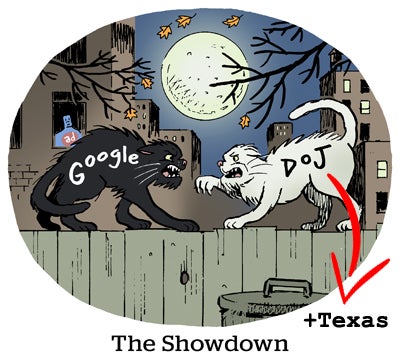
The state attorneys general-led antitrust lawsuit against Google over its advertising practices is like a picture slowly coming into focus.
On Friday afternoon, an amended complaint filed last year was unsealed in a New York district court revealing even more details about Project Bernanke, a Google program to use information coming from publisher ad servers to bolster Google’s own ad-buying technologies.
The new filing goes deeper on Google’s alleged plan to mislead advertisers and publishers about the mechanisms of its ad auction.
The extra $9 between the two bids, Google put into a “pool” that it would use to secretly raise the bids by advertisers using its tools to ensure they would always win out over advertisers using non-Google tools. pic.twitter.com/gE5O8Yvvbv
— Leah AntiTrustButVer1fy Nylen 🐧 (@leah_nylen) January 14, 2022

A heavily redacted lawsuit, led by Texas AG Ken Paxton, was originally filed in December 2020, followed by an amended version, also redacted, over the summer.
In October, a judge in New York unsealed the suit, which revealed quite a few juicy details, including Google’s AdX take rate (which is between double to quadruple its nearest competitors), Google’s penchant for purposely slowing the load times of non-AMP ads and more info on Jedi Blue, the secret program to partner with Facebook as part of an effort to kill header bidding.
Price control
So, what was actually happening?
As many publishers ruefully suspected for years, Google appears to have been engaging in a third-price auction of sorts. From its advantaged position on both the demand side and the sell side, Google could see all of the bids coming in.
Demand-side platforms wouldn’t know whether they’d submitted the highest bid or not, and publishers wouldn’t know the range of bids being made. Google Ads (formerly known as Google Display Network) would then pay publishers based on the lowest bid and charge advertisers based on the highest bid. Google would either pocket the difference or apply the difference to boost the bid price to win a subsequent auction. Google only used this program (known as “Global Bernanke”) when buyers bought through Google’s SSP, AdX, where it had full visibility into all the bids and could use that information to tip the scales in its favor.
The upshot was the program artificially reduced bid density and artificially reduced clearing prices. Either way, publishers lose out.
Blue streak
The new complaint also claims that Google CEO Sundar Pichai and Facebook (fine! Meta) CEO Mark Zuckerberg approved the 2018 Jedi Blue pact whereby Facebook agreed not to create its own header bidding product in exchange for Google giving Facebook information as well as speed and other advantages in auctions.
The rise of header bidding around 2015 was a big threat to Google because it gave rival exchanges the ability to compete with Google on a more equal footing.
The previously unredacted suit references an email sent by an unnamed Google executive who wrote that header bidding had the potential to lower Google’s profit margins to around 5% from 20%, thereby threatening Google’s ability to justify its fees.
Google then allegedly hatched a plan to squash header bidding by striking partnerships and developing software to protect its position, including Open Bidding, which allowed publishers to route their inventory to multiple exchanges at the same time.
The purpose of the overall “Jedi” program, so named because Google was playing a “Jedi mind trick” on the industry, was to get publishers to stop using header bidding on their own.
Facebook is not named as a defendant in the lawsuit against Google … although it has been named as a defendant in multiple other antitrust cases, including one filed by the Federal Trade Commission, which recently received a judge’s blessing to move forward.
And on Friday, a coalition of state AGs filed an appeal arguing against a district court’s ruling over the summer, dismissing its complementary Facebook antitrust case. TBD on that one.
A Google spokesperson told Politico that the Texas-led complaint “is still full of inaccuracies and lacks legal merit” and that Google’s “advertising technologies help websites and apps fund their content and enable small businesses to reach customers around the world.”
Get caught up
Google Misled Publishers and Advertisers, Unredacted Lawsuit Alleges (WSJ, Jan. 2022)
Dominance And Collusion: Inside The Unredacted Antitrust Lawsuit Against Google’s Ad Tech Business (AdExchanger, Oct. 2021)
What Pubs And Ad Tech Really Think Of Google’s ‘Project Bernanke’ (AdExchanger, April 2021)
Texas AG-Led Antitrust Complaint Against Google Alleges Anticompetitive Ad Tech Policies, Collusion With Facebook (AdExchanger, Dec. 2020)








