Are public ad tech companies totally screwed?
“Um, do you want the short answer?” said Rocco Strauss, a partner at independent equity research firm Arete Research.
“Because the short answer is … yes,” Strauss said.
Although upfront commitments for the second half of the year may delay the inevitable, platform privacy changes and recession fears will start having a serious impact on ad spending in the near term.
Just look at the rather unfortunate recent earnings reports from Meta, Snap, Pinterest and Twitter. But smaller ad tech companies are also feeling the pressure.
As Arete pointed out in a recent research note, all 15 of the ad tech companies that went public since 2020, including Viant, AppLovin, AdTheorent, AcuityAds, Zeta Global, Taboola and Outbrain, are below their IPO price, some by as much as 90%.

More screwed vs. less screwed
But although public ad tech companies as a broad category are on a bad road, there is some nuance in terms of how they’ll be affected by the economic downturn, signal loss on mobile and the eventual phaseout of third-party cookies.
“There are some outright ‘zeroes’ and some that have a bit more time to figure out a way to survive,” Strauss said.
Companies like Criteo and The Trade Desk might get hammered (although not this past quarter, to be fair; TTD’s stock was up 15% after reporting its Q2 earnings). But the third-party cookie delay in Chrome gives them at least one extra year to generate cash tied to third-party cookies while simultaneously doing their best to change the wheels on their respective moving buses.
Criteo’s investments in commerce media may provide a safety net, and the company can still rely heavily on revenue from its retargeting business, which stays viable as long as third-party cookies are available, in the interim.
Meanwhile, The Trade Desk made so much hay last year when Wall Street briefly rekindled its on-again, off-again (mostly off-again) romance with ad tech stocks that its value can fall precipitously and the company will still be mostly fine.
Right now, The Trade Desk has a market cap of around $27 billion, which is down by more than $10 billion since late 2020, but it could fall another 50% to 70% and still be higher than it arguably should be, said Richard Kramer, managing director and founder of Arete.
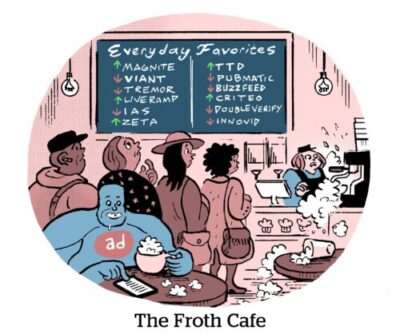 The bigger question, Kramer said, is whether whole swathes of lesser ad tech – the many SSPs, DSPs and data providers out there – will be able to survive in the long term.
“I’d argue that many of these companies will go extinct,” he said. “It’s going to be a bit like ‘The Hunger Games,’ where three or four make it through to the other side and the rest just get … yeah. The long-tail is going to get chopped.”
The ‘other’ headwind
And then there’s the carnage that’s about to go down in the mobile ecosystem with the imminent rollout of a beta version of Android 13 later this month.
The first cut – Apple’s ATT – was the deepest. Meta and mobile ad tech companies are still reeling.
But the release of Android 13, which will include elements of the Android Privacy Sandbox, will foment further chaos.
Take the SDK Runtime API, which will create a separate environment for third-party SDKs to run in, essentially cutting off an SDK’s ability to gather in-app data that it doesn’t have permission to collect.
For some, the one-two punch of signal loss from device IDs coupled with the SDK Runtime API will land a serious if not fatal blow, Strauss said. Using an SDK to suck up data for targeting purposes won’t be possible on Android devices anymore.
If that’s the case, why aren’t we hearing more people talk about Android 13 as much as they talk about the end of third-party cookies in Chrome, a topic that has jammed the airwaves since January 2020?
“It’s because this mostly affects a bunch of smaller, shady mobile ad networks – they’re the ones that are going to get choked off when SDK Runtime comes in,” Kramer said.
But what about a big public company like AppLovin, which just announced its bid to merge with Unity (and scupper Unity’s planned acquisition of ironSource in the process)?
Without some kind of carveout for mediation, SDK Runtime could really mess with AppLovin’s MAX business, among other things.
Kramer isn’t one to mince his words.
“It absolutely affects them, but who cares about AppLovin?” he said. “They’re a big company, sure, but in the grand scheme of things, not really.”
Not impressed
Well then, what to make of AppLovin’s offer to buy Unity for $20 billion?
The bears consider it to be a Hail Mary of sorts to avoid a stock plunge tied to lowered guidance.
“We see AppLovin’s bid for Unity as another attempt by mobile ad networks to ‘huddle together’ and ‘bury the bad news’ of underlying guidance cuts,” Kramer wrote in a note to investors on Tuesday.
AppLovin cut its 2022 sales guidance for its first-party apps business on Tuesday. (The projected range is now between $1.7 billion and $1.85 billion rather than between $2 billion and $2.15 billion.)
Although AppLovin only lowered guidance for apps and not for software, Kramer predicts that this could be a harbinger of trouble ahead for AppLovin’s software solutions business.
And the forecast does call for the headwinds to continue.
AppLovin’s software biz is exposed to signal loss from Apple’s privacy changes (well, who isn’t?) and also from the APIs under construction in the Android Privacy Sandbox.