What advertiser wouldn’t want in on a high-demand, high-intent opportunity? The catch, of course, is having enough scale to make it worth the spend.
Although buyers are eager to invest in ChatGPT, where their ads will (ideally) be served against relevant search queries, OpenAI has been having trouble meeting that need.
But now, ChatGPT ads are beginning to appear for users who aren’t logged in, expanding the pool of available inventory.

To date, a number of advertisers participating in ChatGPT’s ads pilot have been dissatisfied with the amount of money they’re able to invest in the channel, a digital ad executive told AdExchanger.
Although the spend minimum looks “attractive on paper,” as the exec put it, many advertisers are having a hard time exhausting their budgets due to insufficient ad frequency and inventory. ChatGPT recently dropped its spend minimum from $200,000, when the pilot launched, to $50,000.
One way to increase delivery, of course, is to expand the number of users who are eligible to see ads.
OpenAI appears to have recently started doing this by rolling out ads to ChatGPT users who are not logged into the platform. Although an OpenAI spokesperson did say in February that the next round of testing would include serving ads to logged-out users, they didn’t share a timeline for when this would happen.
It’s worth pointing out that OpenAI has made no official announcement about serving ads to unauthenticated users. OpenAI currently states on its website that the ad experience for logged-out users is designed to be “appropriate for all ages,” but further down on the page specifically notes that ads will not appear to logged-out users during the initial phase of testing.
AdExchanger reached out to OpenAI for more information, but a company representative declined to comment.
Regardless, the proof is in the pudding.
Earlier this week, a source shared with AdExchanger that she had begun seeing ads in ChatGPT while logged out.
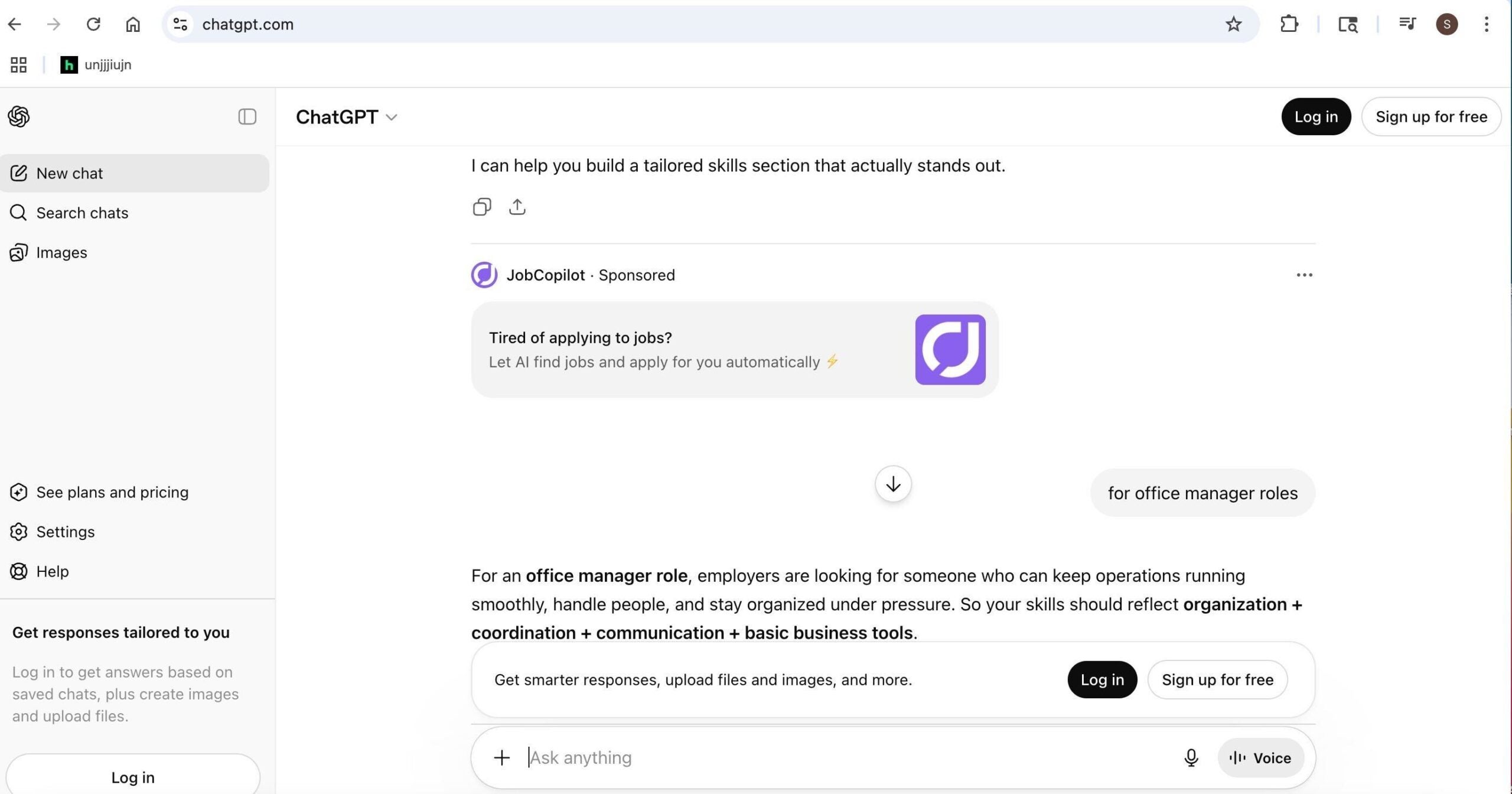
The source, who doesn’t work in the ad industry, said the introduction of ads felt “pretty seamless” since they show up within the flow of the chat, rather than as a visually distracting pop-up. She also said that seeing ads didn’t reduce her trust in the platform since they’re clearly demarcated.
Still, if she hadn’t seen news stories about the introduction of ads in ChatGPT, she said, “I don’t think I would have noticed [them].” During a 10-to-15-minute conversation with the LLM about advice on how to structure her resume, she was served two ads, one for Canva and one for JobCopilot.
Ironically, one of the ads was challenging to read, because it was partially blocked by, you guessed it, another ad – this one prompting the user to log in or sign up for a ChatGPT account.
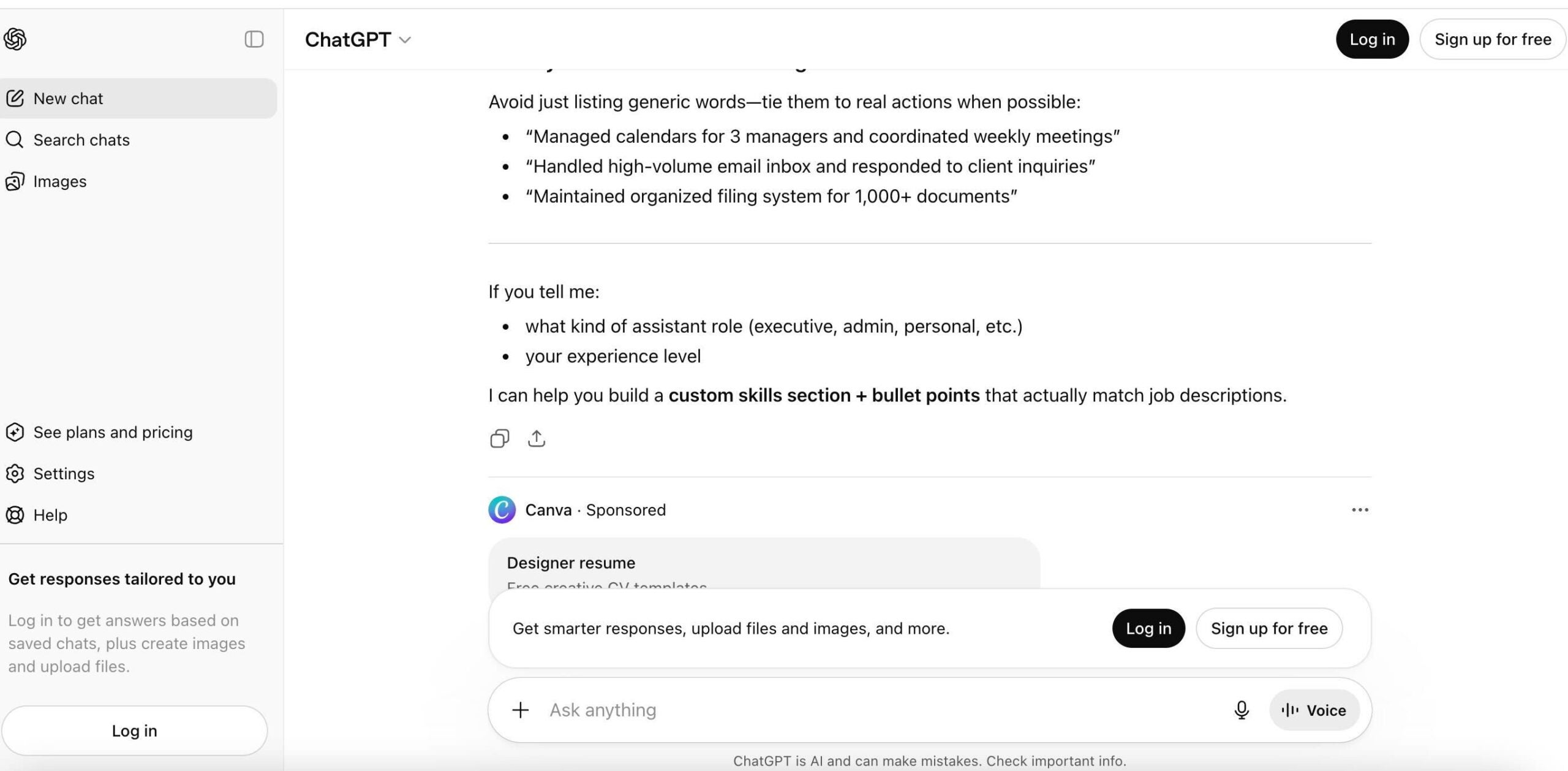
But if that’s the biggest design flaw, OpenAI could be doing a lot worse.
The ads are relatively undisruptive, don’t detract from the content of the conversation and often feature emojis. “I like that,” the source added. “It’s a little funny.”