No Such Thing As A Free Scrape?
The days of free content scraping may be coming to an end.
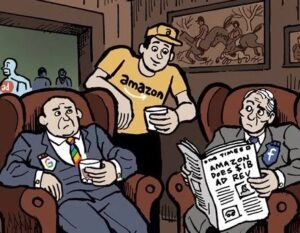
Monetization (or, rather, the lack thereof) has been a hot topic, as LLMs unabashedly scrape publisher content while sucking up their traffic – a lose-lose for pubs. But Amazon is now planning to launch a marketplace where publishers can sell their content to AI companies, The Information reports, as per two people who spoke to Amazon.
While some compensation is better than none, a one-time payment isn’t a great deal for publishers, many of whom want usage-based payments that reflect how often their content is used to help answer queries (a model that aligns with the IAB Tech Lab’s recommendations).

On Tuesday, AWS hosted a conference in New York for publishers and circulated slides in advance that referenced a “content marketplace,” according to The Information.
But even as more companies strike payment deals – Microsoft, for example, just announced a new initiative to help connect AI developers with rights-cleared content from opted-in publishers – getting AI companies to actually pay up is often another story.
Did you know, for example, that some bots actually pose as human visitors to avoid honoring these types of agreements?
When LTV Ruins Lives
Personalized advertising can feel useful to many people – except, perhaps, for problem sports gamblers.
One big issue with gambling sites that bundle sports bets, not just traditional game lines, is that there are practically infinite ways to run insider trading schemes. One bettor on Polymarket, for example, clearly knew the Super Bowl halftime show would feature surprise appearances by Ricky Martin and Lady Gaga, and profited hugely by setting up those seemingly low-chance bets.
But the sportsbooks and trading sites themselves also know their customers well and are highly efficient at extracting revenue through personalized offers and nudges to re-up a bet after a loss. Other countries often require a “cooling off period,” as noted in this newsletter from Bharat Ramamurti, former deputy director of the National Economic Council.
Not across most of the US, though.
Ramamurti recommends that sports gambling operators be forbidden from sending personalized ads or messages, only generic communications, as well as from allowing dynamic bets while games are in play. He also called out sportsbook marketers that use “VIP” programs to entice high-loss bettors.
State lotteries, by contrast, generate major revenue while sticking closer to these guardrails – which is partly why they produce far less financial harm and problem gambling than sports betting apps.
Feeding The Beast
YouTube made $60 billion in ad revenue in 2025. But that’s not enough for its biggest creators, who are branching out into other endeavors, TechCrunch reports.
Take MrBeast, whose YouTube channel boasts more than 440 million subscribers. His company, Beast Industries, acquired Step, a banking app aimed at young people, on Monday. He’s also building a theme park in Saudi Arabia.
Then there’s Emma Chamberlain, who has 12 million YouTube subscribers. She launched a beverage brand, Chamberlain Coffee, in 2019 that projected $33 million in revenue last year.
Founding a beverage brand is a popular way to parlay YouTube success into entrepreneurship. Logan Paul launched Prime, an energy drink, in 2022 alongside fellow YouTuber KSI. The brand topped $1.2 billion in sales in 2023. Paul has also dabbled in NFTs and apparel, as well as boxing and professional wrestling.
Their reasons for diversifying vary. Some creators like MrBeast have outgrown YouTube’s platform and can strike their own licensing deals. Others, like Paul, have been periodically demonetized by YouTube for violating content guidelines.
Plus, YouTube’s ad revenue growth has slowed compared to Google’s other channels, with YouTube up just 9% in Q4 2025 but search growing 17%.
Meanwhile, opportunities to become the next MrBeast are dwindling as social platforms increasingly personalize their feeds, limiting universal reach. So most creators will just have to settle for their slice of ad revenue.
But Wait! There’s More!
News publishers are ditching their moral pleas against overzealous brand safety blocking and embracing AI platforms to demonstrate how their inventory has been undervalued. [Digiday]
Spotify saw subscription revenue rise by 8% to $472 million in Q4, but its ad revenue fell by 4% despite a 4% uptick in ad sales. [Variety]
Google provided ICE with personal data on a student who attended a protest against companies selling weapons to Israel – including the student’s usernames, addresses and credit card and bank account numbers. [The Intercept]
Rather than lightening workloads, a new study finds that AI tends to intensify work, resulting in employees taking on a broader scope of tasks – which then leads to burnout. [Harvard Business Review]
Ring’s Super Bowl ad about using its cameras to find lost dogs prompts backlash as consumers are now aware of the company’s wide-ranging surveillance capabilities. [Inc.]
Generative AI video startup Runway raised $315 million in Series E funding, doubling its valuation to $5.3 billion. [TechCrunch]
Due to complicated broadcast licensing arrangements between ESPN and Major League Baseball, MLB.TV subscribers will also have to subscribe to ESPN Unlimited if they want to watch out-of-market games this year. [Awful Announcing]
You’re Hired!
Indie media agency Mile Marker promotes Tony Russo to VP of AI innovation and strategy, and brings on David Grey as senior director of analytics. [release]
Thanks for reading AdExchanger’s Daily News Roundup. Want it by email? Sign up here.