GDP vs. ROI
One long-standing concern among investors is that ad-dependent businesses – even the largest ad platforms – are tethered to the economy. When growth slows, advertising budgets are among the first to be cut.
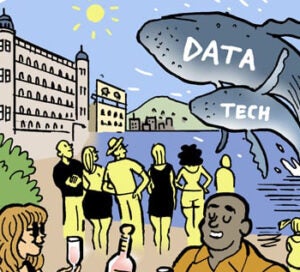
But, according to a piece in The Economist, the biggest Big Tech giants have been making the case that they’ve broken free of this macroeconomic trap. They expect ad revenue growth even if GDP growth stumbles.
Their confidence reflects a shift in how businesses now approach advertising “as a cost of doing business rather than fuzzier brand-building,” according to The Economist.

Still, digital ad players might be a little too optimistic here. Sorry, guys, but your revenue isn’t immune to economic cycles – especially since most of it comes from legions of smaller advertisers who are quick to cut discretionary budgets, namely marketing, when conditions worsen.
And, unlike TV buys that get locked in by contract months earlier, online ad spending can be dialed down almost instantly.
“The next time the macroeconomy is rocked, in other words,” The Economist writes, “the digital ad men may find themselves ordering a particularly stiff martini.”
LLMs, But Legal
First, publishers began suing AI companies for copyright infringement. Then, one by one, they started licensing their content to those same companies instead.
Now, Microsoft Advertising is hoping to scale that process – as in, the licensing part, not the lawsuits.
On Tuesday, Microsoft announced its new Publisher Content Marketplace (PCM), an initiative to connect AI developers with rights-cleared content from opted-in publishers.
Microsoft worked with major publishers, including Condé Nast, Hearst and Vox Media – all of which have also announced strategic content partnerships with OpenAI, by the way – to develop the PCM framework, featuring usage-based reporting and publisher-defined licensing terms.
Microsoft is already pitching PCM as a win-win: new revenue for publishers to offset lost search traffic and higher-quality content for AIs than they’d get from scraping the internet.
But whether LLM-based agents – which typically generate text responses based on word probability – will be able to consistently use this premium content to generate better answers is another story entirely.
Every-botty Have Fun Tonight
Moltbook, the new social media site for AI bots (uh, sure), is dealing with some foreseeable issues – at least from a human perspective.
For one, there’s a glaring site security vulnerability. Anyone who accesses an API key exposed in Moltbook’s code can view nearly anything on the site, including “around 1.5 million bot ‘passwords,’ tens of thousands of email addresses and private messages,” Fortune reports.
Plus, OpenClaw, the software that powers many of the site’s bot users, became a vehicle for malware within a matter of days. Not that the malware operators care about scamming AI agents. They’re targeting humans whose agentic assistants were given personal data or credentialed access to other software or platforms that require a log-in.
Experts worry that Moltbook may become a jumping-off point “for attackers to test malware, scams, disinformation or prompt injections that hijack other agents before targeting mainstream networks,” Fortune notes rather ominously.
There’s also the whole “robots plotting human extinction” thing. Though, ironically, many of those posts on Moltbook were written by humans masquerading as bots.
But Wait! There’s More!
Fubo’s stock crashed on Tuesday after the streamer reported its most recent results and a $19.1 million loss following its merger with Hulu. [Fast Company]
Inside NBCUniversal’s test using AI agents to sell ads against a live NFL game. [Digiday]
Google’s biggest web-crawling challenges from 2025. [Search Engine Roundtable]
How Jeffrey Epstein used search engine optimization to hide news about his many crimes. [The Verge]
French authorities raided X’s offices in Paris and summoned Elon Musk and former X CEO Linda Yaccarino to appear at legal hearings in April. The UK has also opened a fresh investigation into xAI’s Grok over its “potential to produce harmful sexualised image and video content.” [BBC]
On a related note, SpaceX is acquiring xAI. The combined company is now valued at $1.25 trillion. [WSJ]
On Saturday, a community in Chile turned off all AI for a day and powered a “human-operated chatbot” to demonstrate the water footprint of AI usage. [AP]
You’re Hired!
Josh D’Amaro, current chairman of Disney Experiences (the company’s theme parks division) has been named Bob Iger’s successor as Disney CEO. [Vulture]
Mediaocean announces that Innovid CEO Zvika Netter will also serve as Mediaocean’s chief innovation officer. [release]
Thanks for reading AdExchanger’s Daily News Roundup. Want it by email? Sign up here.