Don’t Hate, Mediate
Whenever AppLovin processes a mediation request, that request (which is a packet of data wrapped in a cryptographic protection) includes all sorts of juicy details about the user and device, such as clock settings, battery status, mute switch location, phone orientation, location, mobile carrier info, time zone, text size and installed keyboards. The data isn’t encrypted, though; it’s just cryptographically obscured by a mathematical code.
But this cryptography can be broken. And then all the data (AppLovin’s own device fingerprint, in essence) becomes available.
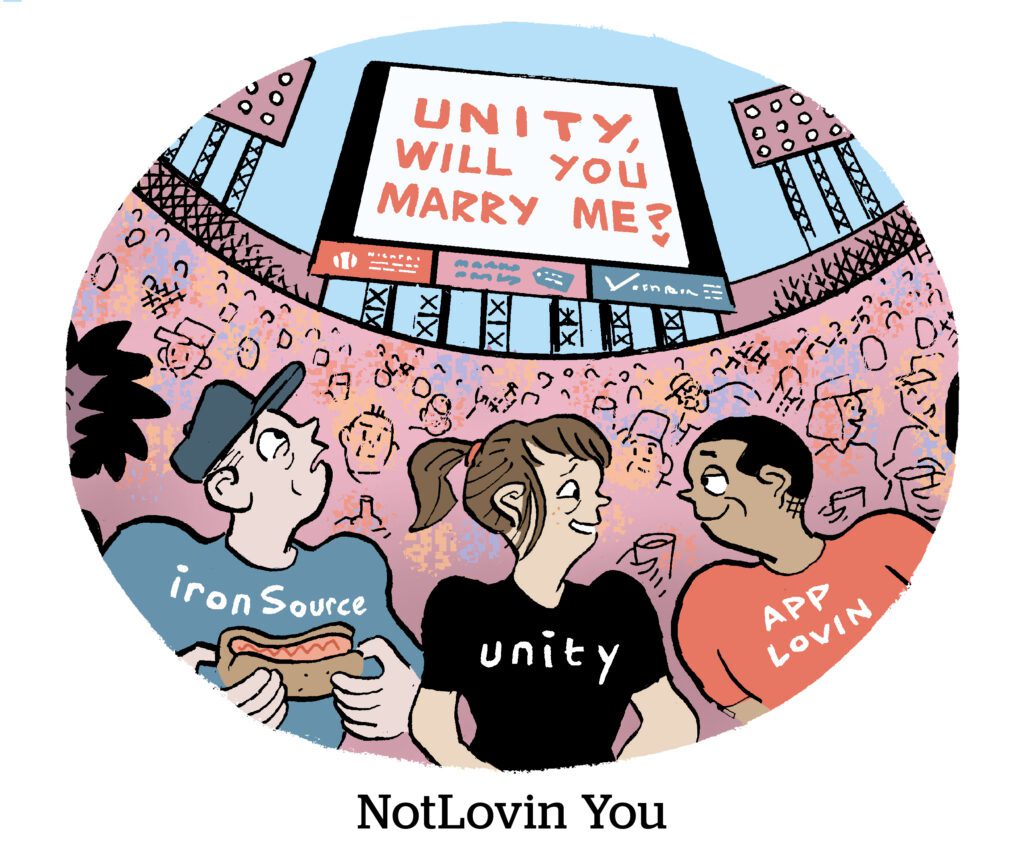
That is some useful context behind a Digiday report that AppLovin is suing Unity alleging that the rival mediation service has collected that output, probably cracked the cryptographic protection and is now using the data to inform its own models.

Unity argues that AppLovin is being a bully incumbent trying to stifle a smaller challenger.
The case adjudicates an interesting open question: If the data is freely available in mobile campaign reports and for device owners, why shouldn’t it be available to Unity?
AppLovin dubs its mediation packet info in the suit as “Protected Data.”
But is that a legal classification?
Who Creates The Creators?
Everyone wants a piece of the creator pie these days.
Last week, YouTube announced several new features at its Made On YouTube event to provide creators with new ways to increase their audience footprint and engagement.
The IAB launched an entire new event dedicated to the creator economy.
And Meta? It had a booth at the IAB CreatorFronts, where it demonstrated its brand-creator matching system, and it claims it has over 1.5 million discoverable creators in Instagram’s creator marketplace.
But many creators and others in the ad industry aren’t sold on Meta’s creator ambitions.
“Until they can prove that creators are a priority for them, I don’t believe it,” an anonymous industry observer told Mike Shields, founder of Convergence Media.
However, the success of Meta’s creator program depends on one’s definition of “creator.”
High production quality, living room viewing habits and close audience connections on YouTube have seemingly elevated its creators to the level of some TV stars. Meanwhile, social influencers on short-form platforms like Instagram tend to feel a bit less glamorous in comparison.
As Jamie Gutfreund, founder of Creator Vision, put it, “Meta is great at turning creators into ads. YouTube is great at turning creators into businesses.”
CM-Oh No
It’s hard out there for CMOs. Only 36% of Fortune 500 companies even have a chief marketing officer these days, according to Forrester. And CMOs stay in their roles for just 3.9 years on average.
But, on top of dwindling job prospects, CMOs now have to contend with the possibility that generative AI search will send an angry mob after them.
Converse’s former CMO, Rodney Rambo, tells Adweek he’s faced a deluge of death threats amid the brand’s recent controversy over an ad that critics say resembled lynching imagery.
The problem? Rambo left Converse back in January and had nothing to do with the ad in question. But that’s not what xAI’s Grok and Google’s AI Overviews told the online hordes.
And Rambo didn’t just face one side of the outrage machine. The typical crop of racism apologists that flock to these types of controversies pointed to Rambo, a Black man, as proof that Converse’s campaign could not be racist.
Making matters worse, Converse never explained who was responsible for the ad in its public apology. Instead, Rambo had to rely on his professional network – including another former Converse CMO – to push back against the social media cacophony.
And Rambo’s attempts to correct the chatbots didn’t help. Adweek says Google AI Overviews now point the finger at the CMO of Converse’s parent company, Nike. Converse’s actual CMO declined to comment when contacted by Adweek.
But Wait! There’s More!
Dodge AI announces a $2.65 million round of funding from Accel and Google. [release]
OpenAI launches its own agentic AI tool to compete with Meta’s Muse. [The Verge]
Meta, meanwhile, is already adapting its Muse agent for small business owners. [The Information]
Walmart bans its stores from using AI-generated posters. [Business Insider]
Here’s what it’s like when an AI-generated content mill fabricates a story and attributes it to a real reporter without their knowledge. [The Nerdy Bird]
Thanks for reading AdExchanger’s Daily News Roundup. Want it by email? Sign up here.