
Here’s today’s AdExchanger.com news round-up… Want it by email? Sign up here.
The Real Verifiers
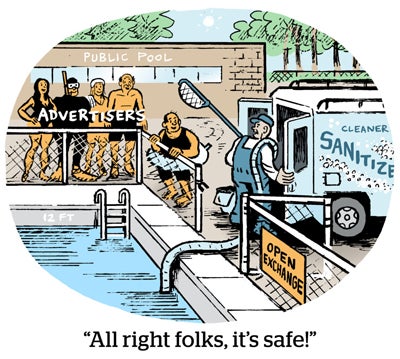
The DOJ and Naval Criminal Investigative Service are talking to ad industry execs about brand safety issues exposed by recent Adalytics reports, Marketing Brew reports.
Adalytics does use Congressional offices, the armed services and other high-profile government agencies as examples of advertisers in its reports. (Screenshotting the Navy or FBI running recruitment ads on a sanctioned Iranian site means a whole different level of uncomfortable client phone calls.)
While Google was the leading lady in Adalytics’ investigations, DoubleVerify and Integral Ad Science are being name-checked by investigators as well.

Of course, these types of inquiries don’t necessarily lead to full-on investigations. Regardless of the scope of this inquiry, it’s part of a trend that’s putting brand safety and verification services in an uncomfortable spotlight. On the buy side, advertisers take “100% Fraud-Free Guarantees!” that are simply not true. Advertisers buy the bot and fraud identification services and still pay for ads to bots and fraudsters.
Publishers, meanwhile, deeply begrudge IAS and DV’s leverage over web publishers and that the vendors scrape sites to create their own contextual tech.
Attention Deficit
Brands might be paying too much attention to attention.
As Ad Age reports, a new Advertising Research Foundation study recently found “almost no correlation” between attention metrics and brand success, based on a review of 12 different companies that conduct eye-tracking, facial coding and other forms of attention measurement.
Similarly, research from the retail media network Kroger Precision Marketing into DoubleVerify’s Authentic Attention solution suggests that it doesn’t have much of an impact on incremental sales.
Interestingly, Kroger also found that viewability, which measures an ad’s potential to be seen, did correlate positively to sales. That’s ironic considering that attention and viewability are so commonly compared, often in favor of attention.
Of course, research from companies within the attention space tend to say the exact opposite – that attention not only beats out viewability but also meaningfully drives business outcomes.
The whole thing brings to mind an informal poll taken during last week’s CIMM summit, observed by AdExchanger, in which only a handful of audience members indicated they thought attention is ready to be transacted against.
With back-and-forth like this, no wonder not many media buyers are confident in attention’s currency potential just yet.
What’s The Deal?
New details are emerging about the behind-the-scenes haggling between Google and California lawmakers over legislation to support the local journalism industry, Bloomberg reports.
Reportedly, Google was willing to walk away from the deal unless California taxpayers contributed tens of millions of dollars to fund newsrooms alongside Google. Google apparently wanted the taxpayer support provision included as a precedent that would inform future legislative attempts to make it compensate publishers for use of local media content in the platform’s search results.
The taxpayer support provision also ensured that, if Google was on the hook for paying newsrooms, it would get something out of the deal, too, in the form of AI funding. And, presumably, Google required the public funding commitment to ensure that any other legislatures looking to hold the company accountable would pay a high political toll to do so.
Further complicating matters, California Governor Gavin Newsom reportedly was reluctant to support one of the two original proposed bills, as he considered it to be imposing a new tax, which he had campaigned against.
Meanwhile, weeks after the deal was originally announced in August, there’s still only a framework in place. And the California legislature still has to sign off on the taxpayer contribution.
But Wait, There’s More!
A deeper look into how TikTok Shop works with “affiliates” to boost sales. [Rest of World]
Meanwhile, TikTok’s own research admits that the app negatively affects teen users. [TechCrunch]
Adobe launches a new suite of generative AI video tools for social media ad campaigns. [Ad Age]








