Clip It To Win It
If attention is currency, clippers are generating the change in your wallet: It might not look like a lot but, eventually, it adds up.
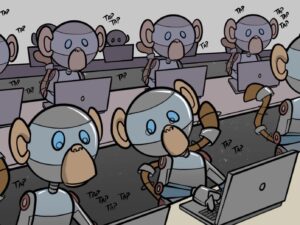
Clipping, which is the practice of creating short snippets of longer-form content, has become a standard media strategy for many creators, and is often outsourced to professional “clippers.”

But despite its widespread popularity, some argue that “paying random accounts” to spread content more widely, as The Verge puts it, is “deceptive” and manufactures “fake fandom.”
Anthony Fujiwara, founder of the not-so-subtly named startup Clipping, doesn’t deny it. He acknowledges that clipping is a way for marketers to “abuse the algorithms of other platforms” to spark growth, which, he said, has become a “necessary marketing play.”
And it’s a pretty sweet gig. Fujiwara said the 62,000 clippers on his platform earn an average of $3,000 a month by pulling relevant snippets from videos – usually without additional edits – and pairing them with resonant captions.
But opportunities for clippers may be dwindling. For example, Instagram recently announced that it will no longer recommend accounts that “didn’t make or meaningfully edit” the majority of content they share. Guess you could say Meta is clipping their wings.
Maxxing
Google’s AI-powered bidding products, namely AI Max, have expanded the pool of search keywords. In fact, that’s pretty much the point of AI Max, which Google frames as a way to find pockets of potential demand or keywords that a manual search advertiser wouldn’t think to target.
The same products also use generative AI creative to conjure text and imagery that fulfill more searches. Plus, many more SMBs and local advertisers can now generate ads to compete in those same searches.
The net result can be rough for search advertisers, though, because the density of bidders in certain brand verticals or keywords keeps going up and up, Digiday reports.
“AI Max has sort of opened up these elements a little more aggressively for our competitors, for ourselves, for [everyone],” says Paul Low, PMG’s head of search. “It’s a more open game.”
The total number of search ad auction participants has increased by 35% in the past year, largely attributable to AI Max adoption, according to search intelligence platform Adthena. Independent media agency Collective Measures, meanwhile, reports cost-per-click ad rate increases of between 10% and 25%.
“The CPC pain is real,” says Adthena CMO Ashley Fletcher.
EZ Money Flow
The Association of National Advertisers (ANA) has long railed against the ad tech tax quietly draining media budgets. Well, now, the ANA is introducing its own ad tax of sorts through its cross-media measurement platform Aquila, MediaPost reports.
Aquila is designed to measure campaigns across TV, digital and streaming so advertisers can understand their true unique reach without double counting.
To fund Aquila, the ANA is implementing a fee called the “Fractional Advertising Contribution” (or FAC, as if we need another acronym) that will be embedded directly into media buys. Aquila CEO Bill Tucker, a longtime ANA exec, positioned the 0.075% fee (capped at $750,000) as a necessary evolution.
It wouldn’t be sustainable if the ANA had to scramble every year or every other year to fund Aquila, according to Tucker. “So the decision was made to have a durable, ongoing payment system,” he says. “And the decision was made to have it funded, ultimately, inside the media budget.”
The fee will flow through Mediaocean-powered transactions, with Tucker likening the process to drivers having an EZ Pass. Which makes sense but is also kinda rich considering how long the ANA has reproached middlemen.
Anyway, guess the ANA is in the tollbooth business now.
But Wait! There’s More!
Google Chrome silently installed a 4GB AI model on your device. [The Privacy Guy]
Meanwhile, Google has offered the EU a settlement in its news search case – one that would dodge both fines and stricter rules. [Bloomberg]
AI is making it harder for journalists to sound more human in their writing. [WSJ]
Some kids in the UK are fooling automated verification checks with fake mustaches. [TechCrunch]
WTF are brand health metrics? [Digiday]
AI costs are on the rise. Businesses, developers and even investors are feeling the strain. [The Information]
Here’s today’s AdExchanger.com news round-up… Want it by email? Sign up here.