

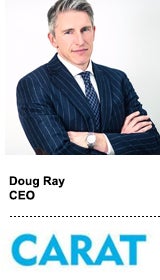
 Carat has a leg up on holding companies scrambling to integrate siloed teams.
As part of Dentsu Aegis Network, the media agency operates on a shared profit-and-loss (P&L) statement by country across the network. That allows it to pull in specialist media capabilities to better serve its clients, without those teams competing financially.
“This idea of a single P&L and agencies within a holding company coming together is the future,” said CEO Doug Ray. “I think we’re ahead of the curve.”
Carat leads most of Dentsu’s media relationships, but it doesn’t have the same depth of expertise in performance media as iProspect, digital creative capabilities as Isobar and out-of-home as Posterscope. In today’s multichannel world, you can’t discuss media plans without those capabilities in the mix, Ray said.
“You couldn’t have a conversation about media without talking about its relationship to search or the landing page a consumer might experience,” he said.
But as Carat started to lean more heavily on its sister agencies for specialization, it began to question its own identity.
“As fragmentation happens, less and less specialization is sitting within Carat,” Ray said. “So then it starts to beg the question: What does Carat stand for?”
After a year of soul-searching, Carat found that as steward of most media relationships in the holding company, it served the increasingly necessary purpose of “chief integration officer,” managing the client relationship across the network.
“I think [Procter & Gamble Chief Brand Officer Mark] Pritchard said it best: ‘The holding company’s complexity is not my problem,’” Ray said.
Ray spoke with AdExchanger.

AdExchanger: Is it the media agency’s job to integrate specialized services?
DOUG RAY: Specialized media services, for sure. We’re in a couple pitches right now where the incumbent is a media agency and sister digital agency at a holding company, and it’s not working because they’re on separate P&Ls.
When we won Microsoft, we created a bespoke agency in a bespoke location. The problem with these is now you’re on an island. As an employee in that specialist agency, where’s my career path? Do I go back into another media agency in the holding company? How easy is that? How plugged in am I to them and the work they’re doing? What is the culture here?
You have an integrated team for General Motors sitting in Detroit. How is that different and why is it working?
You have to have a single point of contact and give that person accountability for the business. That can be full financial accountability or full transparency into the financials. But people might not be inherently thinking about running a business. If they are, maybe they’re not thinking strategically around the corner about the next thing. That’s the challenge.
How does Carat approach that challenge?
We’ve got a commercial leader on each account to have business conversations. Clients expect you can manage a team and keep the best talent on their business while managing commercials and interfacing with procurement. Let’s unburden that from our client leads.
How much onus is on the marketer to modernize along with agencies?
Clients recognize that they need to transform their organizations to get out of their complacency. We’re moving from a world that is rooted in legacy where media is typically a reserved relationship to a biddable or automated approach. In TV, we’re getting into much more of an addressable, programmatic and agile approach. We reserve and negotiate some predefined inventory, but we’re utilizing data and technology to be more addressable on a one-to-one basis. I can be much more agile because I’m not held to some of the cancellation options, and I can evaluate what’s working and what’s not optimize that in real time.
Where is Carat at with addressable TV?
We’re very bullish on addressable TV. Dentsu Aegis Network is the largest spender in the space. We’ve got a number of clients, like General Motors, that have leaned into this quite a bit. We’ve done addressability down to the household level and corrected misconceptions about how scalable addressable is. We’re going to be at well over 72 million households. There’s a far greater amount of data that can allow more categories to benefit from addressable TV, like Nielsen Catalina, Polk (which provides auto registration data), Experian, Acxiom and Mastercard Advisors. We’re not transacting on a biddable environment – it’s still a reserve environment – but we’re applying some of the data and technology capabilities to that.
Will TV ever go fully addressable?
I don’t think it will. Clients and agencies are demanding that traditional broadcast TV owners provide more capabilities similar to digital. We want to go beyond age and sex demographics. We need to have the data and back-end technology to do that. NBC and AdapTV have been working to do that. You’ll probably see some acquisitions in the future as well.
On the other side, digital video suppliers are applying traditional metrics from TV, like reach and frequency guarantees [through products like] Nielsen’s digital audience ratings. IAB is coming out with guidelines. My concern is that as the networks continue to try to be more addressable, they will start to create their own walled gardens. [If] there’s not a common data currency like Nielsen, that’s going to be a fundamental issue for the industry.
Does measuring digital video with traditional TV standards work?
Absolutely. We’ve seen a shift in absolute dollars from our clients moving from linear TV into digital video. They’ll never walk away, but it’s a complement.
We’ve created a planning tool that allows us to look at single-source reach across video platforms, including YouTube and Facebook. If you stay in the legacy world, it will cost you more and more to achieve that reach. But if you are able to measure cross-screen reach, you’ll see that, for the same dollars, you gain more reach by shifting dollars into digital video. We’re seeing today 15% to 25% of dollars across all demographics is the sweet spot.
What’s your relationship like with walled gardens? How are you able to measure their data?
We’ve spent a number of years working with global media partners to help solve cross-screen reach and frequency. They’re giving us their data. You can use off-the-shelf tools, but they’re not measuring YouTube, where the amount of time spent is tremendous.
As an agency, do you need to create your own measurement tools through bespoke relationships with walled gardens?
Yes. We’re looking for some exclusivity. It’s just a matter of how you view these big media owners. They’re not going away; they’re just going to continue to get stronger. I don’t have time to negotiate with 25 different individual publishers to achieve the scale that I need when I can go to Facebook, Google or a programmatic ad exchange. I want my teams to use their time more effectively than chasing small opportunities because our clients need scaled solutions.
What’s your relationship with Dentsu Aegis’ trading desk, Amnet?
We work very closely with Amnet. We believe there needs to be a center of excellence for a specialization. However, you can have a distributed center of excellence. We will get to a point where our Carat employees can have a conversation about these areas, but today we need some specialists [embedded in the agencies] to help then make this move. That might be different from the programmatic analysts that are actually pulling levers on campaigns.
Have you started working with Merkle since the acquisition? What’s your relationship going to be like?
I have my first meeting with Merkle executives this week. They have very strong capabilities on the data side. What they’re going to bring us in terms of the proprietary data that we have access to will be tremendous. And that data will then be used to help us understand audiences, inform content, media and execute.
Edited for clarity and length.
Update: Carat will reach 72M households with addressable TV. The original story stated the figure 120M. The data provider previously referred to as Pulp is called Polk.







