
Here’s today’s AdExchanger.com news round-up… Want it by email? Sign up here.
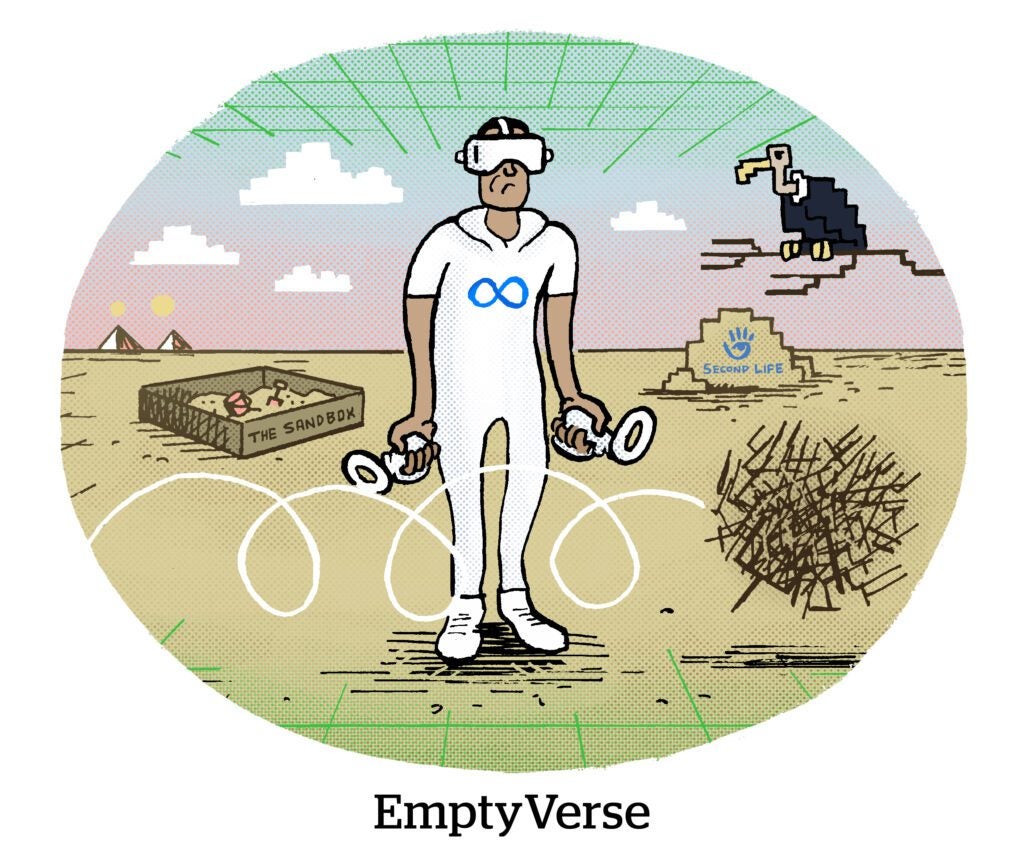
The Metaverse’s Second Life?
The metaverse has gone from the next big thing to a punchline about the danger of chasing Big Tech’s shiny objects.
Even Meta is downplaying its investment in immersive virtual worlds.
Yet, despite reports to the contrary, metaverse marketing is not completely dead, according to brands and tech companies that spoke with Adweek.
Microsoft is still building metaverse infrastructure and doubling down on (actually successful) metaverse-adjacent offerings, such as the multiplayer sandbox game Minecraft, and Nvidia is partnering with WPP on AI and metaverse-related projects (see below).
Meanwhile, the Metaverse Interoperability Forum continues to hold weekly calls with the aim of bringing the metaverse’s promise of interoperability across virtual worlds to fruition.

Oh, and Publicis is focused on measuring attention in the metaverse, while R/GA is adapting attribution to metaverse environments.
Brands are also rethinking what campaign success looks like in the metaverse. For example, Nike entered the metaverse in 2021 with an interactive world, NIKELAND, that allowed users to play online mini-games. A year later, Nike shifted its focus to Swoosh, a metaverse-based ecommerce platform.
Guess we shouldn’t be surprised if the next hype cycle positions online retail as the savior of the metaverse.
The AI Race Continues Apace
Agency holding company WPP is teeing up a generative AI ad platform with Nvidia, an AI hardware and software supplier whose star has risen alongside generative AI, Ad Age reports.
The platform doesn’t yet have a name or a release date.
But, coming soon, WPP will be able to link generative AI tools from disparate partners, such as Adobe and Getty Images, through Nvidia’s cloud platform, and brands will be able to make 2D images and videos and 3D simulations for ads.
Despite a rising chorus warning against AI tech’s dangers – including a statement this week that “mitigating the risk of extinction from AI should be a global priority” on par with pandemics and nuclear war – the AI fever shows no signs of cooling.
And WPP is far from alone among agency holding companies wading deeper into AI waters.
Publicis recently acquired a full stake in Publicis Sapient AI Labs, Omnicom partnered with Adobe and Microsoft to weave generative AI throughout its operations, and Stagwell is awash in AI initiatives.
Do Try This At Home
Airbnb is at home with its in-house agency.
In-house creative agencies sometimes take flak for being limited in vision because they only work with one brand as opposed to external agencies, which have a broader purview.
But Airbnb calls that critique “a fallacy.”
The brand’s in-house team handles marketing strategy, creative, design and research.
Putting great creative minds right beside the product folks is actually quite helpful, Hiroki Asai, Airbnb’s global head of marketing, tells Digiday.
Sometimes the work that comes back from an external agency isn’t on point – or may not even make sense – because the agency’s creatives were too far away from the design process. “Those conversations happen now way upstream,” Asai says, “versus at the very end of the chain.”
But there are still certain tasks Airbnb hasn’t brought in house, such as having EssenceMediacom manage the brand’s media buys.
Other brands, meanwhile, have gone down the arduous road of in-housing their media operations, including HP, and it’s been mostly worth it (scars aside).
“You’re incentivized by the business, not by anything else,” Freddie Liversidge, HP’s global head of media, told AdExchanger in a past interview. “There’s no other pitch, no other money to go after. If HP has a good year, you have a good year.”
But Wait, There’s More!
Two-thirds of Netflix password sharers say they’ll open their own account – but 52% of millennials and Gen Z say they’ll cancel their account if they can’t share it. [MediaPost]
European marketers consistently adopt less mar tech than their American counterparts. Gartner research suggests that gap is closing. [The Drum]
Matthew Ball on Big Tech’s efforts to build billion-user platforms. [blog]
Meanwhile, Twitter challenger Bluesky’s user count surpasses 100,000. [Jaz]
Microsoft and Activision Blizzard outline their strategy to appeal the UK’s decision to block their proposed merger. [Gamesindustry.biz]
You’re Hired!
Former General Motors CMO Deborah Wahl joins Mediaocean’s board of directors. [release]







