Here’s today’s AdExchanger.com news round-up… Want it by email? Sign up here.
Reach For The Stars
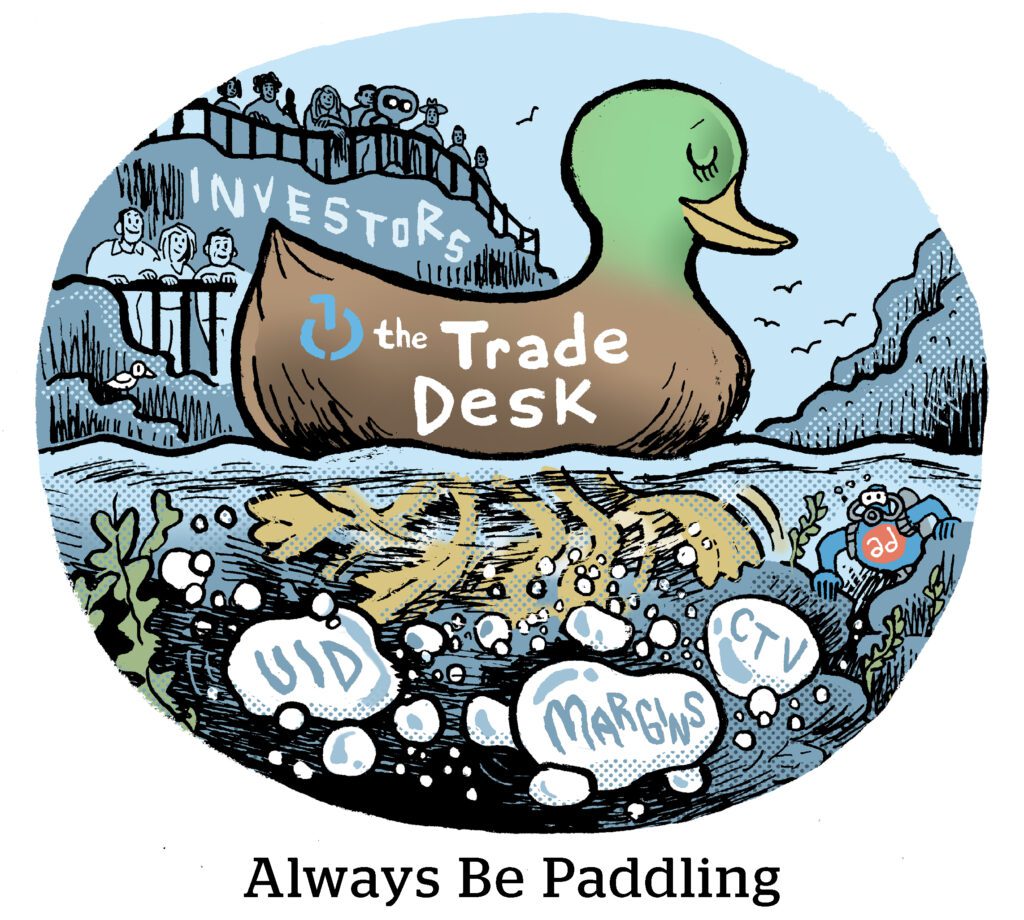
The Trade Desk announced a new product, called Galileo, that consolidates the company’s existing first-party data solutions. The free-to-use hub includes data clean room services, onboarding and identity plug-ins for Unified ID 2.0.
In an interview with Adweek, TTD Chief Strategy Officer Samantha Jacobson compares Galileo to walled-garden-based clean room products – which she doesn’t cite, but are namely Google’s Ads Data Hub and Amazon’s Amazon Marketing Cloud (which is actually part of Amazon Advertising, not the AWS cloud business). Except that where walled garden versions spit out only results, with no transparency into user or impression-level campaign data, Galileo still reports log file data.
On an unrelated note, big ups to The Trade Desk for its commitment to eccentric product names. Galileo is the latest launch, but Solimar, the new DSP dashboard (not to be confused with a beach resorts or sunscreen brand), was the major update in 2021 and 2022. Solimar followed the launch of Koa, the machine-learning-based campaign optimizer, and a user interface called Megagon.

Discontent Moderation
Facebook has been trying to reduce, if not outright stop, the spread of political news on the platform. Distinguishing legit news outlets from bad-faith news has never been a Facebook skill. Easier to suppress distribution of the content and limit political advertising as a way to keep divisiveness down.
Since 2021, Facebook has experimented with methods for suppressing “sensitive” political content. They range from changing what signals its content recommendation algorithm prioritizes to suppressing the sharing of any sensitive content in the newsfeed, The Wall Street Journal reports. Facebook even considered muting all recommendations of political content – which puts a short leash on the organic reach for any political post.
However, the result of explicitly reducing political news publishers means that the garbage outlets that front as news are still on the platform and now vastly outweigh credible info sources. A perplexing situation for people who once found actual news on Facebook.
And even after Facebook implemented these changes, around 60% of US users still say it has a negative effect on politics.
BMW’s Art And Science
BMW is conducting a full agency roster review, Ad Age reports. The auto brand currently uses IPG firms for media buying and CRM services, Omnicom for creative and web development and the indie shop Anchor for social.
BMW says the review is “part of our normal course of business.” Meaning it’s a regular process of evaluating accounts every few years.
But the BMW account contest, which will take most of 2023 to complete, is also part of a trend for brands consolidating creative and media buying agencies into single accounts.
The issue isn’t consolidation for consolidation’s sake or to squeeze a few more points in vendor fees. Marketing just works better when creative production is tied directly into media buying, especially early in the strategy process.
Bethany Evans, VP of media and channel marketing at The North Face, consolidated creative and media accounts to WITHIN last year because the brand no longer distinguishes “performance marketing” (data-driven and digital-first) from “brand marketing” (creative-driven national campaigns) as separate channels. Those funnels have simply collapsed into one.
But Wait, There’s More!
TikTok users now have access to in-app movie and TV pages powered by IMDb. [TechCrunch]
TikTok will produce a weekly show for Vevo’s FAST network. [Ad Age]
How AppsFlyer tested Apple’s SKAdNetwork black box attribution. Spoiler: SKAN does faithfully report click-to-install conversions but remains lacking as an overall attribution solution for iOS. [blog]
WPP acquires Fēnom Digital. [release]
Behind the scenes at the Encyclopedia Britannica of memes. [WSJ]
Criteo and Magnite partner to increase commerce advertising demand. [B&C]
Transmit.Live, a streaming TV ad tech company, is acquired by the investment bank LionTree. [release]
You’re Hired!
multilocal adds Simon Reed as CRO and Fern Potter as VP of product and business strategy. [release]
The Coalition for Innovative Media Measurement (CIMM) names Tameka Kee as deputy managing director. [release]