

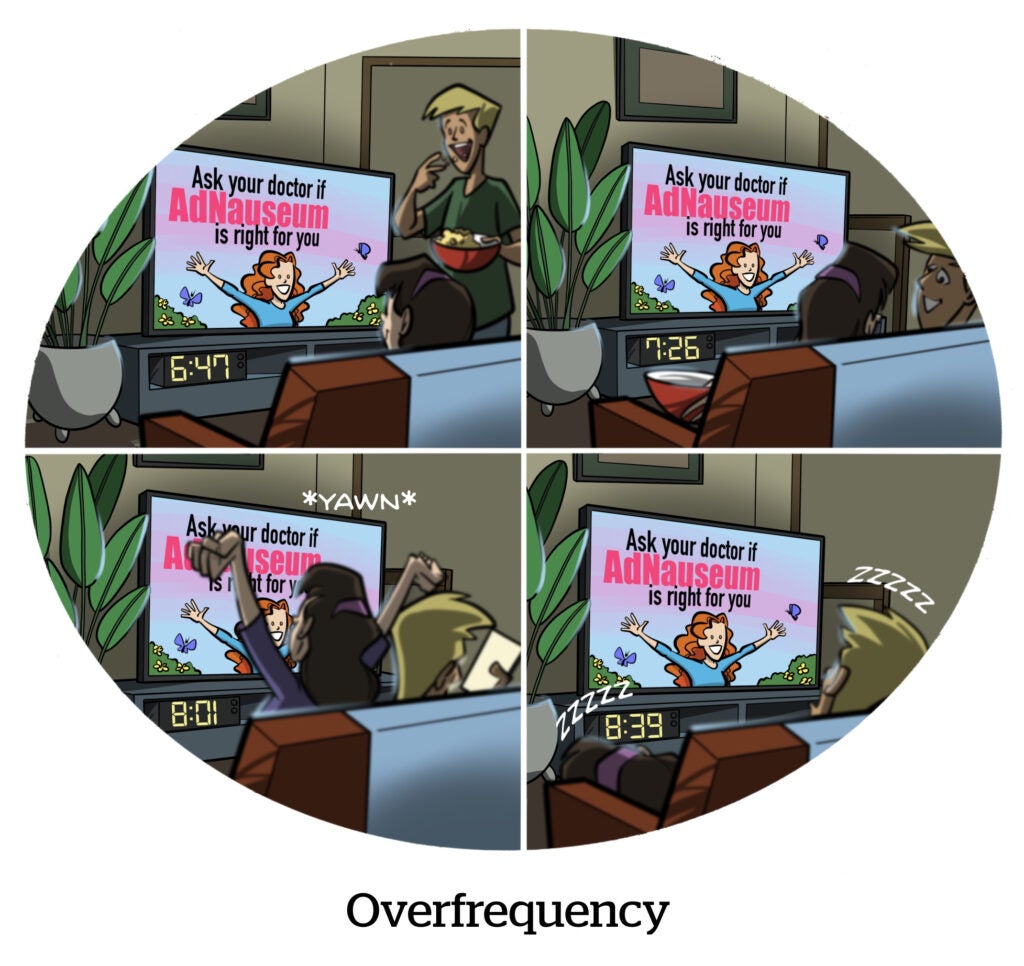
Omnicom just took a major step forward in solving CTV’s long-running frequency capping problem.
The agency holding company announced Monday that it’s adding new capabilities to the cross-platform clean room that its media services division, Omnicom Media, introduced in 2023. These new features enable postcampaign measurement of a campaign’s reach, frequency and performance across multiple streaming publishers and linear TV broadcasters within a single clean room instance.
Anyone who’s ever watched streaming TV has had the experience of being blasted with the same ad playing over and over again across ad breaks. This problem persists because streaming platforms don’t usually share granular data with advertisers on the content in which their ads ran and how often individual households were served. And this lack of transparency also makes it harder to compare how often viewers saw an ad across multiple streaming networks.
Now, Omnicom agencies – including the former IPG agencies Omnicom acquired last year – can measure cross-platform campaigns at both the creative and audience level. That way, they can tell how often viewers were exposed to specific ad creative and how often that creative has run on different platforms.

And brands can add their postcampaign sales and performance data to the clean room to determine how ad frequency and reach impacted business outcomes, then optimize future campaigns accordingly.
“The ability to understand creative frequency and performance across audiences and environments at a much deeper level helps us deliver advertising that feels more relevant, less repetitive and ultimately more valuable for viewers,” said Baldwin Cunningham, head of media and marketing intelligence at State Farm, an Omnicom client.
The new frequency measurement capabilities are now live across Disney, NBCUniversal, Paramount and a host of other large and small VOD platforms and FAST channels. Omnicom plans to announce more integrations with other big-name streamers in the coming months.
No more negative reach
The updated cross-platform collaboration environment represents the first time Omnicom’s agencies and clients have been able to directly compare ad frequency and performance across multiple major streamers, which typically prefer to keep data locked inside their walled gardens, Megan Pagliuca, chief product officer at Omnicom Media, told AdExchanger.
Plus, it should help brands avoid “negative reach,” she said, or the hits to brand reputation caused by viewers being overexposed to the same ad creative.
Although frequency capping issues are typically caused by platforms refusing to pass data on creative exposure, consumers are more likely to blame the brand itself for inundating them with repetitive ads, Pagliuca added.
She pointed to Omnicom’s Connected Content study, which was released on Friday. It found that 51% of consumers say a bad ad experience reflects more poorly on the brand than on the platform serving the ad. Plus, 80% of consumers said bad ads are worse than no ads at all.
Now, Pagliuca said, Omnicom’s agencies have more granular insight into ad frequency and reach than they get from traditional post-campaign reporting, which typically looks at ad exposures in the aggregate and boils the data down to averages. And this more granular data should give them a better idea of the ad experience actual viewers are seeing, rather than an aggregated approximation.
“When you think of an average in frequency, it’s kind of like saying your head is in the freezer and your feet are in the oven, and on average you’re fine,” she joked.
ID infrastructure
So, what finally made this solution possible after years of advertisers catching flak for repetitive TV and CTV ads?
Omnicom’s multiplatform clean room is built on the Acxiom identity infrastructure the company added as part of its acquisition of fellow holdco IPG at the end of last year.
Omnicom had already built a clean room that can measure performance across multiple publishers in partnership with cloud infrastructure provider Snowflake and retail media platform Albertsons Media Collective back in 2023. But, after Omnicom brought Acxiom into the fold, Acxiom was able to work with Snowflake to bring these new ad frequency measurement capabilities to the clean room, too.
The frequency piece relies on a Creative ID that is embedded by the publisher in the creative to track how often that particular ad spot gets served by the platform. This integration represents the first time major CTV publishers have allowed the Creative ID to be passed back into a multiplatform clean room environment, Pagliuca said.
In addition, Acxiom’s Real ID helps Omnicom track which households have been exposed to the ad campaign and whether those exposures drove purchases or other conversions like site visits.
And Omnicom’s partnership with video measurement platform VideoAmp brings in automatic content recognition (ACR) and set-top-box data to track the impact of creative exposures across linear TV.
Attribution and decisioning
The combination of all of these signals creates closed-loop attribution for CTV and TV campaigns across a variety of publishers, while also weighing how ad frequency affects performance, Pagliuca said.
Now, the next challenge for Omnicom is turning these performance signals into “actionable intelligence,” said Jarrod Martin, chief transformation officer at Omnicom Media and CEO of Acxiom. The goal, he said, is “understanding which messages resonate, where they resonate and how often consumers should see them to drive business results.”
Advertisers can factor performance insights into their campaign optimization decisions, Pagliuca said, including for applications like dynamic creative personalization. The data can also help them determine whether more creative versions are needed to cut down on ad repetition. And it helps track the impact of sequential storytelling, in which a brand’s multipart creative messages build on each other when played during consecutive ad pods.
As a result, Omnicom now has new tools for benchmarking CTV frequency across clients and measuring how frequency affects ad performance over time. And all the data is being combined in a dedicated clean room that the holdco controls, rather than siloed across different walled gardens.
“By having the frequency view within and across publishers,” Pagliuca said, “this is a huge unlock for improving the consumer experience and eliminating waste, and then also tying video performance back to sales.”










