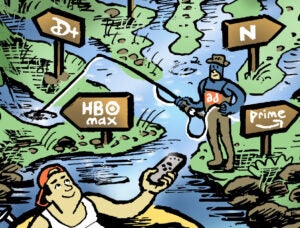
YouTube Won TV, Or Did TV Win YouTube?; Down Like A Leads Balloon
TVs are officially the most popular device for watching YouTube; Google’s lead generation comes under fire; Temu tests a “half custody” distribution model to counter import tariffs.
The Google Chrome team is getting closer to deciding on its cookie consent mechanism. And Paramount resolves its four-month standoff with Nielsen, as the mechanics behind currency change forever.
Paramount and Nielsen have ended their measurement standoff. Plus, a new survey says digital ads now cost more and convert less.
Things aren’t going well for Hollywood. Plus, Nielsen is finally ripping off the Band-Aid.
Nielsen’s Matt Devitt, head of advertisers and agencies, discusses the biggest changes in how advertisers and agencies are buying TV.
Complexity is going to create new opportunities to reach audiences, says Nielsen Chief Marketing Officer Alison Gensheimer. She sits down with AdExchanger Executive Editor Sarah Sluis to discuss how Nielsen can observe nuanced behavioral differences in streaming behavior, and how brands can use this data in order to reach their audiences more effectively.
Every week, we publish an original comic creation inspired by trends in the online advertising industry. These are the stories – and the highly specific double entendres – behind AdExchanger’s top 10 comics of 2024.
It would probably be fair to call 2024 the year that CTV went programmatic and became a digital performance channel.
Publishers expect the agencies will eliminate tech redundancies as they consolidate, which could compel pubs to shed redundant tech themselves. The merger could also entrench principal-based buying, which may not be a bad thing.
Curation is a reaction to programmatic’s worsening queries-per-second problem, says Permutive’s Joe Root. DSPs are biased toward impressions that have an identifier attached, so SSPs are using curated deal IDs as a stand-in for third-party cookies.
Change is hard for a company like Nielsen, which has been around so long it even predates the first publicly available television sets.
Nielsen has received accreditation from the MRC for a product that integrates a broadcaster or media company’s first-party streaming data into Nielsen’s TV panel ratings. Plus, Google launches a curation service that bundles ad inventory within its own Google Ad Manager.
Despite their dependence on Nielsen, programmers love complaining about the TV ratings titan. But Paramount Global recently went beyond griping when it announced its contract with Nielsen had lapsed.
Lyft’s media network has grown a lot in two years. On Tuesday, the rideshare company announced a new slew of partnerships to boost its measurement capabilities for ads across its network.
Paramount is the latest entertainment studio headed for a showdown with Nielsen. Plus, Forbes seems to have been rebuked by Google Search.
Winners and losers are emerging from the streaming melee. (Or at least the winenrs are.) Plus, CNN will begin testing metered content.
Randomized controlled trials are the best source of evidence of cause-and-effect relationships, including advertising’s impact on sales. Imagine the potential for conducting geo experiments using ZIP codes instead of DMAs.
Chrome Privacy Sandbox adds support for deal IDs and extends Protected Audiences’ lifespan to 90 days; Google’s ad tech antitrust trial could open YouTube to DSPs other than DV360; and former Kubient CEO charged in accounting fraud scheme.
Adelaide used this latest cash injection to boost its valuation to $60 million ahead of an all-stock acquisition of Rita, an Amsterdam-based data marketplace with a focus on the EU.
Ad tech faces a GDPR compliance paradox. Plus, TikTok will make it harder to target teenagers and plans to give users more control.
Yahoo may have earned itself a stay of execution with The Trade Desk. Plus, TV buyers are clinging to Nielsen for yet another upfront season.
The TV market’s vanishing impression problem is even more concerning than the numbers indicate. But maybe a little impression scarcity is a good thing.
Enjoy this weekly comic strip from AdExchanger.com that highlights the digital advertising ecosystem …
Now that alternative TV currencies have passed the initial sniff tests, how should buyers and sellers compare their viewership numbers? The leaders of Nielsen, Comscore, iSpot and VideoAmp gathered onstage during the Coalition of Innovative Media Measurement summit in New York City to answer that question.
Big streamers aren’t joining the JIC, which could spell trouble for the broadcaster-backed organization; Spotify raises prices again; Chase gets into retail media.
Nielsen held a press briefing to reassert itself as the go-to TV measurement and currency company ahead of upfront negotiations. To back up its assertion, it shared a status update on its currency offerings and a comparison to its competitors.
The MRC and the broadcaster-backed joint industry committee released a joint statement to clarify the difference between them, which has been a charged topic ever since the JIC formed last year.
In today’s newsletter: Performance Max has many imitators, but Google’s still ahead of the pack; France’s competition authority fines Google for using news content to train its Bard AI model without their knowledge of consent; and Apollo Global Management offers to acquire Paramount Global for $11 billion.
Data has not only become the new oil for marketers; it is also the oxygen breathing life into TV advertising with new branding and performance opportunities.
In today’s newsletter: The simmering tension between Apple and Meta keeps growing; Nielsen panels have staying power; Temu’s Super Bowl play probably won’t pay off.