
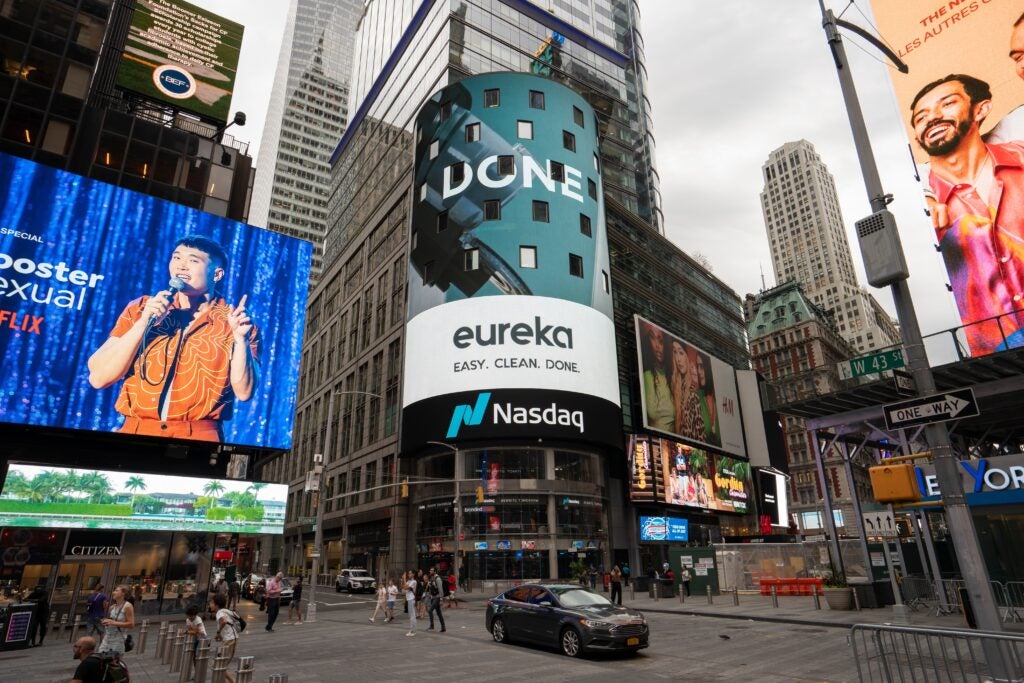
It’s a bucolic scene: the out-of-home views framed by the clouds.
But, actually, it’s a programmatic UI play.
That’s regarding the recent $20 million investment outdoor media giant OUTFRONT made in digital out-of-home (OOH) DSP specialist AdQuick.
The OOH market is turning to cloud-based systems to simplify sales across a range of digital and static supply.

OUTFRONT, one of the largest OOH media platforms in the US, struck a deal that gives it exclusive access for three years to AdQuick’s cloud-based sales tech for campaign planning and buying, the companies announced at the end of February. The solution will allow OUTFRONT’s sales team to quickly produce a campaign proposal that surfaces inventory across OUTFRONT’s platform in response to an advertiser’s brief.
Meanwhile, AdQuick gains access to its largest investment backing, having previously raised about $11 million, said its CEO Chris Gadek.
And if the platform impresses OUTFRONT clientele, AdQuick could also build relationships with new publishers and advertisers that go beyond the initial three-year arrangement.
Modernizing OOH
The AdQuick deal is the latest example of OUTFRONT modernizing its back-end sales with cloud-based tools, said Premesh Purayil, CTO at OUTFRONT.
AdQuick’s sales cloud “streamlines how we package, propose and transact premium OOH across our footprint,” Purayil told AdExchanger. Integrating AdQuick’s solution will not only improve the speed to market for an OOH campaign but standardize how OUTFRONT presents its inventory and builds proposals, he said.
In addition to shouting out the AdQuick investment during OUTFRONT’s Q4 2025 earnings call two weeks ago, OUTFRONT CEO Nick Brien also mentioned recent deals with Amazon Web Services and Salesforce as indicators that the company is bringing its sales approach more in line with ad-agency and buy-side workflows.
Which is to say, programmatic campaign planning and buying has already mostly switched to cloud-native infrastructure. The deal with AdQuick allows OUTFRONT to quickly meet those customers where they’re already doing their data-driven OOH work.
“We’re building a more interoperable architecture where core capabilities like inventory presentation, packaging, proposals, trafficking and measurement can connect cleanly with the systems our customers and partners already use,” Purayil said.
Not that OUTFRONT’s investment means there will be more open programmatic OOH inventory available.
Open auction programmatic is still a “drop in the bucket” for many premium OOH media categories, such as billboards and ads shown in transit, Gadek said. Rather, he added, the sales cloud primarily streamlines the execution of programmatic guaranteed and direct-sold campaigns.
The changing role of DSPs
The Outfront/AdQuick deal is another sign that the DSPs, they are a-changing.
And in the OOH market, those changes mean greater alignment with how agencies manage their campaign workflows. As well as greater integrations directly with media companies – a trend mirrored in the omnichannel DSP market.
For example, AdQuick initially launched as a tech-enabled OOH agency itself before spinning out an OOH-native DSP in 2020, Gadek said. But, increasingly, the company has been working directly with digital OOH publishers, such as by opening up its analytics suite to sellers.
AdQuick has worked with OUTFRONT for about four years now, Gadek said, dating back to the startup’s launch of an API for real-time pricing and OOH inventory availability.
However, early API integrations with OOH platforms were limited to billboard-based inventory, Gadek said. Which left some premium pieces of OOH inventory, such as mass transit display networks, out of the equation.
Now, the OUTFRONT partnership – and the three-year exclusivity period – allows AdQuick to bring these reserved pieces of inventory into its sales cloud’s standardized workflow. For example, AdQuick has already integrated “more robust transit visualizations for train and subway stations,” Gadek said.
In that sense, the deal is “going to be a nice way to build out the full spectrum of media formats from the publisher side,” he said. He added that, traditionally, “not all media formats that large publishers have are able to be transacted via API. But that’s changing.”
Agentic investments
Another important detail with OUTFRONT’s investment in AdQuick, according to Gadek, is that the startup doesn’t need the money.
The investment formalizes an exclusive arrangement between the two companies. But AdQuick has been profitable since 2023 and didn’t have expenses or growth costs earmarked for the investment, as would be typical when venture capitalists back a startup.
Gadek said this means the money will go to incremental product development, including AdQuick’s agentic AI product, and is therefore more like a true windfall.
And although OUTFRONT is now contractually allowed to review AdQuick’s financial performance, OUTFRONT doesn’t control AdQuick’s road map, Gadek said.
The exclusivity period – and OUTFRONT’s $20 million investment – officially kick in upon AdQuick’s delivery of certain product features, including the visualizations for new inventory types, Gadek said. Practically speaking, he expects AdQuick will deliver those features within six months.
Once the exclusivity window closes, AdQuick can theoretically bring the expanded sales cloud product, including any new API integrations for OOH pricing or access, to a wider range of publishers, Gadek said.
Perhaps most importantly for AdQuick, its OUTFRONT partnership is the startup’s entrée to much larger holding company deals and budgets locked up within omnichannel campaigns.
Hopefully, Gadek said, the relationship will allow AdQuick to “be able to get the media buyers at the holding companies thinking a little bit more seriously about how OOH contributes to an omnichannel campaign.”