Viant reported Q1 2026 earnings on Monday, with its DSP revenue growing by 18% to $50.3 million.
The company’s total net loss in the quarter shrank from $3.3 million a year ago to $2.2 million. Viant prefers a metric for net income that excludes some costs, such as stock-based compensation, and which would count the company as earning $5.5 million in profit.
Regardless of how investors parse Viant’s finances, though, execs and investors were more interested in discussing philosophical matters, rather than those trackable in documents filed to the SEC.
For example, Viant COO Chris Vanderhook declared that, based on what the company is seeing in market, “advertisers and agencies have finally drawn a line in the sand with regards to the self-attributing tactics of walled gardens and the general lack of transparency provided by our competitors.”
It is quite a bold claim, considering the vast ad revenue growth and ostensible market share gains made by the walled garden platforms. Alphabet, for one, recently reported Q1 earnings and cleared $100 billion in revenue during the year’s relatively weakest period for ad spend.

Viant’s entire business is a rounding error for Google’s or Amazon’s ad platform.
However, there is also a percentage-based growth dynamic at play, since Viant is small enough that only a few big advertiser wins could meaningfully grow their business. Vanderhook cited recent flagship clients Molson Coors and WHOOP, a wearable product for health and fitness.
WHOOP in particular is a neat example, as he explained. The company has an antagonistic relationship with the walled gardens. That’s because Apple, Amazon and Google compete with WHOOP – they each have wearable health-tracking devices, the Apple Watch, Amazon Bee and Google’s Fitbit.
Amazon is the worst offender, Vanderhook said.
“We hear these horror stories firsthand from advertisers leaving their platform,” he said. Advertisers claim the Amazon DSP diverted spend increasingly to Amazon’s owned properties, like Prime Video and its sponsored product ads. Amazon and other big tech companies then leverage their brand-level ad data to improve the performance of other brands from their category – like turning your fashion brand customer, say, into a general men’s clothing purchaser for a direct competitor. Amazon, in particular, Vanderhook said, uses the data to create and inform its white-label product lines.
“How on earth does this model represent a viable option for advertisers?” he said. “There is no partnering with Amazon, and the advertisers that have been spurned by this model are looking elsewhere.”
Amazon and Prime Video, Google and YouTube, even Yahoo DSP and Yahoo’s publishing portfolio create conflicts that lead to those ad-buying platforms prioritizing the company’s own media.
“Well, advertisers are finally waking up,” he said.
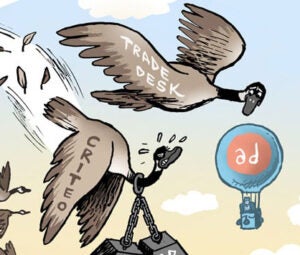
The Trade Desk made a similar pitch in its earnings call last week. CEO Jeff Green sold a vision of marketers who are adopting new ad platforms that prioritize independence and objectivity.
But it does raise the question: Does this kind of brand marketer actually exist?
Viant has its “largest RFP cohort in company history” right now, meaning many large advertisers are testing numerous DSPs with plans to commit to a preferred option in 2027, CFO Larry Madden told investors.
“These DSP selections, they’re a heavy lift on the advertisers,” Viant CEO Tim Vanderhook added later in the call. If those RFPs prove winners for Viant, he said, the ad budget gains should start to accrue during 2027.
And investors still aren’t sold on the thesis that marketers are rejecting grade-your-own-homework ad platforms.
Laura Martin, an analyst at the investment bank Needham, said investors have increased their valuation of Viant based on its acquisitions of what are now exclusive data sets (TVision, Iris.TV and Lockr).
“The other thing Wall Street really believes is that proprietary supply, like unique content or unique types of ad units, also have pricing power,” she said.
Will Viant pursue that type of exclusivity on the supply side?
That’s a line in the sand that Viant will not cross, responded [Tim] Vanderhook.
Owning exclusive media or inventory misaligns the DSP incentive as the executor of the advertiser in the programmatic market, he said.
Prime Video has great content, he said, adding that YouTube has not such great content but lots of it. And they deserve to be on the media plan.
“But [Prime Video and YouTube] consistently – look, for lack of a better term – they rig the reporting so they get the highest share of wallet,” he said. “And it’s at the detriment of the advertiser.”