Wall Street investors know that, in the advertising business, Q1 is generally the poorest-performing period of the year. And this is a particularly poor macro-economic time.
Alphabet is operating in a different reality. Or so it would seem while listening to the company’s Q1 earnings, which were released on Wednesday.
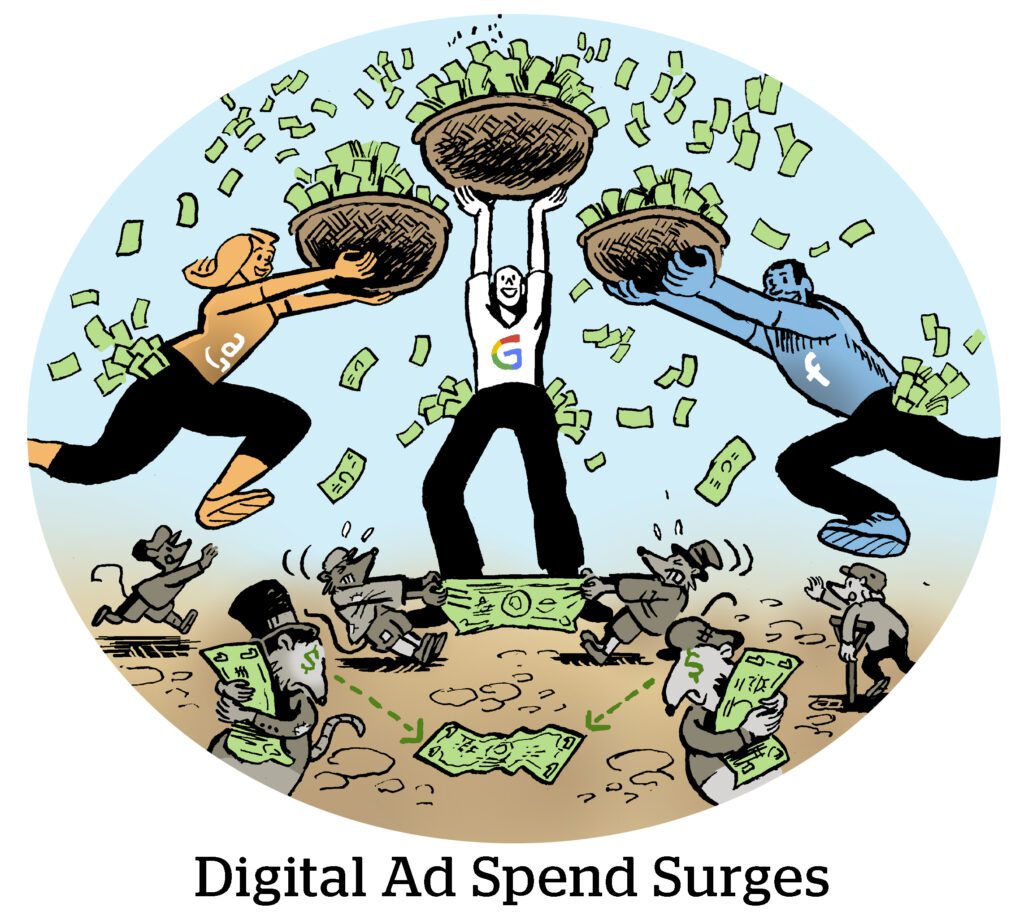
Alphabet earned $109.9 billion in Q1 this year, up from $90.2 billion a year ago.
And that’s not even the truly gobsmacking number. Google’s net income, or true profit, almost doubled year over year from $34.5 billion in Q1 2025 to $62.6 billion in the 2026 period.
After cutting back its work force by tens of thousands starting a few years ago, the company is also now back up to an all-time high to end Q1 with 194,668 total employees. So the radical growth in the profit line can’t be conveniently attributed to headcount cuts. And Google’s 2026 profitability is yet more impressive considering Q1 2025 profitability was up 46% year over year.

Before 2024, Alphabet’s Q1 net income bounced between $14 billion and $17 billion for years. It is only in the past couple of years that its profitability has cranked up to an entirely different level.
Artificial is getting real
Unsurprisingly, AI tech was the central if not sole focus of Alphabet investors, deviating only slightly into topics like whether total AI compute could support the growth in search volume and cloud data consumption.
The Google Network business segment, where Google reports revenue from ads served to other publishers around the web, was noted by Google as the only part of the business that declined in revenue from a year ago. Revenue from that segment dropped from $7.3 billion to $7 billion, though investors likely wouldn’t have asked if the entire segment dropped to zero.
For a sense of comparison, Google’s “other income” segment enjoyed a $37.7 billion gain, “primarily the result of net unrealized gains on our nonmarketable equity securities.” That is heavy SEC document jargon for gains in private market equity investments – Anthropic, anyone?
Google does face some astounding expenditures due to AI. CFO Anat Ashkenazi told investors that the company’s forecast for 2026 capex is being raised to $180 billion to $190 billion. And though no estimate is forthcoming for next year, “we expect our 2027 capex to significantly increase compared to 2026,” Ashkenazi said.
Although Google has assuaged investors that its mounting capex costs are well worth the investment.
Even aside from the jump in profitability – the ultimate investor anxiety relief – Chief Business Officer Philipp Schindler noted that one area where AI may be able to transform the standard Google ads product is by using Gemini models to improve the number of queries that can be interpreted as showing commercial intent. For instance, a hard-to-parse string of product-related keywords stuffed into a search bar, such as “men’s dress pants baggy tan large tailoring available in Austin,” might be more effectively targeted now, whereas Google previously may not have known how to interpret that query.
Historically, Google has monetized about 20% of its total search queries. “With the ability of AI to better understand intent and a lot of other factors around it, I think there is upside in that coverage number,” Schindler said, referring to the 20% coverage of queries by ads.
And there are whole untouched white canvases that Google hasn’t even despoiled yet with ads.
Michael Nathanson of the investment bank MoffettNathanson noted that Schindler touted Gemini as an internal product of Google’s ads business, but what about serving ads in the Gemini app itself. Will Google cross that Rubicon?
Right now, Schindler replied, the ads team is focused on unlocking more inventory and greater value within AI Mode and AI Overviews ads.
“It’s fair to say that we really believe a format that works well in AI mode would transfer successfully to Gemini app,” he said. “Today in the Gemini app, we’re focused on the free tier and subscriptions. … But let’s also be clear, ads have always been a big part of scaling products to reach billions of people.”