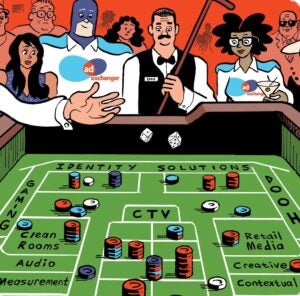
Brands are starting to look at video games as an inventory source, but there’s no scaled programmatic infrastructure to help aggregate supply in video games.
And so that’s where in-game ad platform Bidstack is focusing its road map.
“We’re moving toward being a gaming SSP, a pure tech play,” Bidstack Founder and CEO James Draper told AdExchanger.
Today, Bidstack helps developers monetize their games, but there’s no way to coordinate and manage supply across publishers.
“As the market is now starting to mature,” Draper said, “we want to move ourselves into that tech play, rather than having to tread the pavement and open doors at the agency groups.”
Bidstack recently raised $11 million to support its US expansion and the licensing of its in-game ad tech. That infusion brought the company’s total funding to date to just under $42 million.
Draper spoke with AdExchanger.

AdExchanger: What is the current state of programmatic in-game advertising?
JAMES DRAPER: The PMP [private marketplace] is the main driver for in-game. Now that standardization is coming, we can run display for OMP [open marketplace]. Today, agencies mainly want to take a display banner and put it into a game environment. Even if a publisher wants to do that, we’re hesitant, because we don’t want a community coming after us.
The trouble with OMP is that there’s no content approval layer, you can’t really have age gating and you’ve got to make sure the ad fits the title.
Have the new IAB and MRC standards for in-game advertising increased demand?
There’s more demand for dedicated gaming budgets. The numbers have gone from $3,500 to $6,000 per campaign in 2018 and 2019 to where test spends now are $500,000 to $700,000 and beyond.
What’s missing in terms of buy-side infrastructure?
We can see signals like duration of play, session time, whether a player is stuck on a level and whether we’ve already shown them a rewarded video, but we’re not monetizing those signals. We do custom activations at a managed service or PMP level, but if there was a DSP that was taking advantage of those signals, you could do some really cool things.
Is in-game advertising revenue enough for publishers to risk upsetting their fans with bad ads?
The gaming community resides on Reddit, and if you irritate them, you’re toast. The advertising industry’s not bringing in enough dollars yet from a brand activation point of view to really move the needle for publishers.
What have you learned from measuring in-game ad impact?
If you play a game regularly, you know the layout of the maps and you know the controls instinctively. So, if there’s an advert served in that particular game, you’d notice it, because it’s the only thing you’re not used to seeing in there. That means your brand lift will be way higher than if it’s a game you’re not playing regularly. If you’re still figuring everything out as a player, it’s unrealistic to expect the brand recall to be as high. You can only absorb so much information in one go.
Therefore, we should be charging more for loyal players. We’re going to do more research around that, as well as emotional context. For example, you could reward players when they finally crack a level they’ve been stuck on for half an evening.
How does Bidstack’s recent fundraising factor into your plans to build a gaming SSP?
We’re primarily using it for enterprise-level deals and diversifying our customer set. We’re building our proprietary SSP and data. We’re not leaning on third parties like BidSwitch, for example. So that gives us the opportunity to license our technology to others.
How do you plan to build your customer base?
Our team will be selling rewarded video, so we’re making sure we can service that format in all the buy-side platforms. If you’re net new to in-game, you can buy rewarded video, and we will do a one-for-one deal on in-game impressions.
How much room is there for the in-game ad market to grow?
All brand activations in gaming currently make up less than 1% of the global ad mix. For intrinsic in-game, there was maybe $20 million in total top-line revenue this year. The year before that, maybe $4 million or $5 million. This coming year, it will be closer to $100 million.
In-game is sexy, but there’s a lot more space to grow other formats, including in-menu or rewarded video. Sony and Microsoft are leaning in. Once you get onto consoles and a 70-inch screen in someone’s living room, you can charge a lot more.
Do you think Sony and Microsoft would be more inclined to build their own SSPs or work with third parties?
They’ll work with third parties.
Has Bidstack tried working with them?
We went to Microsoft a year and a half ago and said, “We want middleware approval.” We went through all the hoops and thought we got it done back in 2018 or 2019. Eventually, they put a pause on it, because once you turn on the pipes, you allow so much of your user data to go out to DSPs.
But Microsoft’s acquisition of Xandr is interesting, because we’ve got a good relationship with Xandr. They’re running tests with third parties, and we’re one of them.
Is Bidstack open to growing through M&A?
There’s going to be a lot of M&A activity in gaming over the next 12 to 24 months, and there are some companies we’re looking at acquiring.
As far as being acquired, it would have to be a tech-led exit that gives us access to scale. Going into one publisher doesn’t make much sense, but going into an ecosystem that gives us access to a portfolio of titles makes a lot of sense.
This interview has been edited and condensed.
For more articles featuring James Draper, click here.