
Here’s today’s AdExchanger.com news round-up… Want it by email? Sign up here.
Clean Bill Of Health?
Everyone knows the infamous anecdote of a young woman’s early pregnancy being spotted and outed by a Target circular back in the early days of advertising-oriented predictive analytics.
But big retailers still casually profile customers using a mix of health and consumer data.
The latest example is Walmart, which saw the basket size decrease among customers taking the Ozempic weight-loss drug, US CEO John Furner told Bloomberg. Furner’s comments are part of a broader debate in the snack and beverage industry about Ozempic, since people using weight-loss drugs obviously consume fewer calories and especially eat less junk food.
But it shows how health and consumer data can become riskily intertwined, even without cynical intent.

Big grocery-pharmacy stores also do things like identify early sickness consumer indicators – including toilet paper and disinfectant spikes – to drive sales of much higher margin health care items.
Washington state has a health data law – the My Health My Data Act – which will come into effect next year and make it illegal to infer a health status (like if Walmart concluded someone was taking a weight-loss drug because their food purchases changed, and certainly the Target pregnancy example). And individuals have the right to sue.
Me, Me, Media
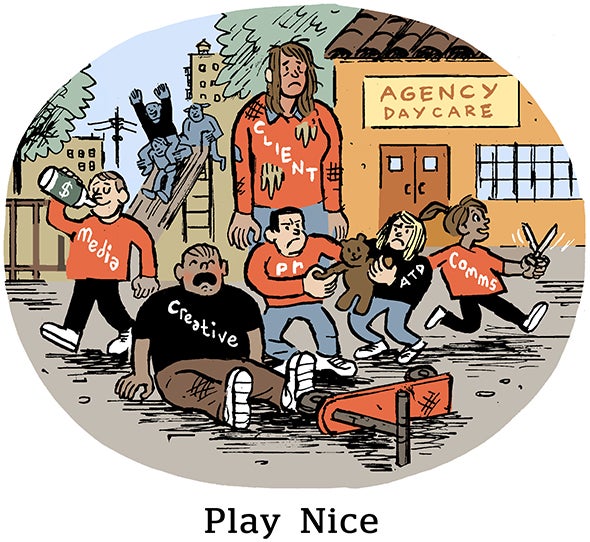
In the agency world, media agencies are heavy hitters – which is no surprise, since they’re the ones spending money and the glory days of Mad Men-style creative power are seemingly over.
As agency holding company units recently dwindled, media agencies had a small growth spurt.
Although there are still vulnerabilities for media, as Madison and Wall’s Brian Wieser highlights based on a recent World Federation of Advertisers survey. The survey gathered 70 global brand marketers’ thoughts about their agencies.
For one, the divide between media and creative remains pronounced, with 59% of respondents’ media agencies operating separately from creative.
And, perhaps relatedly, a surprising number of marketers think their agencies aren’t going to fit the bill. A quarter believe their current agencies are “unfit” for their future needs, according to the report.
It really sounds like a communication problem between brand and agency. But comms is one of the agency units that have been downsized, so what are you going to do?
High On Your Own Supply
Twitter’s been called out for a new ad unit it serves when supply exists, but no advertiser is buying.
The ads appear as organic tweets, but the entire post is actually an image that directs to a made-for-advertising site (e.g., “This Sounds Unbelievable But Happens In Dubai Everyday” and “If You Suffer From Tinnitus You’ll Love This Recent Breakthrough,” each posted by a chumbox URL).
There is no ad disclosure or transparency into what business purchased the ad, Mashable reports.
The new units are a sign of MFA sites’ basic market power – dumb money meets dumb supply.
But Twitter also risks the advertising dilemma of grabbing the lowest-hanging fruit when that fruit is likely to be rotten.
The dummy MFA ads at least make something and are a sliver of Twitter’s total ad supply. General users won’t notice.
But the ads are a fraction of a percent of Twitter’s ad supply and only pay pennies on a click. So it’s entirely possible the tactic does more harm than good since legit advertisers are looking for reasons not to return.
But Wait, There’s More!
YouTube isn’t happy you’re using ad blockers – and it’s doing something about it. [Mashable]
Tech companies tout new AI business tools but must figure out how those products will generate a profit. [WSJ]
‘Content is something you eat and throw away’: Martin Scorsese to young filmmakers on reinventing film for streaming. [Variety]
Benedict Evans: Unbundling AI. [blog]







