
Here’s today’s AdExchanger.com news round-up… Want it by email? Sign up here.
Tough Cookies
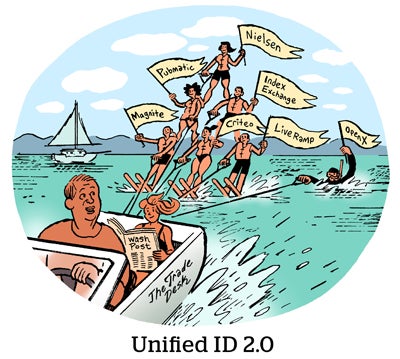
Some industry observers (including AdExchanger) have deliberated on The Trade Desk’s apparent withdrawal from – and direct antagonism with – the Chrome Privacy Sandbox.
Bill Simmons, TTD’s VP of product, penned a column in December for The Current, which is The Trade Desk’s content marketing site, staking out a strong position against the Privacy Sandbox, alleging Google failed on its stated goal to create a workable alternative to third-party cookies. Oh, and advertisers and publishers should prioritize open industry ID initiatives – not a surprising POV for TTD.
Further, Simmons argued that Chrome’s alternatives may only prove workable for Google and a few other ad platforms that have their own addressable data at scale.

This is a hill TTD appears very happy to die on (or survive on, as the case may be).
“Google’s solution, the Chrome Privacy Sandbox, which only works on a Chrome browser, likely doesn’t benefit anyone other than Google,” The Trade Desk’s UK VP, Phil Duffield, tells BBC. “The advertising industry is on a collective mission to build something better.”
Although, to be fair, the advertising industry at large has been making that claim for at least as long as Google has been pushing its sandbox, with similarly little to show for it.
A New Planet
People resolve to join gyms in the new year … and gyms resolve to launch retail media networks.
Here comes the PF Media Network, an ad network operated by the Planet Fitness chain of gyms using LiveRamp for data onboarding and matching services.
Although the PF Media Network is similar to RMNs operated by other retailers, it also serves as a case study for how difficult it will be to develop industrywide RMN standards.
Planet Fitness ads span in-club placements, out-of-home static signage and wall-mounted TVs. There’s a programmatic network for the web, plus CTV and social media extensions, as well as email marketing opportunities, in-app ads and affiliate campaigns. No doubt Planet Fitness will court endemic advertisers, such as supplement and vitamin brands, both categories of which are major affiliate spenders.
While that’s all relatively standard fare for an RMN, every business has its nuances. For example, what does the screen above a deli counter have to do with an ad playing on a TV mounted on the wall in front of a standing bike?
Creating campaigns that work fluidly across many RMNs will be an uphill run.
It’s All Fun And Games Until …
… someone adds ads.
A word of caution for any company considering launching ads: The low-hanging revenue fruit must be balanced against the inevitable distortion of your business priorities.
Netflix Gaming, for example, defined itself early as an opportunity for game studios (it even acquired a few) to develop titles without accommodating the need for advertising or in-app purchases. Instead, developers could focus on the gameplay.
Now, however, Netflix is considering new ways to wring revenue from its games, The Wall Street Journal reports.
Today, Netflix games are free for subscribers. One option is to charge for more sophisticated or higher-end games to support the investment in production quality.
Or Netflix could incorporate in-game purchases and ads, which the company may do for those who subscribe to its ad-supported streaming tier. (They’re already watching ads in shows, right?)
But Netflix may not diverge from its stated vision for the gaming business, the Journal cautions. Still, the internal push and deliberation about in-game ads and payments is “the latest example of how the streamer constantly reassesses the balance between customer experience and the need to make money.”
But Wait, There’s More!
Lessons on privacy, data security, truth in advertising and AI drawn from a trio of FTC cases. [blog]
Disney’s Jeremy Helfand is headed to Amazon to lead Prime Video Advertising. [Adweek]
What the heck is going on with headlines on X? [Fortune]
Prepare for a ton of dumb, counterproductive streaming video mergers. [Techdirt]
You’re Hired!
LG Ad Solutions hires Dave Rudnick as SVP of engineering. [release]
Sarah Personette, Twitter’s former ad sales chief, joins news startup Puck as CEO. [Variety]







