Your SaaS Is Grass
The great AI pivot happening across business sectors right now – particularly in data-driven marketing – has led to a sudden, strange gap in the payment models of many SaaS and ad tech companies.
The Information has some insider details on software companies, such as Replit and Anysphere, that cranked up revenue after launching successful generative AI coding agents in the past year or two.

But even 12x growth in annual recurring revenue (i.e., SaaS earnings), as in Replit’s case, has proven insufficient. As of February, the company’s gross margins were an attractive 36% – but they’ve since dropped to negative 14% post-agentic launch, because Replit’s LLM bills are based on usage. And usage is through the roof.
Earlier this week, AdExchanger reported on Zillow’s pilot test of “containerized RTB.” This is another example of vendors – here Index Exchange and Chalice – having to deal with cloud bandwidth costs that must be retrofitted into the CPM-based ad tech business model.
Relatedly, LiveRamp CEO Scott Howe announced on the company’s earnings call earlier this week that it’s begun testing a new usage-based pricing model, currently in beta with 40 customers, based on its issuing of “fungible tokens across all products.”
These tokens act like interchangeable units or credits that customers consume as they use LiveRamp’s services.
AdLovin
AppLovin has been on a rollercoaster ride since mid-February, when several anonymous investors and funds published critical reports and shorted the stock. Its share price dropped from $510 to $220 over just a couple of weeks.
But AppLovin has mostly bounced back. Its shares now stand at $437 as of the end of trading Thursday.
AppLovin was helped by its positive Q2, during which its ads business grew 77% to $1.26 billion. The company’s updated guidance calls for between 58% and 60% growth for the rest of the year, notes Eric Seufert at Mobile Dev Memo.
There’s more, though. AppLovin also placed an important stake in the ground. CEO Adam Foroughi told investors that the company’s self-serve commerce advertising beta program – a product akin to Meta’s Advantage+ Shopping Campaigns and Google’s Performance Max – will open to all advertisers by the first half of 2026.
That’s a big step, considering AppLovin has carefully limited its participants, which helped buoy campaign ROAS since there are fewer advertisers soaking up the demand.
Something to watch out for: When AppLovin’s commerce media becomes an open program, achieving the same performance benchmarks will be much more difficult.
Grok ’N’ Roll
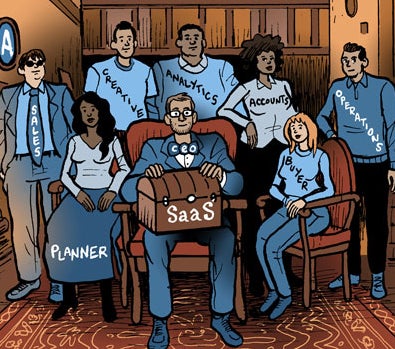
No CEO? No problem. While we’re at it, who needs a media buyer, strategist or account manager, either?
According to Elon Musk, X certainly doesn’t. He says Grok will replace all three of them.
Musk’s vision, as described during a live Spaces session on Wednesday, is that brands will eventually be able to outsource the entire process of creative production and optimization to Grok.
Once advertisers upload their ads to Grok, Musk said, advertisers won’t need “to do anything at all.”
His goal, Digiday surmises, is to get people “to buy directly from the app.”
But buyers aren’t sold. During the Spaces, senior marketers from Lowe’s, Uber, SharkNinja and Kia tuned in to ask questions – and they specifically highlighted their brand safety concerns.
But, hey, at least the ads will be, uh, pretty? Roman Grachev, who leads X’s ad engineering team (which exists apparently?) was present during the session and noted that Grok will assign an “aesthetic score” to all ads uploaded to the system.
The ads that the AI model deems superior will have preferential ranking in the app.
But Wait! There’s More!
Magnite hints at future legal action against Google. [Digiday]
WPP’s profit margin is down 70% as it suffers from client losses and macroeconomic effects. [The Guardian]
Google and Perplexity are offering free one-year trials of their AI tools in India. [Rest of World]
People weren’t thrilled when Duolingo announced it was going AI-first. Now, the language learning app is playing it safe and forgoing its notoriously “edgy” social media posts. [Business Insider]
AI slop pages on Facebook are editing nature photos and trying to pass the new (anatomically inaccurate) versions off as their own work. [PetaPixel]
Glenn Kessler: Why I left The Washington Post. [blog]
You’re Hired!
The Trade Desk appoints Alex Kayyal as CFO. [release]
Here’s today’s AdExchanger.com news round-up… Want it by email? Sign up here.