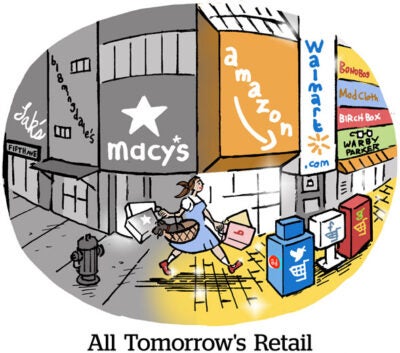
America’s biggest department stores are changing, and changing fast.
In the past quarter, for instance, Target has piloted a new store model in Chicago, where it’s begun segmenting some stores into more backroom operations and fulfillment for online orders, while high-foot-traffic locations will prioritize in-person shopper engagement and on-shelf inventory availability. The company plans a major remodel of its store footprints next year.
Best Buy, meanwhile, introduced a third-party marketplace in August for online sellers that carry items not sold in stores. The marketplace has onboarded more than 1,000 sellers and already carries 11x more products than are in Best Buy stores, CEO Corie Barry told investors last week.

And, of course, big retailers like Target, Best Buy and Walmart now prize their advertising and media businesses as the connective tissue for the company overall.
Advertisers are friends
For big retailers, advertising and retail media isn’t just a revenue line; it’s a deeply interwoven part of the business and incorporates important outside partners.
Take Best Buy. Earlier this year, the chain launched a social media ad-buying extension to its ads business, which it calls Social+. For now, the “social” element is a bit of a misnomer, since the product exclusively works with one partner – Meta’s Advantage+ Shopping Campaigns.
Barry also noted that Best Buy is doing a big marketing push, citing ESPN as a publisher it’s targeting for a big streaming campaign to promote its NFL sponsorship. Plus, Best Buy Media has a major new store takeover ad offering that begins in January. The first sponsors are ESPN and Meta.
Retail media network businesses can often create relationships on one side of a business as either a market or publisher that can then flip from spending to earning revenue.
In an interview with AdExchanger from October, for example, Mark Grether, who now leads the PayPal Ads business, cited the company’s work with Ulta. Right now, that means PayPal is helping Ulta spend its marketing budgets by targeting PayPal shoppers. However, if that partnership takes off, it could include PayPal generating ad revenue for Ulta.
When retail media players link up, there is no fixed position where one is supply and the other demand. It can be a nebulous relationship in which one party is sometimes spending, sometimes earning.
Similarly, Klarna, PayPal and Capital One Shopping, the credit card company’s data-driven media business, are new non-endemic advertising clients for Best Buy Media. They are also potential or current payment partners for the retailer.
The new marketplace
Third-party marketplaces have a similar effect for retailers, since they contribute greatly to the ads business and connect back to store performance. Walmart, Target and Best Buy, as of Q3, are the first of the US chains to adopt Amazon’s third-party marketplace model.
“During the quarter, we launched our self-serve platform, My Ads, which is particularly important for our new marketplace sellers,” Barry told investors of Best Buy’s new third-party marketplace.
Target said gross merchandise sales for its Target Plus marketplace were up almost 50% year over year, with mid-teens growth in ad sales through Roundel, the company’s retail media business. This growth is “demonstrating the breadth and growing relevance of our digital ecosystem,” CFO James Lee told investors last month. Just as importantly, he added, advertising and marketplace sales are a key way to influence traffic, since they can be used to direct pickup ecommerce orders to one location, say, while the other is built primarily to serve in-store guests but might not fulfill online orders as quickly.
Walmart cited its ability to sell through inventory more effectively than it has in the past. For big shopping occasions like Halloween and back-to-school, Walmart has made it a priority “that we end clean and we move on to the next season,” said John Furner, EVP and CEO of Walmart US, who’ll become Walmart CEO next year. That’s partly due to more judicious selections of what to carry and how much to stock. But retail media plays a role, too, by ramping spend up or down to clear inventory in particular markets.
“We continue to get better at putting our data to work,” Furner said.
Halloween is a good example, especially considering the outrageous cost of chocolate. A store stuck with unsold candy that must be offloaded at huge discounts could be saddled with painful losses. So chains need to be able to effectively use their Hershey’s retail media spend, for instance, to clear out that inventory.
Need for speed
What do shoppers want for Christmas?
Speed.
Not the drug, mind. But super-quick ecommerce fulfillment options.
In China, where Walmart’s business is 50% ecommerce, almost four out of five online orders arrive within one hour, McMillon said.
About a third of Walmart’s US ecommerce orders are now delivered within three hours, Furner said. And the company’s fastest-growing channel is for orders delivered within one hour.
Walmart+, the retailer’s paid membership program (i.e., its alternative to Amazon Prime), had its biggest quarter of new sign-ups.
“There are really a couple of things that are driving that,” Furner said of the subscription growth. “The first is delivery and delivery speed.”
Best Buy is “focusing on delivery and speed of delivery in particular” to pick up new sales from customers in duress (which is not emotional or physical duress, but retail jargon for when, like, someone’s washing machine breaks) said Chief Financial and Strategy Officer Matthew Bilunas.
Best Buy has traditionally been about premium products, and its stores have been places to research and choose options, which are then delivered. Best Buy is trying to convert more of that intentful demand it sees showing up, often online, by creating offers for people to pick up and leave with an item from the store that very day or hour.
“Really, what we have to do is shift our model a little bit,” Bilunas said.