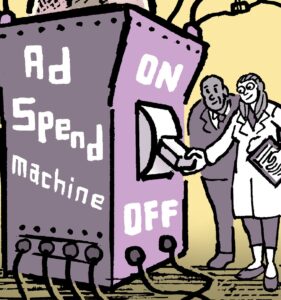
The past year has been momentous for AI search engine ads.
That’s partly due to ChatGPT’s foray into advertising. But the big AI search ad platform in action right now is Google, which, on Thursday, announced new features and ad types for AI Max, its AI-based bidding product for search and shopping or sponsored product ads.
In the past year – and precisely one year, after the April 30, 2025 announcement – AI Max has gained “hundreds of thousands” of advertisers, according to a press briefing hosted by Google earlier this week. That makes AI Max the “fastest-growing AI search product” in Google’s portfolio.
Although, a year ago today, Google also disclosed that PMax had signed up its one millionth advertiser account. PMax now has four million advertisers on the platform, said Brendon Kraham, Google’s VP of product strategy for search ads and commerce, during the briefing. And all four million are eligible to serve AI chatbot ads within Google’s AI Overviews or AI Mode (the generative responses that appear above some search results).
Meanwhile, ChatGPT’s advertiser count was, as of a month ago, only 600.

So what’s new?
The PMax and AI Max usage benchmarks are impressive.
But the main news of the day is Google’s announcement of new features and campaign types within AI Max. The new products expand the advertising AI’s purview to include shopping and travel campaigns, now in a closed beta, and a new campaign setup feature called AI Brief, which is a conversational prompt field that uses natural language rather than the manual toggling and data uploading or onboarding that are normally required.
“This is the first time we’ve brought into [the campaign setup] more natural language,” Kraham said.
Kraham is excited for the chance for advertisers to begin using AI Brief, he added, since the product will also give Google a chance to get feedback, understand the response by clients and develop it into a more effective way to set up a campaign.
Many of the new features are part of Google’s ad platform evolution to meet consumer changes in AI searches.
Advertisers want to show up in new conversational AI interfaces, such as AIOs and AI Mode, or the emerging trend of search queries prompted by a camera, such as Google Lens, Kraham said. “AI Max and PMax are the best mechanisms to show up in those environments.”
For instance, Google is advising, suggesting and in some cases simply switching advertisers to AI Max from former types of manual control campaigns.
“To help more advertisers access the benefits of AI Max, starting in September 2026, campaigns using Dynamic Search Ads (DSA), automatically created assets (ACA) and campaign-level broad match setting will automatically be upgraded to AI Max,” read a Google update to ad platform customers earlier this month. Google Shopping and travel-related search campaigns appear to be slated for the same eventual absorption into the AI bidder’s system.
AdExchanger asked Kraham if manual control campaigns have lasting value, or if agentic tech will antiquate those types of campaigns, either by advertiser choice or Google executive fiat.
“The future is definitely more automated, no doubt about that,” he said of Google’s new AI ad product suite. “You have the agency and choice to use it.”