
Here’s today’s AdExchanger.com news round-up… Want it by email? Sign up here.
Skipping The Basics
Canada is Netflix’s testing ground for tinkering.
Netflix has not only been diligent about cracking down on Canadian password sharers; it rather quietly removed its Basic plan (which allows viewing on one screen at a time) in Canada this week, TechCrunch reports.
Basic is Netflix’s cheapest ad-free option, and nixing it points to a reprioritization in favor of advertising.

Canadian subscribers now only have two options: They can either subscribe to the ad-free deluxe version or watch ads. Former password-sharing freeloaders are likely to choose the cheapest plan, if any.
On the one hand, this is a sign of advertisers pressuring Netflix to increase its supply. Netflix won’t crank up the ad load too much, so it must add viewers.
But there’s a positive spin for advertising, too, since Netflix already said its ARPU is higher for ad viewers than for higher-paying subscribers. This creates a strong incentive to shift from ad-free viewership to advertising.
There was always a risk associated with Netflix’s embrace of AVOD, though. Once the ad train starts, it either derails spectacularly or chugs forward until an ad-free viewer is worth more per month than an ad-free subscriber.
Netflix practically has a shareholder responsibility to force-switch as many people as possible to ads.
Of Mice And Marketers
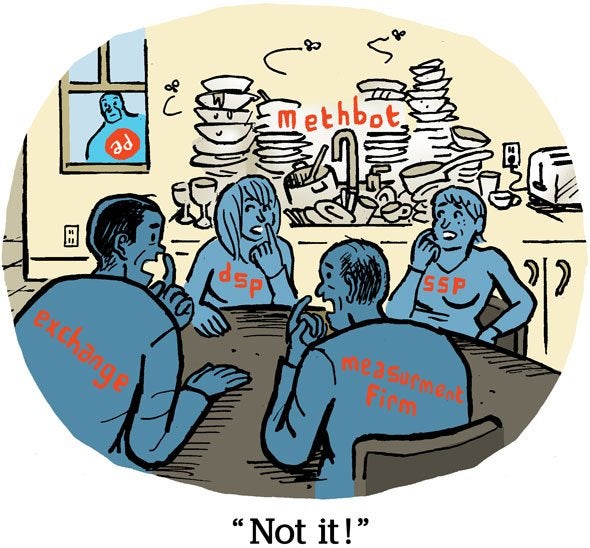
Marketers are quick to deny responsibility when it comes to monetizing made-for-advertising (MFA) sites and other related crud. It’s like a game of “not it.”
They’ve got the fig leaves to prove their innocence, including verification tech that says their ads are squeaky clean.
But there’s little appetite for self-reflection when it slows down the sales machine or reduces ROI calculations. As Digiday notes, despite loud calls by marketers insisting that platforms undergo audits to increase transparency, momentum eventually petered out.
Instead, platform algorithms have become even less transparent over time.
The biggest failure by marketers hasn’t been of competence or investment, however; it’s a widespread failure of leadership. There are vanishingly few high-level marketers at important or even midsize brands willing to catalyze real change by openly critiquing large platforms, such as Google and Meta.
Even Digiday’s story only cites anonymous brand marketers.
And even when Meta screws up big time or marketers have serious issues with Performance Max campaigns, buyers have strong things to say in private … but nothing they’d put their name behind.
A Brave New Prompt
“Made for SEO” content and MFA websites are hardly new. But scammers are now well on their way to making a business out of auto-generated sites that siphon traffic from legit publishers.
A study of auto-generated content identified by NewsGuard found that major advertisers do end up on MFA sites, largely served by Google Ads, the MIT Technology Review reports. (The piece gives “programmatic advertising” the scare quote treatment, which even The New York Times stopped doing six or seven years ago).
Programmatic exchanges all forbid MFA content, but “do not appear to uniformly enforce these policies,” says Krzysztof Franaszek, founder of Adalytics and an ad tech researcher.
“Many of these ad exchanges continue to serve ads on [made-for-advertising] sites even if they appear to be in violation,” he says.
Google’s PMax, for example, will automatically bid on inventory across the Google publisher network and advertisers don’t have control over their targeting strategies or the ability to segment and block certain sites.
Those advertisers won’t know whether their ads showed up on MFA sites until someone screen-grabs them.
But Wait, There’s More!
Amazon, friction and the FTC. [Stratechery]
YouTube is testing an online games offering. [WSJ]
AI is killing the old web – and the new web struggles to be born. [The Verge]
You’re Hired!
Jacki Kelley quits Dentsu to return to IPG as chief client and business officer [Campaign], and Dentsu promotes Michael Komasinski to replace her. [Campaign]








