


The system prompt required by Apple’s AppTrackingTransparency framework doesn’t leave a ton of wiggle room.
Apps have just a brief customizable text field above the fateful choice – “Allow tracking” or “Ask app not to track” – where they can share how they use data and why that data sharing might benefit a user.
But there are some nuances that can’t be expressed in a single sentence.
Listen, please
Take Audiomack, a free youth-focused music streaming service with 5 million daily active users across its app and mobile web experience.
Audiomack has a compelling reason to ask for an opt in: Unlike an ad-supported mobile game, which only has a small cost of revenue when people play – basically, the marginal expense of paying for bandwidth and servers – Audiomack has a hard cost to pay each time one of its users streams a song.

“If you listen to 1,000 songs, we have to pay 1,000 rights holders, which means there’s a real cost anytime someone plays music,” said Dave Edwards, Audiomack’s VP of revenue. “This is something we want to explain, that we have ads not just to line our pockets, but to pay the rights holders who own the music content.”
In preparation for the wide release of AppTrackingTransparency along with iOS 14.5 in April, Audiomack tested and implemented a pre-prompt that would pop up before Apple’s more utilitarian system prompt.
According to Apple, users should ideally already know why an app is requesting permission for tracking based on context. But Apple does allow developers to display custom messaging before showing the ATT alert “if it’s essential to provide additional details.”
A lot of developers believe that it is, indeed, “essential,” since they’re only given one opportunity per user to ask for permission via the ATT system prompt.
Asking around
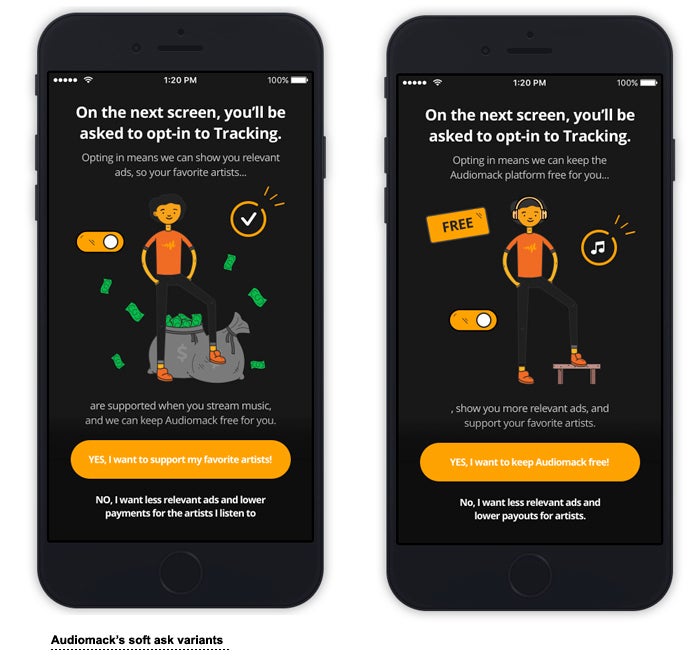
Audiomack’s initial pre-prompt user flow began with a screen explaining Apple’s ATT requirement, followed by a “soft ask” screen, and drew a clear line between personalized advertising and Audiomack’s ability to remain free and support music artists.
Audiomack tested two variants of its soft ask screen, both of which included “Yes” and “No” buttons at the bottom. The first variant emphasized the role that advertising plays in supporting artists, while the second focused more on how ads help keep the app free.
The second variant – keeping Audiomack free – proved the clear winner.
And then came the moment of truth, when users who tapped “yes” on the soft ask screen were presented with the official ATT system prompt.
An impressive 64% of Audiomack’s users opted in to tracking.
Although calculating the industry-wide ATT opt-in rate has been a messy affair to date, getting to 64% is a solid base for Audiomack to work from, especially considering that the majority of its users (71.5%) are already on iOS 14 or higher.
It’s not all roses, though. Despite the fact that most Audiomack users have given their permission, the IDFA is only present for 52.5% of users. That’s because some people who said “yes” to tracking in response to Audiomack’s soft prompt also have tracking turned off in their iOS settings, which bars any app from showing the ATT system prompt.
In that case, Audiomack shows a third screen to those users, asking them to enable tracking for the Audiomack app only. But some people don’t take that extra step.
Ch-ch-changes
But this isn’t the end of the journey. In the past few weeks, Apple has modified certain details in its documentation in terms of what is and isn’t permissible in a pre-prompt, and it’s likely to continue making tweaks.
Audiomack experienced this firsthand in mid-May when it submitted an app update to the App Store for something completely unrelated to ATT.
The Apple reviewer rejected the update and sent Audiomack a note pointing to its amended documentation which says that soft asks cannot contain a “yes” or “no” choice. Developers that display a custom screen preceding a privacy-related permission request are now only allowed to offer one option, such as “continue” or “next.”
Audiomack made the change, but the experience is evidence that app developers will need to stay on their toes, Edwards said.
“We’re a Top 100 overall app in the US App Store and in some foreign markets we’re a Top-five app overall, [and so] the average consumer probably thinks we have a direct line to Apple – a back-and-forth conversation where they share news and best practices with us,” he said. “But we just have to abide by the rules in the documentation – and those can change randomly without warning or a heads-up.”







