Google Won't Kill Off Cookies, Consumers Will – And That’s How It Should Be
The only way forward for the industry is to put consumer choice first. That means putting the cookie behind us and rebuilding our relationship with consumers.
The trajectory of digital advertising remains unchanged. There are plenty of signs that the investments advertisers have made in cookie alternatives are already paying off.
Although the full revenue impact of Magnite’s exclusive SSP partnership with Netflix hasn’t hit yet, simply announcing the deal “created significant momentum for our business,” Magnite President and CEO Michael Barrett told investors.
Ad revenue was helped along by 9% growth in unique visitors to the top sites in DDM’s portfolio. Programmatic ad rates were up roughly 36% in Q2, spurred by adoption of DDM’s D/Chipher contextual targeting solution.
Recent moves by major ad tech players prove the industry doesn’t actually need cookies. But Chrome’s cookie pivot doesn’t clarify what will happen to the 1% of its audience that’s already cookieless or what will become of plans to deprecate the Android Ad ID on mobile.
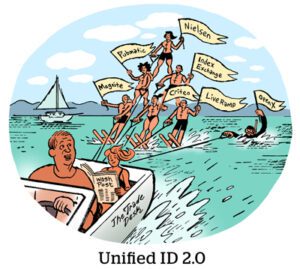
Enjoy this weekly comic strip from AdExchanger.com that highlights the digital advertising ecosystem …
By reversing its position on third-party cookie deprecation, Google’s is acknowledging its inability to effectively execute its plans for the Privacy Sandbox. It’s time Google commits to competing with the rest of the industry rather than dictating terms.
With attribution-based platforms taking over, there aren’t many ways for an advertiser to bet (and win) big. Plus, what about the Google advertising ID?
If Chrome imitates Apple, there may be a de facto deprecation of the third-party cookies, since potentially only a slim percentage of users would consent to tracking. In that case, advertisers would still have to primarily rely on cookie alternatives, including the Privacy Sandbox.
Keep the cookies; hold for consent. We unpack Google’s reversal on third-party cookies and what it means for the ad industry, which was preparing for a cookieless future.
Despite setbacks, the mobile advertising industry has not only recovered but thrived post-ATT. What can overcoming the impact of ATT teach us about overcoming the latest uncertainty around the future of the cookie?
The industry shouldn’t let Google’s repeated delays slow down the progress we’ve made toward a more privacy-friendly advertising ecosystem. The need for innovation and collaboration is greater than ever.
With a multifaceted approach, companies can manage the risks while reaping the rewards of more consumer-conscious ad targeting strategies.
Tech companies have developed AI solutions that shift budgets and strategies toward contextual. But the AI-driven transition to black-box optimization requires agencies to build and develop new skills, custom tools and processes.
Late last year, Morning Brew hired Sara Badler, a longtime programmatic advertising executive, as CCO. But the publisher, which built its business on direct, isn’t planning to change its approach to monetization.
Even if the industry finds a way to replace the cookie, it won’t matter if publishers no longer have traffic to monetize.
Enjoy this weekly comic strip from AdExchanger.com that highlights the digital advertising ecosystem …
There are two paths to transforming your business to capitalize on first-party-data-based advertising: mergers and acquisitions, or making nonrecurring investments. Here are the pros and cons of each.
The delay is an acknowledgment by Google that efforts to prepare its cookie alternative will take longer than its proposed deadline allows, which shouldn’t be a huge surprise to those actively participating in testing.
Cookies aren’t going anywhere. Behind Google’s third missed deadline to remove third-party cookies from Chrome. And what it means for ad tech.
Bonbon gives users rewards – such as discounts or chances to win merchandise – for setting up email registrations with publishers. Now The Trade Desk’s OpenPass will include that same rewards functionality.
To build a first-party data strategy, the NY Post contracted Permutive and Prohaska Consulting for advice on monetizing its audience data and growing its addressable audience. The collaboration prompted Permutive and Prohaska to expand their combined services to all publishers.
Only a small handful of identity solutions will still be standing within the next five years, according to ID5 CEO Mathieu Roche – and he intends ID5 to be one of them.
In today’s newsletter: AppLovin raises $144 million and buys video shopping app Flip; Google agrees to disclose that it collects data from Incognito users; and why Trader Joe’s is (and isn’t) the Shein of grocery stores.
The third-party cookie actually stymied the development of digital advertising. Here’s what the cookie got wrong and what its inheritors need to get right.
Enjoy this weekly comic strip from AdExchanger.com that highlights the digital advertising ecosystem …
Third-party cookie deprecation creates an opportunity for publishers to increase inventory value, efficiency and partnerships in the open exchange. Here are some efficiency initiatives that should make your inventory more valuable to advertisers.
There’s a lot more good than bad in Google’s Privacy Sandbox. Here’s why some of the current criticisms around the cookie alternative don’t hold water.
Privacy Sandbox’s Protected Audiences API causes increased latency, decreasing viewability and yield. Given these issues, publishers simply cannot afford to test PAAPI at scale.
G/O Media introduced a new contextual targeting solution that combines first-party contextual signals and data on audience browsing behavior to create cross-site contextual segments that can be activated programmatically.