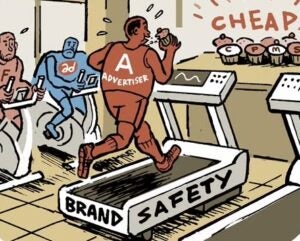
 More and more ecommerce sales are preceded by paid product listings.
The advance of ecommerce advertising in the past year and a half can be seen in the revenue growth in Amazon earnings reports and the promulgation of retail media platforms such as Walmart Connect, Target’s Roundel and Google Shopping.
Marketers, too, are getting used to paying for sponsored listings. Practically every brand that’s sold online is seeing a higher percent of its traffic and ecommerce sales come from paid media, rather than organic listings, said Scott Kennedy, director of ecommerce and digital marketing for the sports equipment brand Franklin Sports.
For the typical web user, the ecommerce advertising trend shows up in the form of sponsored product ads taking over online search and shopping.
In the past three years, Amazon Sponsored Product ads have gone from fewer than 20% of Amazon’s top inventory (the first 10 products shown following any given shopping search) to currently covering more than 40% of average searches, according to data from the Amazon ad agency Momentum Commerce’s Amazon Brand Index tool.
Without paying for placement, it’s become hard for a brand to show up above the fold – before a user scrolls down on their phone or computer – Kennedy said.
“An organically strong brand used to be able to show up atop the page for relevant searches,” Kennedy said. “Now, it’s possible, likely even, that for a competitive search term, the top organic product is way, way below the fold.”
And, unfortunately for online shoppers seeking organic results – and the marketers that need to pay for those placements – sponsored product listings are far from done with their takeover of the web.
Amazon’s competition factory
Amazon more than doubled the average number of sponsored products that show up atop search results, but those rates range from below 20% for some categories, such as frozen food (a tough category for Amazon to warehouse and deliver, so it deprioritizes sponsored listings) to more than 60% for some products, said Momentum Commerce founder and CEO John Shea.
It is unlikely that Amazon’s more competitive categorizes will relax, allowing organic brand listings to reassert themselves, Shea said. Instead, categories with relatively low advertising saturation, even those around the current average of 43% Sponsored Product ads, will grow more competitive with higher rates of paid media to organic listings.
The same dynamic is on display whenever Amazon expands to a new global market or brings Prime shipping to a new country, according to Kennedy. At first, Franklin Sports will see high ROI and organic placement for a spell without many other sellers spending on ads, he said. As more sellers start bidding in that market, ad metrics like cost per click go up. So do the overall rates of Sponsored Product units vs. organic listings.

If Sponsored Product rates do go down, it will be because brands find other ways to pay for top placement.
For example, an Amazon search for “Adidas” returns an Adidas-branded storefront. There are Sponsored Product ads for competitors’ products, but none in the top 10 listings, or even in the top 20. Those top 10 Adidas listings count as organic, but the brand is actually paying heavily for the privilege.
If setting up organic search storefronts becomes a popular Amazon tactic, it would bring down overall Amazon Sponsored Product rates, Shea said. At least for now, those storefronts are for big-spending global brands such as Adidas that have enterprise partnerships with Amazon.
And not every major brand chooses the partnership route with Amazon. A search for “Nike” doesn’t return a similar Nike-branded storefront; It directs the user to the Adidas store. Below those results, Amazon shows third-party sellers that carry Nike products, with Sponsored Product ads accounting for half of the top 10 listings.
Nike stopped working directly with Amazon in 2019, largely because Amazon would not squash the third-party sellers that carried off-brand or used and shoddy Nike products.
So Sponsored Listings can flourish even without the participation of the brand in the search.
The off-Amazon sponsored product surge
Online shoppers are seeing sponsored products overtake organic results across the web, not just on Amazon.
Google averages about 90% sponsored listings in the top 10 products displayed for a shopping-related search, Shea said. However, that’s largely a quirk of how Google constructs its feed; when Google detects a search with high shopping intent, it places a carousel of relevant products atop the feed, and almost all of those listings are paid media. (They are cost-per-click units, even when they seem organic.)
Google’s search and shopper marketing system is fundamentally different from Amazon’s approach, Kennedy said. With Google Shopping, the brand or merchant uploads its whole product library via API. Google’s algorithm surfaces the most relevant items in its carousel based on both a user’s search terms and a retailer’s metadata, such as the copy and keyword tags the brand uses in its product listings.
Comparing Amazon’s and Google’s sponsored product display rates may appear to be apples to oranges. But what Google learned from Amazon is to fully embrace the idea of “pay to play” for any brand that wants to show up above the fold for shopping-related searches, Shea said.
And while Google is Amazon’s only major competition in the search category, its biggest retail opponent, Walmart, is also likely to ramp up sponsored listings.
Walmart searches currently return around 10% to 15% sponsored product listings, Shea said. Sponsored product listings on other retail media platforms, like Target’s Roundel or Kroger Precision Media, are typically in single digits, he said.
Walmart in particular is going to see a jump in paid media competition, because it’s consolidating its store-based ecommerce shopping portal – for grocery orders or other click-and-collect orders that are picked up at a store – and the Walmart Marketplace for third-party sellers to offer products not carried in stores, said Rafael Almeida, Bayer’s head of retail media activation.
At the end of July, Walmart will consolidate its ecommerce platform. It will start to allow conquesting of competitive keywords and, perhaps eventually, competitors’ product page traffic, similar to how advertisers can conquest on Amazon, Almeida said.
This is a painful trend for product brands. But it’s the trend of the internet.
“The tough thing is, we want to make sure our investment is not going to placements where the purchase would have happened anyways,” Almeida said.
But if other brands can snipe traffic from Bayer’s product pages or searches for “Aleve” and “Alka-Seltzer” – two well-known Bayer brands – then those customers might be siphoned off, and Bayer will have to bid defensively on sponsored links for its own search terms.
Walmart is branching out with conquesting ads and increasing its sponsored product rates not just because of its ecommerce competitors. Consumer search patterns changed, Almeida said.
Two years ago, a search on Walmart was at the very bottom of the funnel, he said. Someone was searching for “Aleve” because they were just about to make a purchase. During the pandemic, that behavior changed. Now there are more general searches on Walmart for things like “back pain relief,” since overall consumer habits moved online and Walmart.com became a place for product research and discovery.
Walmart’s ad platform will take advantage of this consumer behavior change to increase its ad density and average price to win a search term, Almeida said. More marketers will bid for terms like “back pain relief” than will pay to contest a search for “Aleve” or “Bayer” that will be expensive with losing odds.
Paying for online placement is now standard, just like a brand must pay to get on the shelf in a brick-and-mortar store, Franklin Sports’ Kennedy said.
But winning in ecommerce will still require more than just a savvy search strategy.
“It isn’t sustainable to have a purely paid-driven business,” Kennedy added. “You still need to win a lot of organic business to level the profitability scales, or it won’t work.”