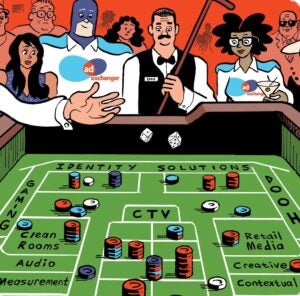
Walled gardens – everybody’s got ’em.
In the US and most of Europe, it’s the usual suspects. In China, it’s what the cognoscenti refer to as the “BAT” companies: Baidu (think Google), Alibaba (think Amazon) and Tencent (think Facebook).
And it makes cross-device quite the challenge.
Although the BAT companies “all have cross-device applications which can generate data on PCs and mobile,” the data isn’t portable, said Minghui Wu, CEO of Beijing-based Miaozhen Systems, a sort of homegrown Oracle of China complete with its own marketing cloud, marketing automation solution, ad tracking tools and programmatic ad serving capabilities.
On Thursday, Miaozhen announced an exclusive partnership with cross-device identity company Drawbridge to try and circumvent the cross-device challenge. The result is probabilistic cross-device matching with a twist.
Traditionally, Drawbridge’s Connected Consumer Graph probabilistically triangulates billions of anonymized third-party data points to make linkages.
But Miaozhen is taking advantage of Drawbridge’s so-called “private graph,” a solution that allows marketers to create what are essentially personal walled gardens by integrating their own first-party data with Drawbridge’s data. The result is a locally hosted graph only that particular marketer can access and use across channels.
In a sense, it’s using a walled garden to combat the supremacy of walled gardens.

“We position ourselves as an independent democratizer of consumer identity, and at the same time we are in-market offering a private graph instance for our customers – but there is room for both,” said Drawbridge CEO and founder Kamakshi Sivaramakrishnan. “Brands are looking for an identity solution, but they also believe that their first-party data is proprietary and valuable to them.”
Miaozhen, whose clients include large global brands with a presence in China, among them Coca-Cola, L’Oreal, Microsoft, Procter & Gamble and Volkswagen, will be powering its private graph in part with data collected from the roughly 30 billion ad impressions it collects across direct RTB buys.
But there are several unique challenges posed by the China market.
For one, most Chinese Internet users frequently delete their browser cookies, which “weakens the power of DMPs and DSPs,” Wu said.
Another dilemma: IP addresses in China are constantly being rotated, which makes them almost useless as a signal of identity. Drawbridge had to modify its algorithm accordingly.
And the sheer amount of mobile use in China in and of itself actually presents a bit of a predicament.
According to the latest figures from China’s Ministry of Industry and Information Technology, mobile phone penetration hit 95.5% in 2015, although not all of those devices are necessarily smartphones. Mobile users in China number roughly 1.3 billion.
That sort of heavy mobile use can actually mess with how a graph operates by flooding the system with more mobile signals than it’s used to dealing with. In the US, for example, roughly 55% to 60% of connected devices in Drawbridge’s graph are mobile devices. In China, the number is well north of 70%, said Sivaramakrishnan.
“That’s even more than the natural dynamic of what it means to be mobile-first, so the data access we get is somewhat skewed,” she said. “We had to fine-tune our algorithm and calibrate it to handle these realities.”
Although some ad tech companies “claim they have cross-device technology in China, no client really uses them in practice,” said Wu, who noted that it’s Miaozhen’s goal to be “China’s first down-to-earth cross-device solution.”
“Down-to-earth” is also a swipe at the great walled gardens of China: Baidu, Alibaba and Tencent.
Take Alibaba and its so-called “Super ID,” a cross-device solution derived from account-based information and the technology it acquired from ad platform AdChina in January 2014. Although Joanna Wang, CMO of Alibaba’s marketing services and data services division Alimama, previously told AdExchanger that Alibaba doesn’t see itself as a walled garden, Wu begs to differ.
“We believe Alibaba’s Super ID is very powerful, however it only works well within the Alibaba ecosystem,” Wu said. “Miaozhen’s graph can run on all publishers and platforms because of our unique third-party role.”