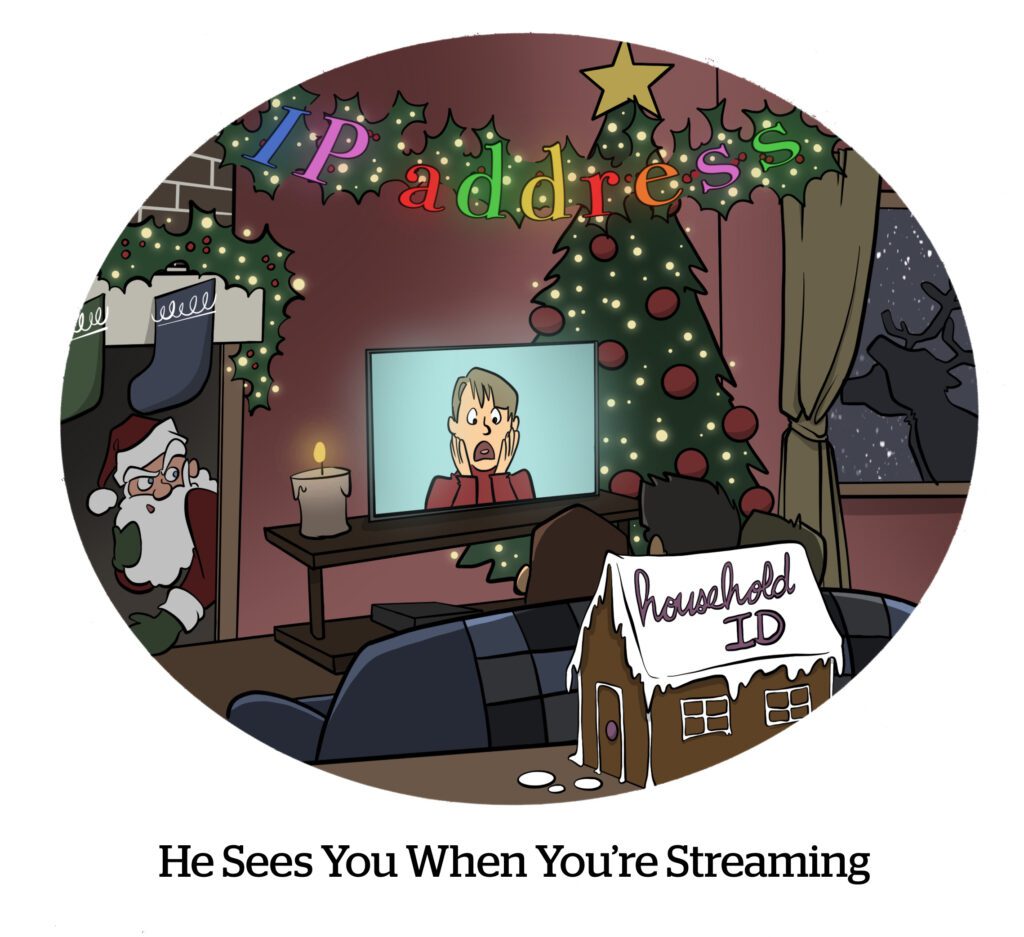
It’s that time of year again – the time when we all start saying things like, “It’s that time of year again!”
It’s also that time of year for end-of-year recaps, which can be a surprisingly tricky balance to manage. For all the effort you save looking back at work that’s already been completed, you make up for it by trying to keep yourself from rehashing the same old cliches over and over again.
With that in mind, I’m switching things up just a tiny bit for 2025. The last two years in a row, we’ve shared the top three CTV stories of the year – so, I thought, why not add one more this time around?

Without further ado, here are four of this year’s most popular CTV-focused posts:
1. Meet The Netflix Ads Suite, Introduced By Ads VP Nicolle Pangis (March)
Less than a month before Netflix was set to debut its in-house ad server, VP Nicolle Pangis chatted with our own executive editor, Sarah Sluis, at CTV Connect in March. (Since then, both have taken on new titles: Sluis as editorial director of ad tech and emergent media, and the event as Convergent TV World for 2026.)
In addition to finally revealing a name – Netflix Ad Suite, or NAS for short – Pangis also teased what buyers could expect once they were able to buy Netflix ads through the new product.
Not long after that, Netflix started touting its ad product as a huge triumph. A few months after launch, President of Advertising Amy Reinhard told advertisers that 2025 would be the company’s “biggest year ever” during the company’s upfront presentation.
That promise has certainly held true for Netflix’s growing ad revenue, at least, which company leadership consistently highlights in earnings reports every single quarter.
(In fact, Sarah Sluis recently theorized on AdExchanger’s Big Story podcast that Netflix would not have put in a bid for Warner Bros. if not for the success of NAS. Something to consider!)
2. Bibbidi Bobbidi Biddable: How Disney’s Ad Sales Are Transforming Its Streaming Business (May)
Okay, I’ll admit it – all that “switching things up for 2025” rhetoric up top was a front. I mostly included this story to revisit what might be my favorite headline I’ve written at AdExchanger so far.
Luckily, the conversation I had with Disney Advertising SVP Jamie Power was interesting and widely read enough to justify this bout of pridefulness. Among other things, she shared how much Disney’s streaming business now relies on its fast-growing (but not FAST-growing) biddable ad revenue.
Disney’s programmatic sales, for example, were up 30% from 2024 to 2025, and 70% of the company’s biddable deals are now tied to upfront commitments – a statistic that Power repeated this fall while at Programmatic IO in New York.
3. At The Tail End Of Upfronts, Nielsen Finds Itself Back In The Doghouse (July)
This year’s upfront cycle was marked by frustration over Nielsen’s Big Data + Panel, which is now the default methodology for reporting TV ratings – and, more crucially, negotiating TV upfront transactions.
Despite achieving MRC accreditation and lots of initial buyer excitement earlier this year, the new product still had some kinks to work out, according to the critics (and especially the Video Advertising Bureau, which just picked another fight about BD+P earlier this week).
Which isn’t to say that Nielsen is in serious trouble yet. After all, it’s still the go-to media currency for all the major broadcasters and streaming networks.
But it goes to show that the CTV industry’s measurement drama is far from over, even if new currency providers like VideoAmp, iSpot and Comscore aren’t quite the novelty they once were.
4. IP Address Match Rates Are A Joke – And It’s No Laughing Matter (November)
Speaking of measurement drama! Just last month, Managing Editor Allison Schiff reported on a study by data validation provider Truthset that demonstrated some serious issues with industrywide IP-to-email match rates.
The study was conducted on behalf of CIMM and Go Addressable and investigated the records of six major data vendors. Most of these providers demonstrated low match rates, almost completely unique matches to one another and inconsistent definitions and formats for organizing data.
Obviously, that’s not great for maintaining accuracy in the CTV ecosystem. But as CIMM Managing Director Jon Watts noted, it’s not going to get better unless the entire industry finds a way to collaborate on better education, standards and awareness.
Guess that’s something we can all stand to prioritize in the new year, huh?
Questions? Comments? Drop me a line at victoria@adexchanger.com.