
If you buy CTV advertising, you’ve likely encountered two approaches to securing premium inventory: programmatic guaranteed (PG) and buying direct, also referred to as direct IO (DIO).
Both are effective in different ways, but each introduces structural limitations that force advertisers to compromise on cost, transparency or execution.
With traditional DIO, buyers negotiate directly with publishers such as NBCUniversal, Tubi or Disney to secure inventory. Some refer to it as the “old school” way of buying TV, but DIO still offers several advantages over programmatic.
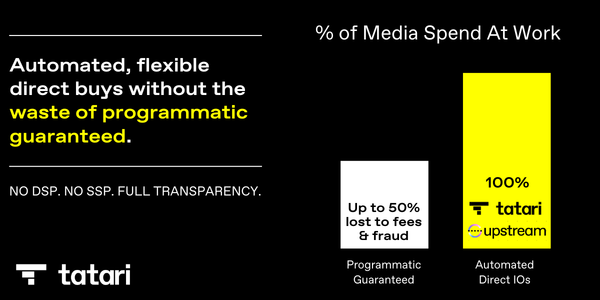
Direct publisher connections mean ads run on verified, premium streaming apps. The bot traffic, device spoofing and counterfeit inventory that plague programmatic CTV simply don’t exist in a direct deal. Publishers tightly control the program and the ads that run alongside it, eliminating brand-safety risks. And because there is no intermediary DSP or SSP involved, advertisers avoid the programmatic fees that can extract 30% to 50% of spend.

DIO also provides greater placement transparency. Advertisers know exactly where their ad ran, against what content and how the campaign performed. It also unlocks access to premium inventory such as live sports, sponsorships and custom integrations.
These advantages explain DIO’s resilience in the market. Today, we estimate that $8 billion of CTV inventory (out of approximately $30 billion) is still transacted this way by larger brands and agencies. Publishers also prefer direct deals because they know the brands, budgets and campaign goals involved.
The main drawback of DIO is the lack of automation. Processing direct buys is labor intensive for publishers and prone to errors, which means DIO is typically available only to brands spending significant amounts on a campaign.
Programmatic guaranteed attempts to solve that problem. It allows buyers to reserve CTV inventory in advance – similar to a traditional DIO deal – but executes it through programmatic infrastructure using a demand-side platform, such as The Trade Desk, DV360 or Amazon DSP.
PG became popular not only because it automates the transaction but because it enables digital-style controls, such as buying audiences instead of specific programs and managing frequency across multiple publishers.
Today, we estimate that $7 billion flows through PG pipes annually. However, the reason why programmatic guaranteed has not replaced DIO is tied directly to the benefits of DIO. When buying PG, advertisers are still transacting through programmatic infrastructure that introduces intermediary fees and reduces transparency.
Introducing another CTV media buying option
After years of operating in the CTV supply space, we realized that traditional SSP models had become too commoditized to drive real innovation or value. Believing that the future of the industry lies in direct media execution, we shifted our focus away from standard exchange tech to build a dedicated direct sales automation infrastructure.
Upstream brings together the best of programmatic guaranteed and DIO, giving advertisers direct API integration into the publisher ad server. Because there is no DSP or SSP involved, there is no risk of fraud, no fees and access to more brand-safe inventory, while keeping all of the benefits of programmatic. Upstream functions as a parallel operating system alongside programmatic, enabling publishers to sell their most prized and highest quality inventory with better automation, speed and scale, without adding SSP fees.
For brands, this unlocks access to high-quality inventory, massive reach and lower cost without the need to transact large amounts. Even smaller brands can buy premium impressions, such as an NFL playoff game, inventory that is often not available via programmatic pipes.
The role of programmatic in the future
Programmatic still has advantages when it comes to precise targeting, such as accessing niche audience segments or retargeting through CTV. For certain brands or certain parts of a campaign, this granularity makes up for the issues surrounding programmatic.
But targeting is not an end goal; it is a means toward performance.
For many brands, the future of CTV buying will be deciding when each approach makes the most sense.
For more articles featuring Philip Inghelbrecht, click here.