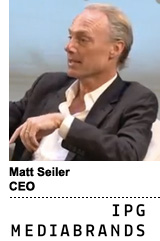
 Matt Seiler is remarkably on-message.
For the past five years, the CEO of Interpublic Group’s media investment arm, Mediabrands, has banged the drum about the need for performance-based compensation for agencies. More recently he also took up the banner of automation, proposing to automate 50% of all media investment by the end of 2015.
Interestingly, the automation rallying cry seems to be taking hold faster than the one about linking agency pay to business outcomes. But Seiler says the one necessitates the other.
And he believes the accelerated programmatic investment of major brands like Procter & Gamble, American Express and Mondelez will accelerate this future.
In a conversation with AdExchanger at the Cannes Lions festival, he explained why:
“[Programmatic and pay for performance] will actually move forward together. My thought always was, if you’re paid always based on your client’s business outcome, then how many bodies it takes to achieve that is irrelevant. How much money it takes to achieve that is irrelevant. And the two compensation models are around how much money you spend or how many bodies it takes to do that. Neither is in a client’s best interest. If you push for automation you’ve got to find a different way to be compensated. Because if it means you stripping out a bunch of bodies, we’re not all just going to make less money. We need to make money based on something that is more important than spend or body count.

If you think about what drives innovation, think about all the garages out of which the best ideas came, (there) ain’t no money there. They had an idea, they were scrappy as hell, and they found a way to get it done.
Owned/shared/earned are things that we as an industry talk about but we don’t really get to them because we get paid based on ‘paid.’ That’s changing. That forces us to think about compensation differently. So, to our mind, don’t pay me based on how much of your money I’m spending because that incentivizes me to spend more of your money than you need to have spent. Don’t pay me on the inefficiency of lots of bodies driving you to the best result. Pay me for the best result.
So, automation can only really happen if you’re getting compensated a different way, and great creative ideas driven by innovation can only happen if you’re getting paid a different way.
But part of the problem is, given we’re human, we don’t like change very much. We like to keep doing what we’ve been doing as long as we can possibly get away with it. The moves of a P&G are awesome because they get us out of that comfort zone. You don’t like it? Tough shit, it’s happening anyway.
Programmatic got a bad name fast. There was too much of a veil. The sense clients had that agencies were ripping them off? Not a good thing. Over the next year there will be a redefinition, and we will drive that redefinition from programmatic … to automatic. Programmatic is a subset of automatic. Automatic has process reengineering. Programmatic is how audiences are exchanged.
Over the next few months you’ll see more flexibility in spend. There will be more money in a slush fund, because you need to be able to react to what’s going on in the world. The value of where and when brands show up is going to increase. And those that are best at driving communication to the place, the time and ideally the place and the time that has greatest value, will win.”