
Here’s today’s AdExchanger.com news round-up… Want it by email? Sign up here.
Can You Talk The Tok?
With TikTok, it’s like the clone wars. (We’re looking at you, Reels and Shorts.) But TikTok has a special power, which is its seemingly limitless feed of quick, infinitely swipeable, likable, shareable videos.
Reproducing TikTok’s success is no easy feat, although many try. On Thursday, Amazon announced a new TikTok-inspired scrollable feed, The Verge reports.
Be that as it may, Snapchat, YouTube and Meta, et al., are having a very difficult time reaching TikTok’s level with their own short-form content. And that’s because TikTok’s real differentiator is how people use TikTok.
YouTube Shorts amasses huge view counts, but YouTube stuffs Shorts into its homepage and carousels of recommended videos. It’s not a firehose feed of videos, at least not yet.
“A user who swipes through thirty fifteen-second videos, say, provides the TikTok algorithm with many more signals than YouTube gets from a user who watches one seven-and-a-half-minute video,” writes John Seabrook in a New Yorker article on TikTok’s stardom.
That velocity matters. TikTok uses a bespoke “thumb stop rate” metric to measure videos that hook users as they scroll. There’s no need for thumb stopping in YouTube’s orderly queue.
TikTok therefore gets far more data about videos that are watched to the end, restarted, watched again and again, liked and commented on, etc.
Of course, every rose has its thorn. There are some things TikTok doesn’t see, including what prompts people to swipe out of a video or bounce from a session entirely.

May The Froth Be With You
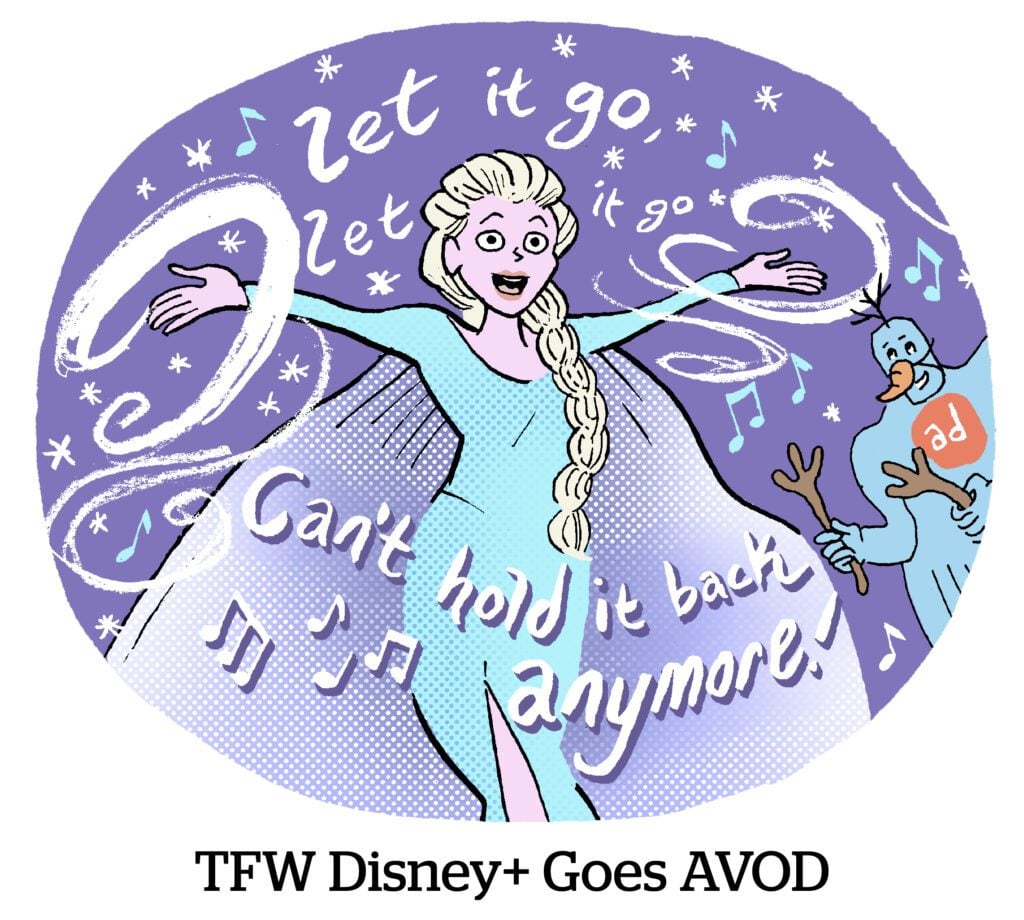
Disney+ with ads is live! Take that, Netflix.
Reducing subscription churn is the name of the game in streaming. Aside from the ad revenue, ad-supported tiers could keep people from unsubscribing after they’ve already seen the shows they originally subscribed for or reach the end of a promotional price deal.
But what about cannibalization? Disney+ may see almost a quarter of its ad-free subscribers switch to the ad-supported plan, according to Kantar. Netflix, meanwhile, claims that its membership plans are typically sticky and expects more traction on its ad-supported tier from net-new subscribers.
That discrepancy suggests competitive pricing is a better way to attract new viewers. Disney hiked up the price of ad-free Disney+ this week, too, so subscribers have to switch over to ads if they want to avoid getting charged an extra $3 per month. Netflix Basic with Ads is one dollar cheaper per month than its Disney+ counterpart.
But what about the advertiser POV? Netflix execs admit that its ad targeting is, well, basic, at least for now.
Audience targeting could be Disney’s value prop to advertisers. Although preschool content will be ad-free at launch, Disney will sell ads based on a user’s age, Insider reports. Sure, that’s table stakes for a network with so many kids’ shows, but it’s still more advanced than Netflix’s genre-based targeting.
Hits Sometimes Hit Back
Speaking of streaming media dynamics, Netflix is stuck in “The Hit Factory Paradox,” writes Julia Alexander, director of strategy at the audience attention metrics company Parrot Analytics, in a column at Puck.
Netflix just had its worst year ever since IPOing 20 years ago. The company gained a meager 100,000 subscriptions in Q3, which was considered great news after shedding more than a million accounts year-over-year during the first two quarters of 2022.
The flip side is that Netflix is still turning out hit after hit.
“Dahmer – Monster: The Jeffrey Dahmer Story,” “Stranger Things 4,” “Squid Game” and “Wednesday,” the new Addams Family-based series, all have huge numbers. And don’t forget about other big 2022 releases, including new seasons of “Bridgerton” and “Ozark,” which are both now in the top-ten of all time for Netflix.
But Netflix’s new hits are expensive and come with a counterintuitive problem. “Namely, many of these big-tent shows often appeal to the same Netflix super users who aren’t actually at risk of churning out.”
Ads to the rescue?
Advertising could rightsize this problem by returning value to tentpole shows, which get advertisers excited and bring in bucks to support more content production.
But Wait, There’s More!
The FTC has sued to block Microsoft’s $69 billion acquisition of Activision Blizzard on antitrust grounds. [Reuters]
Some big brands have cooled on their demands for audits and programmatic transparency. [Digiday]
Amazon and Uber ads appear on Twitter pages of white nationalists restored by Musk. [WaPo]
Matthew Yglesias: What I learned co-founding Vox. [Slow Boring]
Ad.net acquires IntentX, a commerce software provider for publishers. [MediaPost]







