
Here’s today’s AdExchanger.com news round-up… Want it by email? Sign up here.
From Ad Pod To Episode
Advertisers are increasingly participating at the ground level of TV shows or even producing their own content. On streaming services, the tactic gives marketers a way onto streaming services that don’t run ads or have a much lighter ad load than TV.
Coca-Cola, for instance, produced three holiday-themed short films now up on Prime Video, Ad Age reports.
The series employs a relatively light touch. Coca-Cola bottles appear a handful of times in intuitive places throughout each 10-minute episode. Title and credit frames also call out the brand.
The content marketing productions can be great for brand associations with particular emotions or valuable connections. Coca-Cola needs to associate itself with Christmas for Gen Zers, who don’t yet understand how Coke has interwoven its brand with American Santa Claus mythology. It’s also a way for Coke to burnish its creds with big-name independent directors (commissioning a 10-minute production doesn’t break the bank).
Aside from Coca-Cola, TripAdvisor Media produces travel guides for Disney+; Roku has a creative studio for long-form branded content, including a Jӓgermeister series about LGBTQ bar owners; and Colgate-Palmolive is an integrated sponsor of MTV’s new music competition reality show Project Supergroup.

Disemb-Arc?
Washington Post executives proposed a potential sale or spinoff of the Arc XP ad tech software unit to owner Jeff Bezos, The Wall Street Journal reports.
WaPo has had interest in Arc for a price in the low $100 million range. But a sell-off was strongly opposed by Shailesh Prakash, the news company’s former chief information officer, who oversaw the business.
“I personally think that in the long run – and by long run, I mean, three-four years, not 15 years – Arc XP will be the biggest source of revenue for the Post, and certainly the most profitable source of revenue for the Post,” Prakash told Axios this summer.
But last month, Prakash started a new gig – VP and GM of Google News.
The Post expects Arc to eclipse $200 million in revenue by the end of 2027, up from one-quarter of that number, in the $50 million range, this year.
But how much of Arc’s publisher network and advertiser roster is there because it’s The Washington Post’s SaaS unit? If WaPo is selling Arc before achieving profitability, is some private equity owner better equipped to succeed?
Network Effects
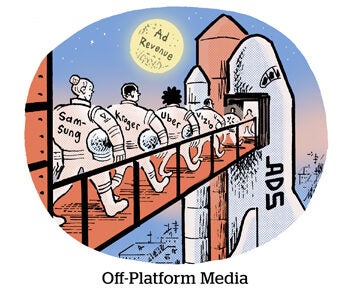
2022 was a breakout year for retail media networks (now RMNs, because nothing can achieve breakout status without a three-letter acronym).
Already, the lines of companies running RMNs are getting longer, from mobility and travel-related networks (Marriott, Lyft, T-Mobile, Volta, Uber and TripAdvisor, but who’s counting) and grocery store ad businesses to those owned by department stores (such as Best Buy, Michael’s and Macy’s). The momentum isn’t slowing.
Lord & Taylor just announced an off-site network and ad stack powered by InMobi. Last week, Microsoft’s PromoteIQ touted a new retail media program for BJ’s Wholesale Club. 7-Eleven recently debuted its RMN, dubbed Gulp Media Network.
Advertising is a strategic part of the retail equation, not just a contributor to the bottom line. Macy’s Media Network, for instance, has relatively little ad revenue – $31 million in Q3, CFO Adrian Mitchell told investors last month. But CEO Jeff Gennette noted that data-driven ads are used to channel online traffic to stores best suited to fulfill online orders.
The labor hour efficiency gains are why Macy’s Media is on the radar of the CEO and CFO.
Programmatic companies aren’t here for labor efficiencies, but they are eager to get their 10% of that $31 million rounding error on Macy’s balance sheet.
But Wait, There’s More!
Meta’s targeted ad model faces restrictions in Europe. [WSJ]
Abandoning intuition: using Generative AI for advertising creative. [Mobile Dev Memo]
Not all advertisers are turned off by Elon Musk’s Twitter. [Digiday]
The future of the African mobile gaming market. [Pocket Gamer]
Amazon is offering customers $2 per month for letting the company monitor the traffic on their phones. [Insider]
You’re Hired!
Dentsu Creative names Paulo Fogaca its US CEO. [Adweek]







