Credit Where Credit Is Due
It’s early days for agentic search marketing, and the industry hasn’t figured out how to attribute purchases to AI agents.
Right now, more than 90% of AI-driven sales are miscredited as branded search, direct traffic or retail media, according to Similarweb.
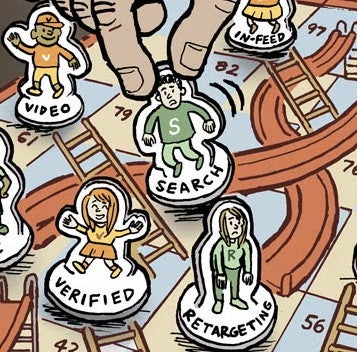
The IAB has proposed a solution: The AI-Era Attribution Blueprint. It establishes three different types of AI-attributable conversion: human-owned, AI-assisted or AI-executed.
A human-owned conversion is when AI didn’t substantively create the purchase intent, influence the product decision or carry out the purchase; however, an AI assistant may still have been involved in the decision-making process.
AI-assisted conversions involve the AI narrowing down and suggesting options. The IAB proposes two sub-types: “AI-influenced” conversions in which the AI “shapes intent” but a human makes the final choice, and “AI-recommended” conversions in which the AI “shapes the choice itself.”
And AI-executed conversions involve a human giving an agent permission to purchase an item. There are two sub-types of AI-executed conversions, too: one in which the human has told the AI specifically what to buy and one in which the AI makes the selection.
If all that sounds a bit ambiguous and not exactly suited to how programmatic measurement works, well, you’re right.
But the IAB’s aim at this stage is just to describe how these AI experiences play out in practice, said Caroline Giegerich, IAB’s VP of AI, during a webinar on agentic advertising on Monday.
“We define this based on what’s actually happening,” she said, “not what we can measure, per se, today.”
Premium Blend
Speaking of the IAB, the organization hosted its “I Want My CTV” event in New York City yesterday.
Among the topics discussed: What’s the deal with “premium” TV, anyway? Does that term even mean anything anymore?
“Premium” could mean any professionally produced content with engaged audiences, said FreeWheel product chief David Dworin during the opening panel at the event. But, he added, the “premium” classification is ultimately less important than finding content – or, more accurately, audiences – that fulfill the buyer’s performance goals.
Not that “performance” doesn’t come with its own baggage as a streaming TV ad term these days. But, as Roku Product Innovation Leader Curt Larson put it, every marketer is a performance marketer, even those who focus on TV.
“You’re not spending money for the sake of spending money,” said Larson. “You’re spending money to create some sort of outcome. And when that outcome is far in the future or very difficult to measure, you call yourself a brand marketer.”
Spicy!
In practice, however, media buyers still need to balance directly attributable performance with things like scale and cost, which also impacts what kind of premium inventory is feasible for them to buy.
“You need premium, first-impression, low-session, very visible placements,” said PMG Head of Video Mike Treon. “But you also need that efficiency to really balance it.”
The Claude Clause
A sweeping new set of Claude usage policies went into effect on Friday.
Anthropic first announced the changes a month ago, but it’s worth calling out a few updates.
One section forbids users being “abusive or cruel toward our models,” a requirement that was widely panned online. So if you’re going to deride some stupid chatbot, save it for Alexa. And so help you if Claude catches you foul-mouthing its predecessor Clippy (just kidding).
Protecting chatbots’ feelings aside, other parts of the new usage policy may make actual differences.
Anthropic now promises to remove state or commercial media outlets that use Claude to fabricate social accounts and news sites or to run other influence operations.
Using Claude to amplify a message while obscuring the person or organization behind that message is also verboten. Misrepresenting sponsored content as organic is another no-no, as is using Claude to game AI search engines in general.
The main focus of the new policies is to crack down on political manipulation. Although Anthropic could do Google a major solid, too, if it strikes at the source of the AI slop news and content sites plaguing Google’s search response pages.
But Wait! There’s More!
Google is testing moving citations to the very bottom of AI Overviews, which should further reduce website referral traffic. [Search Engine Roundtable]
The candy brand Mars has a conundrum: What happens to cash register impulse buys when AI agents do the grocery shopping? [Digiday]
AI platforms like OpenAI and Anthropic have big marketing budgets and want to sponsor podcasts. The problem is that listeners tend to revolt when they hear ads from these companies. [Bloomberg]
After losing “hundreds and hundreds of millions of dollars” over the past few years, The Washington Post’s executive editor Matt Murray says the paper is on the cusp of breaking even next year. [Adweek]
Jensen Huang announces his resignation as Nvidia CEO. Colette Kress, the company’s CFO, will serve as interim CEO until Huang’s successor is appointed. [WSJ]
Here’s today’s AdExchanger.com news round-up… Want it by email? Sign up here.