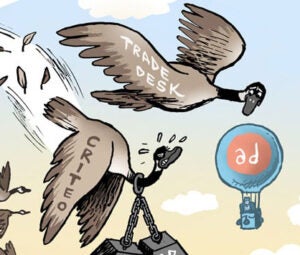
Agents of Confusion
Marketers and publishers are testing agentic solutions for media buying. But it’s unclear whether agents will simplify or further obscure the programmatic supply chain.
Omnicom CEO John Wren told investors last week that the holdco is testing agent-to-agent campaigns without ad tech fees, Digiday reports. Stagwell, Butler/Till and others are pursuing similar agentic tech.
The Trade Desk CEO Jeff Green, however, was skeptical of the inefficiencies created by gaggles of AI agents buying media from gaggles of publishers.
“You more or less create another ad network,” Green told investors during his own earnings call last week. “Where hundreds of thousands of ad networks are created because of the combination of one advertiser to one publisher and agents talking to each other.”
Agentic campaign proponents maintain that the tech could remove intermediaries and improve yield. From a publisher point of view, those changes would increase working media (meaning money earned by the media company, after tech and data fees).
“Agentic media puts buyers directly in touch with the publisher’s ad server and moves other middlemen from the transaction,” says Aditude VP of strategy Justin Wohl.
Grocery Aisle Gross Out
The grocery industry is a mess. Consumer shopping isn’t the cause; it’s retail, household goods and grocery companies managing a snake-like tangle of supply chains and thin profit margins.
Big retailers and discount or regional chains are investing heavily in store upgrades, The New York Times reports. These changes are attributed to winning over (back) shoppers, but retailers are also building for new, more data-driven retail marketing. For example, digital, dynamic price tags are presented as store associate time savers, though the retail media and data-driven personalization use cases are apparent.
Regardless, if retailers are to make hay of their brick-and-mortar footprints, they must repurpose those locations into hybrid ecommerce pickup, warehousing and fulfillment centers, while preserving the in-store shopper experience.
Grocery brands, meanwhile, are swamped by their own supply chains. First there were tariffs levied here and walked back the next day, all on caprice. Now there’s the added complication and costs of fuel prices, The Wall Street Journal reports.
Big brands have already cut marketing way back, made layoffs, raised prices and are trying to hold out before a next big round of price increases kicks in at the end of Q2.
Short And Sweet
Microdramas are officially a macro-trend.
On Monday, Peacock announced that it will bring two unscripted microdramas (think: incredibly short-form reality TV shows) to its streaming app, TechCrunch reports.
The announcement shouldn’t come as a surprise. Last year, microdrama app ReelShort raked in roughly $1.2 billion in consumer spending, according to app intelligence firm Appfigures. DramaBox, a similar app, hit $276 million, more than doubling its 2024 total.
Ads are part of the equation. Through in-app purchases and rewarded viewers pay with their time or money (or both) to unlock episodes.
Earlier this year, TikTok distributed its own microdrama app, but Peacock will be the first major US streaming platform to produce its own microdramas. Peacock is partnering with Bravo for the two shows. “Southern Charm” star Madison LeCroy will perform makeovers on clients while they share bite-size gossip. The other show features a group of university students in Miami, among them a daughter of someone from “The Real Housewives of Salt Lake City.”
You get it.
Bravo is a potentially clever entry point for Peacock’s microdramas, given Bravo viewers’ penchant for soapy reality TV. Peacock already hosts a legion of Bravo fanatics who are there to watch “Vanderpump Rules” and “Summer House.” And who’ll apparently just consume the new micro-dramas like amuse-bouche.
But Wait! There’s More!
Retail media networks are in their “gangly teenager” phase. They’re trying to grow up. [WSJ]
TikTok launches a paid, ad-free subscription for UK users. [BBC]
Writers are leaving Substack over its 10% cut of subscription revenue and switching to Ghost and Beehiiv, which collect flat fees. [The Verge]
Here’s one new way for news publishers to raise revenue: The New York Times is executive producing a new game show to air on NBC based on the word game Wordle. [Today]
Meta is being sued by Santa Clara County, California, for facilitating and earning billions of dollars from scam advertisements. [Bloomberg]
Byron Allen is investing a majority stake in BuzzFeed and will become its next CEO. [Variety]
You’re Hired!
Nisan Schitrit is the new CEO of YouAppi. [release]
Havas Media Network North America names Kristin Gower as managing director of B2B, a new role at the agency. [MediaPost]